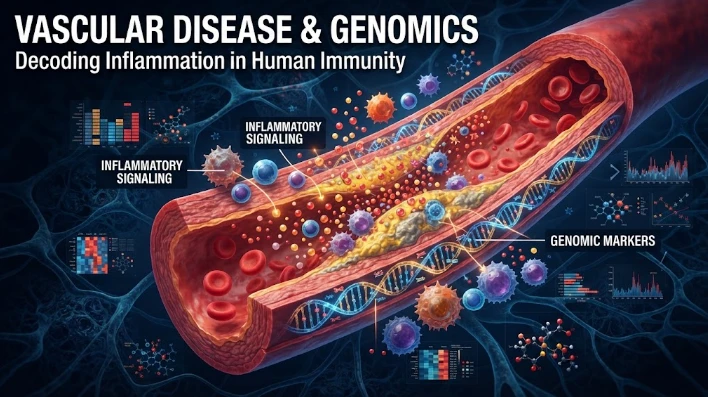
The article describes vascular disease as a longitudinal immune-tissue process shaped by genomic susceptibility and changing inflammatory responses. Human atherosclerotic lesions contain diverse macrophage, lymphocyte, endothelial, and smooth-muscle states, so single inflammatory markers cannot capture disease mechanisms. Gene-regulatory networks and multiomic endothelial studies are discussed as ways to identify programs linked to plaque progression, stability, or vascular injury. The article proposes repeated blood immune profiling, genomic data, vascular imaging, tissue validation, and multi-territory assessment to determine which inflammatory states precede structural progression. Polygenic risk, somatic clonal mutations, metabolic exposures, medications, and anatomical differences are important modifiers. Causal mediation and mechanistic perturbation can test whether inflammation lies on the pathway from susceptibility to vascular change. The article distinguishes plaque growth, instability, and clinical events as separate endpoints. Overall, precision vascular medicine should identify early, persistent, reversible immune programs that add actionable information beyond conventional cardiovascular risk factors.
A lot of molecular studies compare groups of diseased and nondiseased individuals at one time and a vascular disease develops over decades. That design can detect differences but it has no ability to determine if inflammation caused vascular change, if it accelerated an existing lesion, or if it was a result of tissue injury. Cardiovascular genomics provides stable anchors and repeated immune & vascular measurements being used to provide direction through time. A more pertinent question for a longitudinal systems approach would then be: In which individuals and vascular beds do specific inflammatory responses precede progression?
There is a much greater cell diversity in human atherosclerotic tissue than is depicted in typical plaque diagrams. A few recent single cell multimodal studies of carotid lesions identified multiple states of the macrophage, each with distinct transcription or protein expression, as well as multiple states of lymphocytes, endothelial cells and smooth muscle cells. There are sub-populations of macrophages with inflammatory programs, and other sub-populations with lipid handling or tissue remodeling programs. The ratios of these states may vary from stable to symptomatic disease. The vascular response signature should not reduce all the inflammation to a single score but maintain that diversity.
There is a further level of organization in the form of gene regulatory networks. Single cell analysis of advanced symptomatic atherosclerosis has been used to reconstruct networks within the vascular cell population, and to validate a subset of regulators using independent human data sets and cultured coronary smooth muscle cells. The studies suggest that disease associated transcription is not random, but instead, it is structured. Genomic regulation can be influenced by network drivers, which could provide candidate mechanisms linking genomic regulation to plaque stability, involving phenotypic transitions of smooth muscle or immune cells.
The responses are many that are mediated by the endothelium, which serves as a gatekeeper. Cytokine exposure of human endothelial cells has been used as a model to map coordinated changes in transcription, chromatin accessibility, protein and inflammatory signaling through Multiomic analysis. Adhesion molecules, chemokines, barrier function and leukocyte recruitment are all regulated by endothelial activation. Large structural lesions are not always visible, so that the interaction of genomic susceptibility and inflammatory exposure can take place at the surface of the vessels. If there is specific evidence, repeated endothelial biomarkers may be able to identify an early stage of disease.
A different trajectory is followed by smooth muscle cells. These cells can adopt a phenotype in atherosclerosis, to produce extracellular matrix, to take on macrophage-like properties, or to become part of the fibrous cap structure. Smooth muscle regulatory programs have been associated with clinical features of plaques and genetics through integrated transcriptomic studies. A vascular response may then have a protective or detrimental effect, depending on cell state. In some cases, an increase in the production of matrix can stabilize a cap, and in other cases, a maladaptive remodeling can lead to stenosis.
For longitudinal cohorts, both systemic and local measurements should be taken. Blood is an abundant source of inflammatory proteins, immune cell phenotypes, lipid parameters and genetic data. Plaque burden and composition can be measured over time with ultrasound, computed tomography, magnetic resonance or other vascular imaging. Circulating signatures can be localized to local biology via tissue collected during clinically indicated procedures. The intention is not to biopsy all participants, but to determine which blood parameters are reliable indicators of the processes within the vessel wall.
Subgroups can be identified on the basis of genomic information prior to progression. Polygenic risk, variants of inflammatory pathways and somatic clonal mutations are all able to recognise different forms of susceptibility. They can add to the impact of smoking, diabetes, obesity, kidney disease, infection and medicines. A prespecified subgroup analysis can be used to determine if a specific inflammatory signature is associated with progression in one particular genomic background. This type of interaction testing is more robust than the formation of post hoc subgroups after an association has been found.
Adaptation can be captured in repeated immune phenotyping. The composition of monocytes, their cytokine responsiveness, T cell activation and innate immune tone may be altered following infection, weight loss, medication and vascular activity. A sustained elevated inflammatory state means something different than intermittent elevations. Persistent activation, gradual escalation, recovery and episodic disturbance can be distinguished using trajectory models. The patterns can then be correlated with the progression of imaging changes to help pinpoint immune responses that occur before the structural change.
Multi territory assessment is helpful since the disease may be uneven. Carotid plaque, coronary calcification, aortic disease and PAD share mechanisms, but are different in terms of anatomy and hemodynamics. A conserved pathway is suggested by a systemic inflammatory signature that predict progression across territories. A single signal can reveal susceptibilities in a local area. Both are informative but development of treatment needs to know if a target is systemic or anatomically specific.
Causal mediation can be used to assess the role of inflammation in the pathway from genomic susceptibility to vascular progression. A genetic signature of increased inflammatory signaling may be linked to part of the mechanisms that contribute to plaque growth, measured by a protein or cell state. Mediation estimates are still prone to confounding and measurement error, and need to be validated in a mechanistic way. The human analysis can be perturbed by experimental endothelial, smooth muscle or myeloid systems to determine if the vascular phenotype changes.
Intervention can give more robust temporal evidence. Altering inflammatory biology is possible with statins, anti inflammatory therapy, blood pressure therapy, smoking cessation, exercise and metabolic control. When a vascular response signature is detected prior to imaging improvement or event reduction, this sequence is supportive of a modifiable pathway. More specifically, if the signature is still elevated after treatment, it may signify ongoing inflammatory risk. In particular, repeated measures around treatment initiation are of great value as they allow results to be compared for the same person's conditions at baseline and post treatment.
Time should be saved for external validation. This signature should not be assessed in just a case control sample but should be evaluated in a different longitudinal cohort with similar follow-up time. Calibration should be monitored by age, sex, ancestry, disease stage and treatment. There can also be variations in the measurements between different imaging platforms, requiring harmonization. Reproducibility encompasses both laboratory assays and phenotype construction.
The usefulness of clinical utility is dependent on actionability. Lowering the threshold for imaging, more frequent surveillance, or preventive therapy specific to a genomic inflammatory profile should only be considered if it enhances decision making, as risk scores do. To quantify the net benefit at a treatment threshold, decision analysis can be used. A scientifically interesting, but not clinically useful signature may be complex and have little incremental value. Precision vascular medicine demands a straightforward progression from molecular classification to a more secure or effective conclusion.
Longitudinal sampling also helps to avoid reverse causation. If a silent plaque rupture can be identified later, it may look "predictive" because a higher protein level is associated with it. Pre event samples repeated will determine if the elevation was maintained prior to the injury. Imaging can help determine "when" the changes are taking place between visits and allow for a more precise definition of subclinical progression. The molecular and structural trajectories remove the ambiguity and allow to determine which process occurred first.
Event prediction and progression prediction should be two separate tasks. Related but different outcomes are plaque growth, plaque instability, myocardial infarction, stroke, and limb ischemia. The inflammatory pathway, which involves progressive development of plaque, may be different from the path of thrombosis. Prespecified endpoint definitions exclude such mechanisms from a broad composite cardiovascular endpoint. The closer the biological process predicted to the clinical process used for the validation, the more precise the molecular prediction.
Resilience can also be identified through serial data. There are people who have significant genetic and metabolic risk and have only modest vascular progression with episodic inflammation. A comparison of resilient and progressive trajectories can uncover protective regulatory programs, effective resolution pathways, or smooth muscle states, which correspond to stable plaques. Learning from both extremes of precision prevention. The mechanisms of resistance to disease are as revealing as mechanisms that promote disease.
Timothy A. McCaffrey's research interests lie in cardiovascular genomics and inflammation, a theme that conforms to a model of vascular disease as a dynamic immune tissue phenotype, as opposed to a fixed blockage. The genome can help detect susceptibility, the cell can help identify response and longitudinal imaging can help measure consequence. These layers can be integrated across a range of populations to differentiate between a transient inflammatory response and an inflammatory response that may be contributing to disease driving programs and to identify which vascular responses are early, persistent, reversible, and clinically actionable.
CITE THIS ARTICLE
Tasmeem, S. (2026). Vascular Disease Responses through Cardiovascular Genomics and Inflammatory Signaling in Human Immunity. https://www.sadiaresearchhub.com/article/4fefd47a-ca30-533a-a6d9-a71c4597c282
S. Tasmeem, “Vascular Disease Responses through Cardiovascular Genomics and Inflammatory Signaling in Human Immunity,” 2026. [Online]. Available: https://www.sadiaresearchhub.com/article/4fefd47a-ca30-533a-a6d9-a71c4597c282
Tasmeem, S. (2026) ‘Vascular Disease Responses through Cardiovascular Genomics and Inflammatory Signaling in Human Immunity’. Available at: https://www.sadiaresearchhub.com/article/4fefd47a-ca30-533a-a6d9-a71c4597c282
Tasmeem, Sadia. “Vascular Disease Responses through Cardiovascular Genomics and Inflammatory Signaling in Human Immunity.” 2026, https://www.sadiaresearchhub.com/article/4fefd47a-ca30-533a-a6d9-a71c4597c282.
Sadia Tasmeem. “Vascular Disease Responses through Cardiovascular Genomics and Inflammatory Signaling in Human Immunity.” (2026). https://www.sadiaresearchhub.com/article/4fefd47a-ca30-533a-a6d9-a71c4597c282.
Tasmeem S. Vascular Disease Responses through Cardiovascular Genomics and Inflammatory Signaling in Human Immunity. 2026. https://www.sadiaresearchhub.com/article/4fefd47a-ca30-533a-a6d9-a71c4597c282
@misc{article_4fefd47aca30533aa6d9a71c4597c282,
  title = {Vascular Disease Responses through Cardiovascular Genomics and Inflammatory Signaling in Human Immunity},
  author = {Sadia Tasmeem},
  year = {2026},
  url = {https://www.sadiaresearchhub.com/article/4fefd47a-ca30-533a-a6d9-a71c4597c282},
}
TY  - GEN
AU  - Sadia Tasmeem
TI  - Vascular Disease Responses through Cardiovascular Genomics and Inflammatory Signaling in Human Immunity
PY  - 2026-01-04
UR  - https://www.sadiaresearchhub.com/article/4fefd47a-ca30-533a-a6d9-a71c4597c282
ER  -
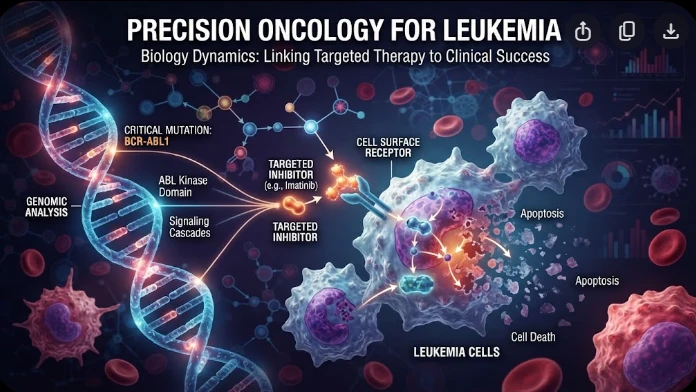
The article examines leukemia as an evolving population under targeted therapy, using chronic myeloid leukemia as the main example. BCR–ABL1 inhibition can produce deep responses, but every treatment changes the competitive environment among malignant clones. Quantitative transcript monitoring provides a continuous measure of disease burden, while deep sequencing can identify emerging resistance mechanisms before hematologic progression. A detected mutation is clinically meaningful only when its
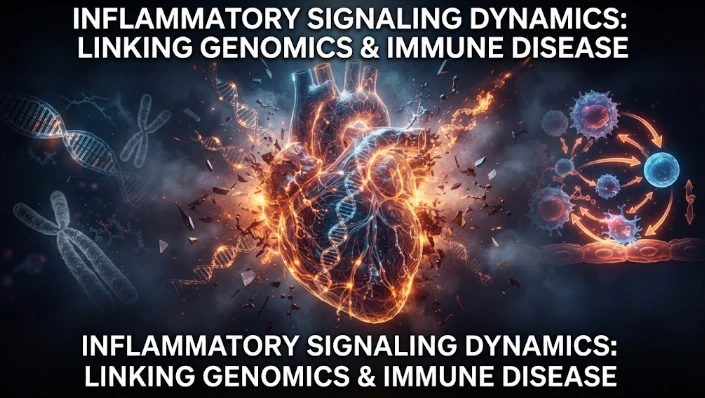
The article examines how cardiovascular genetic risk becomes biologically active through cell-specific inflammatory signaling. Because many vascular-risk variants lie in regulatory DNA rather than coding regions, their effects may appear only in particular endothelial, macrophage, smooth-muscle, or lymphocyte states. Single-cell studies of human atherosclerotic lesions and multiomic endothelial experiments are used to illustrate this context dependence. The article also discusses IL6-related sig
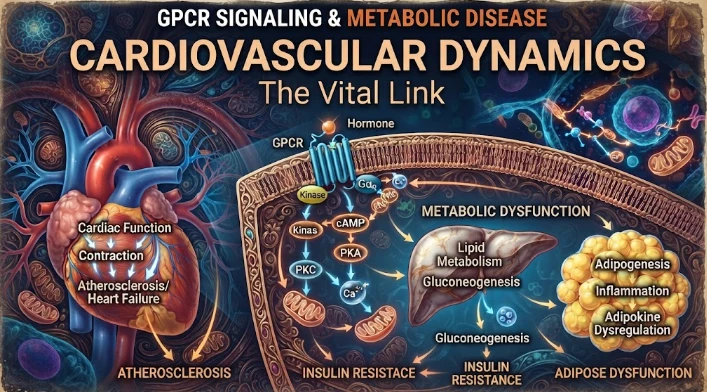
The article examines cardiovascular GPCR signaling as a dynamic response system whose abnormalities can remain hidden in resting measurements. Mechanical stretch, hormones, nutrients, sympathetic activity, and fluid balance can change the amplitude, duration, localization, and recovery of receptor signaling. Examples include mechanically activated angiotensin-receptor signaling, endosomal signaling, beta-arrestin-dependent trafficking, and biased glucagon-like peptide-one receptor responses. The