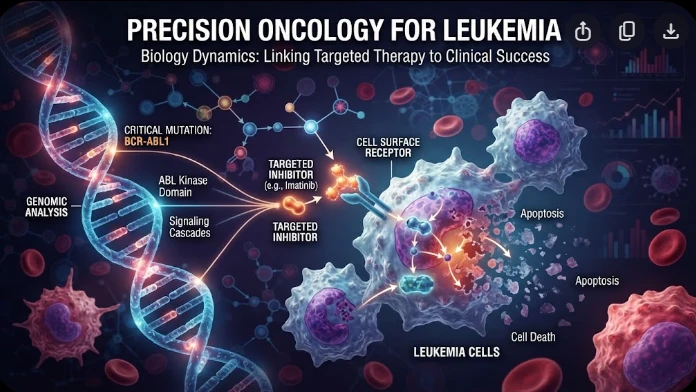
Targeted drug therapy is a dynamic process in the study of leukemia. First dose alters environment for all malignant clones, by rendering one signalling pathway too costly or unavailable. Sensitive cells contract, partially resistant cells benefit, and rare variants can be clinically relevant. Precision oncology is thus reliant on not only knowing what mutation is present but also how the leukemia population evolves over time under selective pressures.
The best example is chronic myeloid leukemia. The disease is driven by the fusion kinase BCR ABL1 and TKI's are very effective in inhibiting this activity. The molecular response is monitored by quantitative assessment of BCR ABL1 transcripts, leading to a continuous record of disease burden. Increased transcript levels may indicate loss of control, prior to hematologic progression.
Clonal evolution is responsible for the fact that the same treatment may be effective for many years and then lose its efficacy. A mutation in the kinase domain that confers resistance can be present at a very low frequency or generated in the course of replication. Drug exposure eliminates sensitive cells that would otherwise compete with the resistant cells for nutrients and other resources, making the resistant cells grow more. Biological significance of a mutation is thus determined by the direction of change, rather than just the detection of a mutation.
The sensitivity to other inhibitors varies with different mutations. The role of T315I is crucial, as the binding of several of the earlier drugs has been hindered by steric and structural effects. Other substitutions result in narrower resistance profiles. The use of mutation to inform the choice of a specific inhibitor is an example of a highly advanced precision oncology model in which molecular mechanism drives treatment selection, not just as a prognostic label.
However, mutation testing does not check all failures. A combination of other chromosomal abnormalities, signaling network modifications, drug carrier, epigenetic modification and blast phase may account for resistance that cannot be attributed to a single BCR ABL1 mutation. Sequential genomic testing can uncover a point at which the biology of a disease becomes more complex, and no longer dependent on a single kinase.
In leukemia, the logic of liquid biopsy is particularly simple because the presence of cancer cells and nucleic acids in the blood is possible. Molecular burden can be monitored often, without repeated invasive tissue samples, by serial plasma or blood based measurements. Deep sequencing can search for resistant subclones and quantitative transcript assays can monitor the predominant disease marker. The combination can help distill the burden from the mechanism that causes the burden.
The modeling of clonal evolution can be used to infer a relationship between variants in serial samples. A mutation that arose from a very low proportion to a high proportion following treatment probably represents an increasing resistant lineage. A second mutation that only appears on the genome and then is erased could be a short-lived branch that has little fitness. Using phylogenetic models one can distinguish between shared ancestral events and branch specific changes.
Bone marrow continues to be relevant since not all cellular states are captured in blood samples. Primitive leukemia cells have the ability to occupy niches that are conducive to quiescence, metabolic changes, and resistance to chemotherapy. A clone may then be present in marrow without causing clinical symptoms. Blood and marrow paired analysis at specific clinical milestones can identify when useful systemic measurements are not reflective of biologically important residual disease.
There is a need for prospective outcome validation prior to a change in care because of a new molecular signal. Action should be based on evidence that the signal is predictive for loss of response or progression, and a rare mutation can be identified with very sensitive sequencing. It is important for studies to be based on predetermined criteria and to have follow up instead of retrospective identification of "striking" cases. Analytical sensitivity is not the only thing that matters—calibration matters too.
All the molecular interpretations may be impacted by treatment exposure. The reason for rising BCR ABL1 without the development of a novel resistance mechanism could be poor adherence, drug interactions, absorption issues, and interruptions in drug therapy. The documentation of medication history in addition to molecular change will avoid pharmacologic failure being attributed to clonal evolution. The model used must take into consideration both the biology of the tumors and the real selective pressures applied.
There is the added dimension of a treatment free remission. For patients who have achieved a sustained deep molecular response, the treatment with tyrosine kinase inhibitors can be discontinued under careful supervision and maintained in remission. Some people have a relapse in their cells and are able to resume treatment. This indicates that it is not entirely disease burden that affects clinical behavior. Whether a small residual population grows or not is likely determined by immune control, the state of the stem cell population, and the fitness of the clones.
Testing that idea might be possible with serial immune profiling. Alongside the measurement of molecular disease burden, there are T cell states, natural killer cell states and myeloid states. Recurring immune patterns that follow sustained remission after withdrawal of drugs may provide some clues about the host component of control. These associations are still to be validated as immune state is affected by age, infection, and previous treatment.
The most practical dynamic model incorporates molecular burden, resistant mutations, lineage relationships, drug exposure, marrow biology and clinical response. Each measurement provides a different question. Burden and sequencing reveal the extent and evolution of leukemia, respectively, whereas functional assays determine if leukemia's detected alterations actually affect drug sensitivity.
The sequence of mutations may affect the phenotypes. If there is another abnormalities that occurs before the kinase mutations, it can generate another clone from the same abnormalities, but in reverse order. That sequence can be reconstructed by the use of serial sequencing and single cell phasing. This is important as it relates to more descendants sharing the early events, and more stable therapeutic dependencies.
The competition with other clones is a further challenge. Therapy switching can help to limit one lineage and let another lineage which may have been small grow. Molecular response can be improved at times without any evolutionary response change. The reservoir would be concealed if only the dominant mutation is reported. More extensive sequencing for key transitions in treatment can include competing branches.
Growth rates can be estimated using mathematical models under different inhibitors. A clone which grows slowly in one drug and quickly in another gives information about relative fitness. These are only useful if sampling interval and assay precision is sufficient. A few measurements can yield a highly erratic growth parameter that appears more accurate than the data warrant.
If there is doubt about clinical action is reversible. A low frequency mutation may warrant closer surveillance prior to a treatment change, and a rapidly growing resistant clone may warrant more speedy intervention. When action matches the strength of the evolutionary evidence delayed treatment and unnecessary changes are reduced.
Error corrected sequencing can be used with longitudinal sampling to enhance the detection of low frequency clones. Mutant molecule detection should be reported along with biological interpretation, as the presence of 1 mutant molecule does not mean a growing population. Random sampling can make apparent trends unlikely, when sampling errors are minimized by replicate sampling.
Evolutionary models should also include the possibility of extinction of clones. A resistant lineage may be eradicated following a change of therapy, and another lineage remains. Information is gained from tracking disappearance because it shows selective cost. If the mutation is lost quickly in the absence of the selecting drug, it may have a fitness cost which can affect future treatment decisions.
Estimation of clonal fitness can be done after withdrawal or switch of treatment. If a plant clone is fast to infect when selective pressure is changed, it likely has some biological cost. This information can be used to support a sequence of therapies, which seek to exploit alternating fitness landscapes and do not apply one therapy until it fails to work.
That evolutionary information can direct intensity of monitoring and target the evolution of a resistant lineage is becoming or losing competitive fitness.
Brian J. Druker's translational research into leukemia and targeted treatment of cancer shows the need for precision oncology to be longitudinal. Inhibitor is a successful creation that creates a new evolutionary landscape, in which leukemia adapts. When monitoring is able to uncover the mechanism of adaptation early enough, it is more than surveillance, it is a means to testing a rational next therapy. Disease control is then dependent on the ability to read the clonal change as it occurs and not wait for the resistant biology to manifest itself in the clinic.
The results of such mutation can then be readily translated into a direct estimate of competitive change by using serial interpretation.