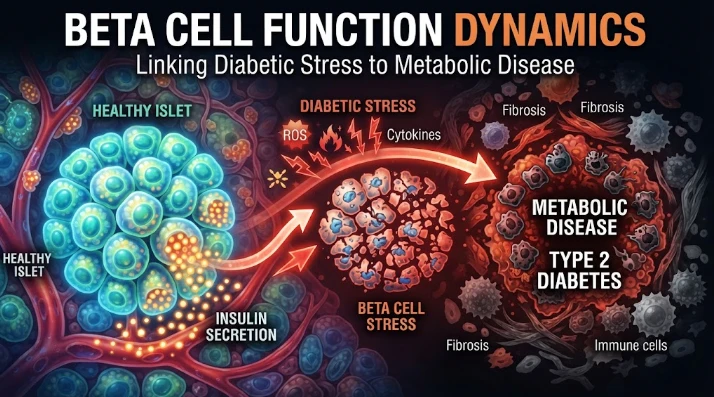
The article examines beta-cell function as a dynamic physiological response that can deteriorate before fasting measures reveal overt diabetes. Human-islet studies show that endoplasmic-reticulum, inflammatory, and glucose stress produce cell-type- and donor-specific transcriptional changes. The article links these molecular responses with calcium signaling, mitochondrial activity, insulin secretion, paracrine communication, and recovery kinetics. Dynamic challenge tests—including perifusion, glucose stimulation, mixed meals, and continuous glucose monitoring—are emphasized because delayed peaks, reduced first-phase secretion, abnormal pulsatility, or poor recovery may expose declining reserve. Timed phosphoproteomics, metabolomics, transcriptomics, and proteomics can map fast and slow adaptations. Repeated donor and human longitudinal measurements are needed to separate biological transition from technical variation. Reversibility after stress reduction is treated as a key marker of disease stage. Overall, beta-cell health is framed as metabolic flexibility and coordinated islet communication, with dysfunction emerging when adaptive responses become delayed, disorganized, or unable to recover.
Dynamic by definition, beta cell function is. Insulin is stimulated and suppressed in response to glucose, amino acids, gut hormones, neural activity and neighbouring islet cells. A fasting measurement is a moment of silence in that system. The first sign of metabolic disease is frequently a lack of flexibility of beta cells; they need more intense stimulation, respond at the wrong time or don't bounce back as they are repeatedly asked to work harder. Considering diabetic stress and its relationship to function requires controlled challenges over time, and not one snapshot of a molecule.
Human islet studies help reveal a variety of stress responses. Experiments using primary human islets exposed to endoplasmic reticulum and inflammatory stress combined multiplexed single cell RNA sequencing across donors. Prominent responses were observed in beta, alpha and ductal cells and candidate regulators were identified. The work shows that stress is donor-dependent, and that it is also cell type dependent, which means that measurements across different pools of cells are not easy to interpret.
Exposure to glucose can cause rapid changes in transcription. Multiple different types of pancreatic cells can change their gene expression within a day following controlled stimulation of glucose in single-cell studies of human islets. These reactions are not necessarily pathological in themselves. The most important difference is whether adaptive programs scale appropriately and resolve or whether the repeated metabolic stress causes chronic stress, identity issues and dysfunctional secretion.
Dynamic challenge testing can connect the molecular response to physiology. Stepwise glucose challenge can assess first and second phase insulin secretion, and calcium imaging can provide information on coordination of beta cell. Perifusion systems are able to collect minute-by-minute release of hormones from isolated islets. In humans, these tests of mixed meals and CGM give complementary information on the secretion and glycaemic recovery. These scales refer to various aspects of beta cell flexibility.
Glucose metabolism is informative for calcium because it is thought to close potassium channels, depolarize the beta cell and promote the influx of calcium leading to the exocytosis of insulin granules. Ongoing activation of metabolism may disrupt calcium homeostasis, and can stress mitochondria and endoplasmic reticulum. Dynamic calcium imaging can show that the cells are experiencing delayed waves, decreased coordination or overactive activity before they die. Functional abnormalities may thus occur despite a relatively high insulin content.
These responses are also influenced by intra islet communication. Deletion of glucagon receptor signaling specifically in the beta cell has been associated with changes in beta cell connectivity, first phase insulin release and glucose homeostasis. This discovery reveals that alpha to beta cell signaling are involved in the coordinated function. Thus, a dynamic model of islet stress should not consider beta cells as sensors of glucose but as part of a group of cells that are subject to paracrine interactions.
Multiomics can be synced to challenge phases. Phosphoproteomics helps to understand rapid signaling, metabolomics helps to understand what happens when nutrients are handled, transcriptomics can help to understand late adaptations, and proteomics reveals sustained changes in the machinery. Baseline, peak stimulation, early and later recovery can detect which pathways don't normalize. The shape of the recovery curve may be more useful than the size of the peak.
The mitochondria layer is added. Glucose metabolism is coupled to electrical activation and mitochondrial stress may decrease secretion, and also increase ROS. Experimental systems can measure oxygen consumption, membrane potential, as well as calcium and insulin release. A state of preserved insulin content and impaired mitochondrial responsiveness may reflect early functional impairment that can not be captured by static pathology.
Repeated donor level analysis for human variability. There are differences between the different donor islets in terms of age, body weight, glycaemic history, exposure to medication, ischemic time and quality of cell isolation. A stress response that is observed in one donor may be due to technical injury and not necessarily due to disease biology. Donor effects can be increased in robustness by multiplexing donors within experiments and modeling donor effects. Independent replication of additional islet collections is still crucial.
Then clinical linkages can be done over time to compare the ability of dynamic signatures to predict progression. Early metabolic risk participants can have a standardized meal or glucose challenge at regular intervals with circulating markers and imaging when possible. Changes in recovery kinetics can be compared with changes in glycated hemoglobin, C peptide, treatment requirement, or onset of diabetes as seen later. Across-person trajectories are reduced because they are repeated within person.
Pancreatic beta cell function is currently more readily available as the early phenotype, while imaging of pancreatic beta cell mass is still technically difficult. This poses an interpretive issue: reduction in secretion may be due to fewer cells or to reduced performance per cell. Those possibilities can be differentiated with molecular markers of stress and secretory challenge. The high stress signature, without mass loss, indicates a malfunction, and the low secretion with mass loss indicates a different mechanism.
Reversibility is most clearly seen in intervention. Decreasing the exposure to glucose and/or insulin can demonstrate if dynamic function improves and if the stress markers return to normal in tandem. Experimental islets show that the removal of a stressor can uncover transcriptional identity and secretion. The changes that occur following weight loss or metabolic treatment in clinical studies shed light on whether an abnormal response curve is a state that is reversible or a deficit that is permanent.
Time should be preserved in analytical models. Different aspects of function include peak insulin, area under the curve, time to peak, pulsatility, and recovery slope. Clustering is useful for finding subtypes that would otherwise not be apparent when considering the average value. Mechanistic interpretation should then attempt to determine whether each trajectory represents a single molecular stress program or whether the mechanism can be interpreted based only on the shape.
Non-linear progression can also be attributed to stress thresholds. Years of insulin resistance can be compensated for by beta cells, which then go into rapid decline when their reserve is depleted. Dynamic testing can diagnose shrinking reserve before there is a very noticeable change in blood sugar levels during fasting. A challenge that has generated a quick, coordinated response may start needing more or more stimulation for a more prolonged response. These changes may represent a stage of change from adaptation to decompensation.
Another factor of normal beta cell function is pulsatility. Insulin is secreted in bursts and a decrease in the pulsatile secretion may impair the efficiency of insulin signaling in target tissues. Islet imaging and perifusion can quantify oscillatory behavior and calcium recordings determine if electrical conduction is disturbed. Diabetic stress state can thus manifest as irregular hormone release or as just a decreased overall amount of hormones released.
During stress, the signals that are paracrine can change. Somatostatin secreted by delta cells inhibits secretion, glucagon secretion by alpha cells can modulate beta cell activity, and local factors from endothelial cells or immune cells modulate function. With secreted protein measurements, single cell multiomics can be used to determine whether a change in the communication network occurs due to stress. Revitalizing cell type without addressing a harmful paracrine signal can result in partial repair.
Protocols for challenges should be carefully standardized. Response curves may be modified by glucose concentration, length of exposure, fasting history, media composition, past medication history of the donor and quality of islet isolation. Errors in the timing of the sampling can mimic biological dysfunction, which is also known as technical variability. In cases where the interpretation of rapid phosphoproteomic and/or metabolomic changes is considered as stress dynamics, reference controls, repeated donors and prespecified timing are better for comparability.
Representing clinical trajectories with repeated continuous glucose measures, not just annual averages. Recovery from carbohydrate exposure and/or overnight stability and post meal excursions can show reduced reserve. By correlating those patterns, with C peptide and circulating stress markers, it is possible to identify individuals who compensate with high cost, from their beta cells. A state like this could be the target for earlier demand reduction before the onset of persisting hyperglycaemia.
Raghu G. Mirmira's research interests focus on the biology of pancreatic beta cells and diabetes with a focus on time. Molecular stress can be linked to secretory performance through dynamic challenge testing, single cell profiling, and longitudinal clinical follow up. The aim is to show a path that will outline the moments when the flexibility of the beta cells is still recoverable and when, over time, it has become too much under the stress to recover and fail to coordinate with the rest of the body's metabolism and self-identity.
CITE THIS ARTICLE
Tasmeem, S. (2025). Beta Cell Function Dynamics Linking Diabetic Stress to Metabolic Disease. https://www.sadiaresearchhub.com/article/980f0dd2-68c0-5286-808d-e5820ec9a3c2
S. Tasmeem, “Beta Cell Function Dynamics Linking Diabetic Stress to Metabolic Disease,” 2025. [Online]. Available: https://www.sadiaresearchhub.com/article/980f0dd2-68c0-5286-808d-e5820ec9a3c2
Tasmeem, S. (2025) ‘Beta Cell Function Dynamics Linking Diabetic Stress to Metabolic Disease’. Available at: https://www.sadiaresearchhub.com/article/980f0dd2-68c0-5286-808d-e5820ec9a3c2
Tasmeem, Sadia. “Beta Cell Function Dynamics Linking Diabetic Stress to Metabolic Disease.” 2025, https://www.sadiaresearchhub.com/article/980f0dd2-68c0-5286-808d-e5820ec9a3c2.
Sadia Tasmeem. “Beta Cell Function Dynamics Linking Diabetic Stress to Metabolic Disease.” (2025). https://www.sadiaresearchhub.com/article/980f0dd2-68c0-5286-808d-e5820ec9a3c2.
Tasmeem S. Beta Cell Function Dynamics Linking Diabetic Stress to Metabolic Disease. 2025. https://www.sadiaresearchhub.com/article/980f0dd2-68c0-5286-808d-e5820ec9a3c2
@misc{article_980f0dd268c05286808de5820ec9a3c2,
  title = {Beta Cell Function Dynamics Linking Diabetic Stress to Metabolic Disease},
  author = {Sadia Tasmeem},
  year = {2025},
  url = {https://www.sadiaresearchhub.com/article/980f0dd2-68c0-5286-808d-e5820ec9a3c2},
}
TY  - GEN
AU  - Sadia Tasmeem
TI  - Beta Cell Function Dynamics Linking Diabetic Stress to Metabolic Disease
PY  - 2025-10-19
UR  - https://www.sadiaresearchhub.com/article/980f0dd2-68c0-5286-808d-e5820ec9a3c2
ER  -
The article examines leukemia as an evolving population under targeted therapy, using chronic myeloid leukemia as the main example. BCR–ABL1 inhibition can produce deep responses, but every treatment changes the competitive environment among malignant clones. Quantitative transcript monitoring provides a continuous measure of disease burden, while deep sequencing can identify emerging resistance mechanisms before hematologic progression. A detected mutation is clinically meaningful only when its
The article examines how cardiovascular genetic risk becomes biologically active through cell-specific inflammatory signaling. Because many vascular-risk variants lie in regulatory DNA rather than coding regions, their effects may appear only in particular endothelial, macrophage, smooth-muscle, or lymphocyte states. Single-cell studies of human atherosclerotic lesions and multiomic endothelial experiments are used to illustrate this context dependence. The article also discusses IL6-related sig
The article examines cardiovascular GPCR signaling as a dynamic response system whose abnormalities can remain hidden in resting measurements. Mechanical stretch, hormones, nutrients, sympathetic activity, and fluid balance can change the amplitude, duration, localization, and recovery of receptor signaling. Examples include mechanically activated angiotensin-receptor signaling, endosomal signaling, beta-arrestin-dependent trafficking, and biased glucagon-like peptide-one receptor responses. The