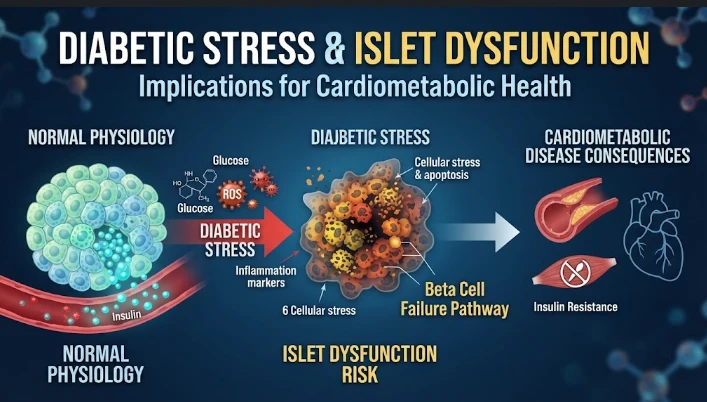
The article explores islet dysfunction as a mechanistic contributor to cardiometabolic risk, focusing on pathways that connect metabolic stress with declining beta-cell performance. Calcium dysregulation, mitochondrial stress, endoplasmic-reticulum burden, insulin-granule processing, inflammation, and loss of cellular identity are treated as interacting mechanisms. Experimental examples involving stress-responsive beta-cell states and PITPNA illustrate how molecular abnormalities can impair secretion and, in some cases, be functionally rescued. The article recommends combining human islets, stem-cell-derived islets, multicellular tissue systems, genetic perturbation, and pharmacological intervention to distinguish causal stress pathways from markers of damaged cells. Prespecified endpoints should include glucose tolerance, C-peptide, insulin sensitivity, glycemic variability, and sustained preservation of function rather than short-term secretion alone. Disease stage, tissue-specific safety, gene–environment interaction, and combination strategies are also emphasized. A convincing target should restore integrated beta-cell function and predict durable metabolic benefit across stages of disease.
The dysfunction of the islets is evident clinically when the islets' insulin output is insufficient to meet the body's metabolic demands; however, the biological transition begins earlier. Problems build up as the glucose level is not necessarily high, and they include nutrient overload, calcium stress, protein folding burden, inflammation, and mitochondrial strain. The ability of beta cells to adapt without losing their identity or secretory precision therefore plays a part in cardiometabolic risk. Mechanistic intervention studies can help determine causative pathways of stress and pathways that merely represent cells that are already stressed.
One possible mechanism is calcium homeostasis. Single cell profiling of islets from early diabetic mice revealed a stress-responsive beta cell state that is defined by the presence of Anxa10 and that was linked by trajectory analysis to the subsequent development of a surge in calcium and eventual mitochondrial dysfunction and endoplasmic reticulum stress. The study indicates that changes in calcium handling may occur when moving from compensation to failure, but not just at the end stage.
Calcium is closely related to insulin secretion and this makes it important to not have too little or too much. The increase of calcium influx into the cell by the glucose leads to the release of granules but a high level of calcium would lead to a high metabolic demand and would stress the mitochondria. Therefore, a mechanistic study should assess dynamic calcium, ATP production, insulin secretion, and stress response in concert. If only one pathway is altered and the other pathways are not, it can be wrongly deemed as damage.
Translational test is provided by human islets. Reduced expression of PITPNA was observed in type two diabetic human islets, and these researchers found that loss of the protein is associated with decreased insulin granule maturation, docking, glucose stimulated insulin secretion, proinsulin processing, and endoplasmic reticulum stress. Reversing PITPNA enhanced some beta-cell functions. The added power of functional rescue is that it shows that the molecular deficiency can be corrected, not just correlated with diabetes.
Islet cells can be created from stem cells and these can be used for controlled intervention. Resistance to apoptosis has been induced by genetic manipulation of stress pathways in these cells under inflammatory stress, endoplasmic reticulum stress and metabolic stress. The isogenic comparison used to examine these models involves making a change in one gene but maintaining the background. While this approach helps to distinguish causal stress regulators from donor variation, it is important to keep in mind that the maturity of islets derived from stem cells needs to be taken into account when applying this to adult human islets.
A good experimental design would involve a combination of several perturbations. Different stresses for diseases: high glucose, high fatty acids, cytokines, and protein folding stress. Candidate genes are genetically modified and/or pharmacologically manipulated prior to every challenge. A protective device that only protects against one artificial stress may not be as clinically important as one that maintains function under multiple stresses. In contrast, stress-specific effects can help pinpoint pathways that are appropriate for specific diabetes sub types.
If possible, organoid or islet tissue systems should maintain the interactions between the cells. Glucagon signals are supplied by alpha cells, perfusion is influenced by endothelial cells, cytokines are supplied by immune cells and the extracellular matrix affects cell survival. If another cell type secretes a competing signal, a protective intervention for a beta cell will be unsuccessful in a multicellular environment. These interactions can be studied in pre-clinical tissue models such as co culture and engineered islet models prior to clinical translation.
Prespecified cardiometabolic endpoints are needed in animal or human studies. Fasting glucose is not enough. Additional information is provided by glucose tolerance, first phase insulin release, C peptide, insulin sensitivity, glycaemic variability, beta cell workload and lipid metabolism. Acute secretion of insulin may make long term stress worse if it creates an increased burden of secretion. Benefit should, therefore, include a long-term glucose change, not a short-term change.
Disease stage can be defined in terms of reversibility. Early stress state may normalize with reduction in demand; later stress state would persist in dysfunctional state despite improvement in environment. It is possible to intervene at different stages to identify the point at which rescue may become incomplete. A pathway that supplies good results in compensation could fail after the loss of many cells or after the cells dedifferentiate, thus making this type of staging significant for precision therapy.
Population evidence can be used to see if the experimental mechanism is important in nature. Association of genetic variants near a candidate pathway, circulating stress markers or expression signatures may be investigated in relation to diabetes progression. These data should be used in conjunction with, not in place of, functional experiments. A pathway which can be rescued in the experimental setting but doesn't appear to be directly related to human progression needs additional explanation before being a clinical target.
Metabolic risk can be linked to islet failure via causal mediation. Insulin resistance can lead to elevated secretory demands and subsequent changes in calcium and endoplasmic reticulum stress and a decrease in beta cell function. Part of that sequence can be tested with human data, as are the longitudinal data. Measurement error is still relevant as beta cell tissue is seldom sampled directly. Whenever possible, accessible biomarkers should be calibrated on studies of human islets.
Tissue specificity is also important for safety. There are numerous stress pathways in the liver, the muscle, in brain cells, immune cells and in heart cells. Systemic inhibition that is meant to help preserve beta cell function can interfere with important responses in other parts of the body. To enhance therapeutic index, targeted delivery or beta cell selective regulators could be used. Studies in early experiments should assess off-target effects in other metabolic tissues, not just islet survival.
Metabolic stress is multifactorial, and combination therapy might be needed. The improvement of insulin sensitivity decreases the demand, and a beta cell directed therapy might increase the stress tolerance or restore the process of granules inside the beta cell. This combination strikes both vulnerability downstream and load upstream. Factorial experiments can be used to determine if effects are additive, synergistic, or redundant and can identify if one effect is masking another's dysfunction.
There should be a difference between compensation and disease modification in clinical translation. A temporary insulin surge can help to improve glucose without maintaining beta cell identity. A disease modifying strategy should stabilize or restore function of the cell and decrease markers of cellular stress and decrease the rate of progression. Long follow up is necessary as short trials may favour an intervention that increases the secretion but decreases future reserve.
PITPNA also provides an excellent example of why granule biology should be part of stress research. Membrane trafficking defects and their role in secretory recovery are restored by restoring defects in phosphoinositide handling, linking secretory recovery with membrane trafficking. A rescue effect that goes beyond molecular processing and glucose stimulated secretion is more convincing than a normalised level of one stress marker. The ability to restore integrated function should be used to assess candidate therapies rather than reduction of endoplasmic reticulum signals alone.
Mechanisms may be prioritized using a genetic risk approach. The two diabetes loci are commonly associated with regulatory regions that are active in islets, but this alone doesn't determine the causal gene. Combining fine mapping with beta cell chromatin data can nominate candidates and CRISPR perturbation tests work. If there is a risk variant, a stress responsive regulatory element and a rescue experiment that all point to the same pathway, the line from inherited susceptibility to beta cell failure is even more coherent.
Compensation can also be identified from intervention timing. A pathway blocked during early metabolic stress may lead to hypersecretion, but not decrease long term function, and a pathway blocked during advanced disease may lead to excessive hypersecretion (loss of reserves). Early and late disease models should be included in studies; they should not be limited to one. The changes from one stage to another are pivotal in precision therapy because a compensation may become insufficient after long periods of decompensation.
Using paired donor information allows human translation to be more beneficial. Functional responses can be analyzed with islets from donors, whose glycated hemoglobin is known, along with their body mass and diabetes duration, treatment, and cause of death. Clinical metadata aid in the separation of disease biology from isolation injury. Sampling of islets is not routinely possible other than transplantation or surgery, and therefore requires easily accessible biomarkers to be used for replication in living human cohorts.
Raghu G. Mirmira's research interests are directed towards understanding the mechanisms of pancreatic beta cells and islet biology, which are relevant to a mechanistic understanding of cardiometabolic risk. Perturbation and functional rescue can be used for calcium regulation, proteostasis, granule biology and stress adaptation. A convincing target is one that restores human beta cell function in controlled models, and also predicts long-term metabolic benefit throughout the stages of disease, in parallel with the molecular mechanism and clinically significant preservation of islet reserve.
CITE THIS ARTICLE
Tasmeem, S. (2025). Islet Dysfunction Risk through Diabetic Stress and Beta Cell Function in Cardiometabolic Disease. https://www.sadiaresearchhub.com/article/b5d40dd1-5c42-5dcb-b285-9661e5a73823
S. Tasmeem, “Islet Dysfunction Risk through Diabetic Stress and Beta Cell Function in Cardiometabolic Disease,” 2025. [Online]. Available: https://www.sadiaresearchhub.com/article/b5d40dd1-5c42-5dcb-b285-9661e5a73823
Tasmeem, S. (2025) ‘Islet Dysfunction Risk through Diabetic Stress and Beta Cell Function in Cardiometabolic Disease’. Available at: https://www.sadiaresearchhub.com/article/b5d40dd1-5c42-5dcb-b285-9661e5a73823
Tasmeem, Sadia. “Islet Dysfunction Risk through Diabetic Stress and Beta Cell Function in Cardiometabolic Disease.” 2025, https://www.sadiaresearchhub.com/article/b5d40dd1-5c42-5dcb-b285-9661e5a73823.
Sadia Tasmeem. “Islet Dysfunction Risk through Diabetic Stress and Beta Cell Function in Cardiometabolic Disease.” (2025). https://www.sadiaresearchhub.com/article/b5d40dd1-5c42-5dcb-b285-9661e5a73823.
Tasmeem S. Islet Dysfunction Risk through Diabetic Stress and Beta Cell Function in Cardiometabolic Disease. 2025. https://www.sadiaresearchhub.com/article/b5d40dd1-5c42-5dcb-b285-9661e5a73823
@misc{article_b5d40dd15c425dcbb2859661e5a73823,
  title = {Islet Dysfunction Risk through Diabetic Stress and Beta Cell Function in Cardiometabolic Disease},
  author = {Sadia Tasmeem},
  year = {2025},
  url = {https://www.sadiaresearchhub.com/article/b5d40dd1-5c42-5dcb-b285-9661e5a73823},
}
TY  - GEN
AU  - Sadia Tasmeem
TI  - Islet Dysfunction Risk through Diabetic Stress and Beta Cell Function in Cardiometabolic Disease
PY  - 2025-10-12
UR  - https://www.sadiaresearchhub.com/article/b5d40dd1-5c42-5dcb-b285-9661e5a73823
ER  -
The article examines leukemia as an evolving population under targeted therapy, using chronic myeloid leukemia as the main example. BCR–ABL1 inhibition can produce deep responses, but every treatment changes the competitive environment among malignant clones. Quantitative transcript monitoring provides a continuous measure of disease burden, while deep sequencing can identify emerging resistance mechanisms before hematologic progression. A detected mutation is clinically meaningful only when its
The article examines how cardiovascular genetic risk becomes biologically active through cell-specific inflammatory signaling. Because many vascular-risk variants lie in regulatory DNA rather than coding regions, their effects may appear only in particular endothelial, macrophage, smooth-muscle, or lymphocyte states. Single-cell studies of human atherosclerotic lesions and multiomic endothelial experiments are used to illustrate this context dependence. The article also discusses IL6-related sig
The article examines cardiovascular GPCR signaling as a dynamic response system whose abnormalities can remain hidden in resting measurements. Mechanical stretch, hormones, nutrients, sympathetic activity, and fluid balance can change the amplitude, duration, localization, and recovery of receptor signaling. Examples include mechanically activated angiotensin-receptor signaling, endosomal signaling, beta-arrestin-dependent trafficking, and biased glucagon-like peptide-one receptor responses. The