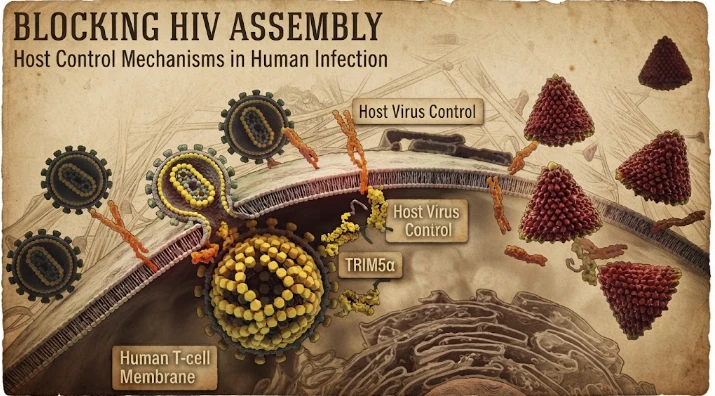
The article examines HIV budding as an interaction between viral assembly machinery and host-cell systems that can both support and restrict infection. Gag organizes membranes, genomic RNA, and ESCRT-dependent fission, while host restriction factors such as tetherin can prevent released particles from separating from the cell. Viral accessory proteins counter these defenses, creating an evolutionary contest over shared cellular infrastructure. The article emphasizes therapeutic selectivity because ESCRT and membrane-trafficking pathways are also essential for normal cytokinesis, endosomal sorting, and membrane repair. Safer strategies may therefore target virus-specific interfaces, such as particular Gag–host interactions or viral antagonists, rather than disabling an entire host pathway. Combination therapy, evolutionary conservation, resistance potential, and functional validation are discussed. The overall goal is to identify host–virus dependencies that are essential for HIV assembly but sufficiently dispensable to the cell, turning viral reliance on host machinery into a clinically useful vulnerability.
Host control of HIV assembly is unusual in that it is dependent upon cellular machinery but is also subject to cellular proteins that inhibit viral release. Budding is possible with the same membrane trafficking systems used in normal cell physiology, and the same interferon response that turns on antiviral defenses can alter the availability of those host factors. The assembly of HIV is an "arms struggle" for shared cellular infrastructure, not a wholly viral process.
Gag is the main viral organizer. Binds membrane lipids, binds genomic RNA, multimerizes and recruits host machinery. Many assembly determinants can be examined without the whole replication cycle, as Gag by itself can produce virus like particles. Although infection models are not needed for functional validation, a particle may develop properly but not mature or enter.
The ESCRT pathway is an exemplary case of cooption of host machinery. HIV late domains interact with TSG101 and ALIX, which are associated with cellular complexes that remodel membranes, connecting Gag to them. Then, ESCRt III components and the VPS4 ATPase help with membrane fission. Breaking these interactions creates particles that will not bud or detach inefficiently.
The host cells also contain tetherin, an interferon-inducible restriction factor that may be able to hold newly formed virions at the plasma membrane. HIV Vpu is an antagonist of tetherin that modifies its localization and causes depletion. This is an example of how an evolutionarily "arms race" can occur: The host might develop a physical barrier to release, while the virus might evolve a protein to neutralise that barrier.
Control can thus take place at multiple levels. Limiting the nucleation by reducing the binding of Gag to Gag membrane. Dislodging RNA packaging can result in particles with defective genomes. Blocking the ESCRT recruitment impairs the scission.
After budding, the dissemination is prevented by strengthening tetherin activity. The therapeutic concept in each stage is different, but targeted therapies to the host should not be at the level of disrupting normal cellular functions.
The biggest issue is selectivity. ESCRT machinery is involved in cytokinesis, endosomal sorting, membrane repair and other vital functions. This is because they may inhibit normal cells as well. The safer approach would be to target specific virus-host interactions, e.g. the exact interaction between a Gag late domain and a host factor, or a viral antagonist like Vpu, instead of the whole cellular pathway.
At high resolution, they can be identified by structural biology. The surfaces of proteins, and biochemical assays, show selectivity of disruption. Live cell imaging can then be used to determine if an inhibitor alters the recruitment kinetics of the assembly sites. The infectivity assays are used to find out if the disruption has an antiviral effect.
The exact same network can be influenced by host genetic variation. Variation in expression levels and allelic variation of restriction factors or trafficking proteins may influence the ability of a virus to replicate. Variants that may be associated with viral load or disease progression may be found in population studies, but functional experiments must be done to demonstrate that a variant alters assembly versus other steps in the infection process.
The state of the cell is also important. There are differences in the membrane composition, trafficking, interferon signaling, and expression of restriction factors between the activated T cell, the macrophage, and other susceptible cells. HIV may be able to assemble in different contexts of cell membranes, depending on cell type. The host dependency of one laboratory cell line should be confirmed in primary target cells.
Viral sequence can be used to predict its possible adaptation to infection interfaces. Variations in Gag or Vpu may be associated with pressure from drugs, immunity or host factors. Although sequencing may be used alone to assign the selective cause, repeated mutations in the same vicinity of a known interaction site may be used to generate hypotheses for functional testing. Laboratory competition experiments can be used to measure the ability of the variant to enhance release or replication in the context of the host.
Experimental infection models can relate assembly and transmission fitness. If genome packaging and/or maturation is impaired, a mutation that enhances the potential to release particles may have a negative effect on viral fitness. Complete replication cycles, cell to cell spread and competition between variants is measured to avoid equating one favorable laboratory phenotype with overall advantage.
Another reason for getting a grasp of assembly is combination therapy. Today's anti-HIV therapies effectively inhibit all phases of HIV infection. An inhibitor for the assembly of an assembly inhibitor would have to be active on resistant variants, have acceptable pharmacology and be compatible with existing drugs. Host directed mechanisms might provide an alternative resistance barrier as long as the cellular toxicity is not high.
Interferon produces a changing host environment by inducing many restriction factors simultaneously. Tetherin is just one player. Other interferon stimulated genes include those related to reverse transcription, nuclear entry, translation, and membrane biology. A post interferon assembly phenotype should then be broken down with specific perturbations and not be assumed to be due to a single factor.
Adaptation can be exposed with the use of virus host specificity. Tetherin antagonism varies among primate lentiviruses, with viral proteins tackling the same host barrier with different solutions. Comparative virology can be used to distinguish between the features that are constrained and those that are tolerant to mutation in the interface. In a highly constrained surface, escape may impose a higher fitness cost and such surfaces may be desirable targets of attraction.
Unusual resistance patterns can also result from host directed therapy. The only thing it can do is to change the target host itself, but it can change the viral interaction partner or around the dependency. Viral populations should then be sequenced for resistance studies and alternate cellular pathways should be tested to get a better sense of whether they are recruited.
Synergistic control points can be detected by way of combination experiments. It is possible that partial inhibition of ESCRT recruitment and the increase in the activity of tetherin may be sufficient to inhibit release more than either. If host toxicity is not acceptably low, then synergy is of no benefit. In addition to antiviral activity, measurement of cellular viability, cytokinesis, and membrane repair should be performed.
At least multiple donor backgrounds should be used for primary cell validation. People differ in their levels of host protein expression and some people may have a stronger dependency than others. The replication across donors minimizes the donor specific or cell line specific effect.
Host interfaces can be prioritized by evolutionary conservation. The binding surface for the virus is likely to be functional, as it is conserved in all HIV lineages. If such a surface is targeted by a compound, then it may be more difficult for it to develop resistance, but can still do it by compensatory mutation.
Host toxicity testing should be done over a longer time than the antiviral assay. A pathway might seem unnecessary for a short experiment but essential for division, repair, immune function on a days-long time scale. Chronic exposure testing can uncover liabilities that may not be identified by acute viability testing.
Reservoir biology makes for an additional complication. Assembly inhibitors work after the virus re-expresses itself, since there is only a small amount of viral protein in latent cells. Their functions would then be to inhibit new particle production, but not to eliminate latent provirus. The biological scope is to be used as a guide for treatment claims.
Also, cellular targets for host interaction should be assessed in resting and activated immune cells because toxicity may vary depending on the degree of proliferation and/or cytokine signaling. A pathway that is tolerated in a transformed cell line may be crucial when the primary T cell gets activated. Safety testing in all cell states minimizes the risk of progress to an antiviral mechanism that interferes with normal immune functioning.
The selectivity testing identifies the potential for a host dependency that is promising and could be practical as an antiviral target.
Carol A. Carter's research on the interactions between host virus and HIV budding is instrumental in the support of a layered model of control. The host provides membranes, RNA binding proteins, and ESCRT machinery, as well as restriction factors like tetherin. HIV recruits them to organize the resources and gets around restrictions by using viral accessory proteins.
The dependency network can be turned into an advantage for infectious disease control, because it allows one to find interfaces that are crucial to the virus but not critical for the host. The most promising target is thus not just a host protein or viral protein, but a vulnerable interaction whose disruption brings the assembly process to a halt, but not the normal cell biology.
CITE THIS ARTICLE
Tasneem, S. (2025). Host Virus Control through HIV Assembly and Viral Assembly in Human Infection. https://www.sadiaresearchhub.com/article/fc1c5981-637b-5f70-adf2-829dba5668b8
S. Tasneem, “Host Virus Control through HIV Assembly and Viral Assembly in Human Infection,” 2025. [Online]. Available: https://www.sadiaresearchhub.com/article/fc1c5981-637b-5f70-adf2-829dba5668b8
Tasneem, S. (2025) ‘Host Virus Control through HIV Assembly and Viral Assembly in Human Infection’. Available at: https://www.sadiaresearchhub.com/article/fc1c5981-637b-5f70-adf2-829dba5668b8
Tasneem, Sadia. “Host Virus Control through HIV Assembly and Viral Assembly in Human Infection.” 2025, https://www.sadiaresearchhub.com/article/fc1c5981-637b-5f70-adf2-829dba5668b8.
Sadia Tasneem. “Host Virus Control through HIV Assembly and Viral Assembly in Human Infection.” (2025). https://www.sadiaresearchhub.com/article/fc1c5981-637b-5f70-adf2-829dba5668b8.
Tasneem S. Host Virus Control through HIV Assembly and Viral Assembly in Human Infection. 2025. https://www.sadiaresearchhub.com/article/fc1c5981-637b-5f70-adf2-829dba5668b8
@misc{article_fc1c5981637b5f70adf2829dba5668b8,
  title = {Host Virus Control through HIV Assembly and Viral Assembly in Human Infection},
  author = {Sadia Tasneem},
  year = {2025},
  url = {https://www.sadiaresearchhub.com/article/fc1c5981-637b-5f70-adf2-829dba5668b8},
}
TY  - GEN
AU  - Sadia Tasneem
TI  - Host Virus Control through HIV Assembly and Viral Assembly in Human Infection
PY  - 2025-04-27
UR  - https://www.sadiaresearchhub.com/article/fc1c5981-637b-5f70-adf2-829dba5668b8
ER  -
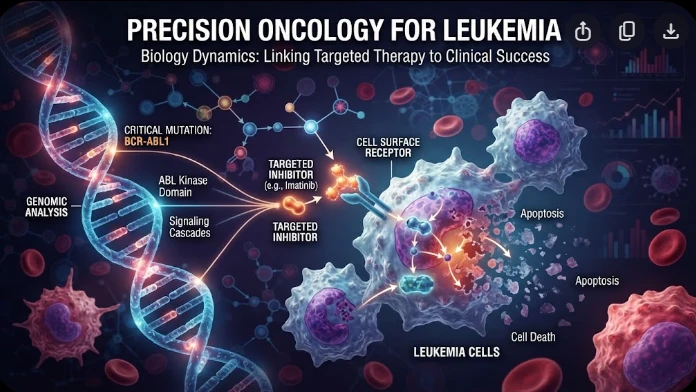
The article examines leukemia as an evolving population under targeted therapy, using chronic myeloid leukemia as the main example. BCR–ABL1 inhibition can produce deep responses, but every treatment changes the competitive environment among malignant clones. Quantitative transcript monitoring provides a continuous measure of disease burden, while deep sequencing can identify emerging resistance mechanisms before hematologic progression. A detected mutation is clinically meaningful only when its
The article examines how cardiovascular genetic risk becomes biologically active through cell-specific inflammatory signaling. Because many vascular-risk variants lie in regulatory DNA rather than coding regions, their effects may appear only in particular endothelial, macrophage, smooth-muscle, or lymphocyte states. Single-cell studies of human atherosclerotic lesions and multiomic endothelial experiments are used to illustrate this context dependence. The article also discusses IL6-related sig
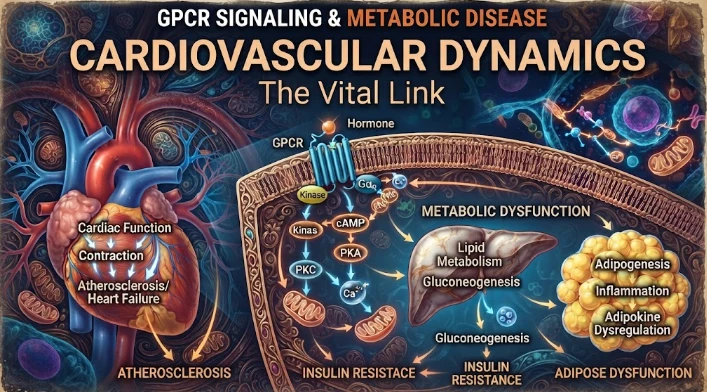
The article examines cardiovascular GPCR signaling as a dynamic response system whose abnormalities can remain hidden in resting measurements. Mechanical stretch, hormones, nutrients, sympathetic activity, and fluid balance can change the amplitude, duration, localization, and recovery of receptor signaling. Examples include mechanically activated angiotensin-receptor signaling, endosomal signaling, beta-arrestin-dependent trafficking, and biased glucagon-like peptide-one receptor responses. The