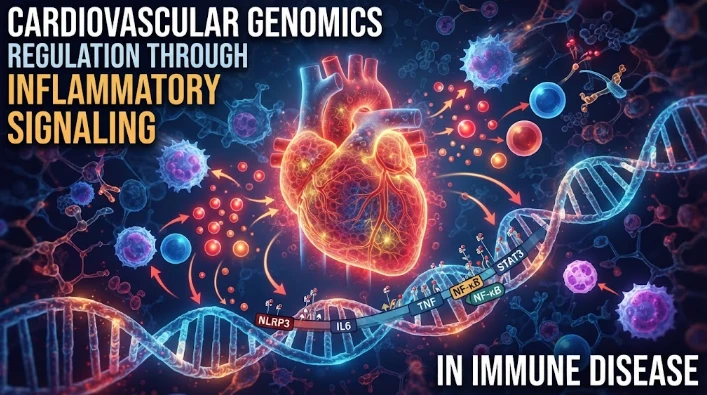
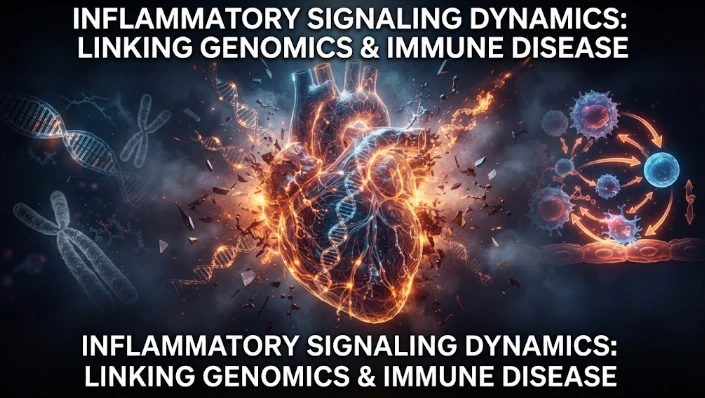
The article connects cardiovascular genomics with inflammatory signaling through clonal hematopoiesis, where somatic mutations in blood-forming cells expand without overt leukemia and can influence vascular disease. Mutations in genes such as TET2, DNMT3A, ASXL1, and JAK2 are discussed alongside clone size and inflammatory pathways. Human genetic evidence involving IL6R and mechanistic studies of TET2-deficient clones illustrate how altered cytokine signaling can increase monocyte and macrophage activity and accelerate atherosclerosis. The article proposes repeated blood sequencing, single-cell genotyping, transcriptomics, plasma proteomics, vascular imaging, and functional immune–vascular assays to establish temporal and causal links. Inherited modifiers, medications, clone-growth rate, competing risks, and disease stage must also be considered. Prediction should add value beyond traditional cardiovascular factors. The central model views somatic mutation, inflammatory signaling, and vascular injury as a longitudinal chain whose modifiable intermediates could support precision prevention.
Now, cardiovascular genomics is going beyond inherited variants, which are fixed at birth. Blood forming stem cells can also develop somatic mutations in the body, multiply in clones, and modify inflammatory output without developing into blood cancer. This is known as 'clonal hematopoiesis' and establishes a direct connection between genome change and vascular biology. The key is not only if the mutation is present, but if a genetically modified immune clone alters inflammatory signaling to the point of impacting atherosclerosis, heart failure, or other vascular outcomes.
Clonal hematopoiesis recur in genes like TET2, DNMT3A, ASXL1 and JAK2, but the biological effect is different. Clone size also is a factor. A small clone can have less systemic influence than a large expanding population and expansion can proceed for years. Other exposures, such as age and smoking, and prior therapy and inflammation can influence the clonal growth. Thus, the moving somatic component is added to inherited susceptibility and traditional risk factors in the field of cardiovascular genomics.
There is human genetic evidence that this process is linked to inflammatory signaling. The large UK Biobank study included a focus on a common IL6R variant that reduces the signaling of IL6, along with clonal hematopoiesis and cardiovascular events. The IL6R variant was correlated with cardiovascular risk attenuation among the participants with larger clones. This type of interaction is informative because it connects a genomic state in blood cells to a specific inflammatory pathway, and doesn't simply use inflammation as a marker.
Mechanistic experiments support that interpretation. Using models of TET2 deficient clonal hematopoiesis, blockade of the interleukin-6 receptor led to beneficial effects on monocyte and macrophage biology and to the slowing of accelerated atherosclerosis. This study linked inflammatory triggering to elevated CSF1 receptor expression, monocytosis and plaque macrophage burden. A genetic lesion can thus alter the cellular response to a cytokine network, leading to a chain of events from the altered hematopoietic clone to vascular inflammation and lesion progression.
This is a mechanism to explain why cross sectional cytokine measurements are inadequate. The amount of interleukin 6 varies during infections, obesity, kidney problems, certain drugs and many other diseases. A high value does not indicate if the signaling occurred before or after the vascular injury or whether the signaling increased due to the disease. Clone identity and clone size is a more stable genomic anchor and repeated inflammatory measurements can illustrate the evolution of the downstream phenotype. There has to be a longitudinal design to create order.
Future studies may start by deep sequencing of blood to take into account somatic clones, inherited genotypes and clone specific mutations. If sequencing was repeated, it would measure expansion or contraction. Single cell transcriptomics and chromatin assays could be used to define the structure of inflammatory cells that emerge as clones grow, while plasma proteomics could be used to follow up inflammatory mediators. Vascular imaging may quantitate plaque burden, arterial inflammation or remodeling prior to clinical events. The entire trajectory would link genotype, immune state, tissue phenotype, and outcome.
The clonal hematopoiesis is a phenomenon that originates in hematopoietic stem cells but can be detected in differentiated lineages and thus requires cellular attribution. Each of the monocytes, macrophages, neutrophils or other descendants may be affected differently by a mutation. Genotypically distinguishing mutant from nonmutant cells within the same person is possible with single cell genotyping coupled with transcriptomics. Many background exposures are automatically controlled by that within person contrast. The greater the reoccurrence of a certain inflammatory program in a clone of mutant cells and the less when wild type cells are located nearby, the more causal interpretation is supported.
Functional assays can be used to determine if those programs alter the behavior of the blood vessels. Cytokine production, endothelial adhesion, migration and macrophage differentiation are compared between mutant and nonmutant monocytes. The secreted signals can be analysed for their effect on vascular activation by co culture with endothelial or smooth muscle cells. Rescue experiments can be provided by gene correction or targeted pathway inhibition. When the reverse of a candidate inflammatory pathway is able to restore immune cell function and vascular readouts to normal, it becomes more convincing.
There are still important contextual factors to consider, such as inherited genetics. Modifications of the cardiovascular effects of somatic clone by variants of cytokine receptors, lipid metabolism, endothelial signaling and immune regulation. The relationship between inherited and acquired genomes could account for differing clinical courses as a result of similar clone burdens. Large population sizes and diverse ancestry are required as modifier variants and linkage structures are different among populations. No conclusion should be drawn from a genomic interaction that is found in one ancestry and is not duplicated in others.
Interpretation is also influenced by clinical exposures. Vascular risk and blood cell dynamics can be affected by statins, anti inflammatory drugs, smoking cessation, metabolic treatment and cancer therapy. A clone that is present in events without intensive preventive therapy could react differently under intensive preventive therapy. Clonal biology and treatment effect can be distinguished with repeated medication records and biomarker sampling. When the inflammatory signal changes but the number of clones does not, this can also be used as a natural experiment to treat the change in treatment.
Inflammation should be considered as a mediator in the theoretical model of disease progress with thresholds. A small clone may exist in a biologically silent state until it expands to a size that significantly alters the cytokine production or the ratio of myeloid cells. Until the endothelial dysfunction and/or the growth of plaques and/or the onset of thrombosis, the vascular tissue can cope with inflammatory stress. This kind of effect could account for the variability seen in some carriers of the genome and more dramatically in others. A single baseline hazard estimate is not appropriate for this process and should be replaced by a time dependent model.
The predictive value should be tested as a separate aspect from mechanism. The only use for a marker is when it adds to decision making beyond age, blood pressure, lipids, diabetes, smoking, kidney function, and existing cardiovascular disease, which sequencing can identify. This is important as the clonal prevalence increases markedly with age (absolute risk calibration). If there is a strong baseline risk to undertreatment and the relative risk is quite dramatic because of a molecular finding, it may not have much impact on treatment decisions.
The most challenging test is in intervention trials. The stratifiable defined clonal states could be followed under targeted or standard preventive strategies. Because cytokine pathways provide protection against infection and normal immunity, safety is paramount. A therapy that lowers vascular inflammation, but raises infectious issues may have a negative net effect. Mechanistic specificity, clinical endpoint enhancement and acceptable risk are thus required for biomarker guided treatment.
Genomics of cardiovascular disease can also shed light on cardiovascular disease in its presymptomatic stages. Ancillary detection of the clonal expansion, along with increasing inflammatory proteins and early imaging changes, may help to recognise a transition from genomic susceptibility to ongoing tissue damage. Multiple measurements can determine if intervention disrupts that sequence. The importance of this in a practical sense is to identify a modifiable intermediate condition rather than permanently classify a carrier as high risk on the basis of one sequence result.
The growth rate of clones may provide additional information to clone size. If two participants have the same level of the variation in alleles, but one is stable for years and the other is growing faster, they can have different pathways. That can be estimated by serial sequencing and tested to see if it is correlated with increases in inflammatory proteins or deterioration in vascular imaging. A genomic measure that varies with the dynamics (is dynamic) could, therefore, be better at detecting biological transition than a simple binary measure of absence or presence.
Competing risks need to be considered in older people. Hematologic progression, infections, history of cancer treatment and cardiovascular events can all be linked to the same clonal state. Estimates of vascular risk may be distorted by analyses that do not account for death or significant non-vascular disease. Clone evolution can be modeled with joint longitudinal and time to event models, allowing for competing outcomes. This type of modeling is particularly relevant for adults who are otherwise asymptomatic and in whom clonal hematopoiesis is identified by screening.
Timothy A. McCaffrey's research interests in cardiovascular genomics, inflammation, and vascular disease are congruent with a new paradigm in integrated immune vascular biology. The interrelated causal chain of somatic mutation, inherited variation, inflammatory signaling, and tissue response can be tested at various levels. Prospective genomics, single cell profiling, functional perturbation and longitudinal vascular outcomes could identify the time of the emergence of an immune clone as a vascular driver and the most precise time for targeting an inflammatory pathway.
CITE THIS ARTICLE
Tasmeem, S. (2026). Cardiovascular Genomics Regulation through Inflammatory Signaling in Immune Disease. https://www.sadiaresearchhub.com/article/b4802d37-c444-5ed6-9b48-1f998132344c
S. Tasmeem, “Cardiovascular Genomics Regulation through Inflammatory Signaling in Immune Disease,” 2026. [Online]. Available: https://www.sadiaresearchhub.com/article/b4802d37-c444-5ed6-9b48-1f998132344c
Tasmeem, S. (2026) ‘Cardiovascular Genomics Regulation through Inflammatory Signaling in Immune Disease’. Available at: https://www.sadiaresearchhub.com/article/b4802d37-c444-5ed6-9b48-1f998132344c
Tasmeem, Sadia. “Cardiovascular Genomics Regulation through Inflammatory Signaling in Immune Disease.” 2026, https://www.sadiaresearchhub.com/article/b4802d37-c444-5ed6-9b48-1f998132344c.
Sadia Tasmeem. “Cardiovascular Genomics Regulation through Inflammatory Signaling in Immune Disease.” (2026). https://www.sadiaresearchhub.com/article/b4802d37-c444-5ed6-9b48-1f998132344c.
Tasmeem S. Cardiovascular Genomics Regulation through Inflammatory Signaling in Immune Disease. 2026. https://www.sadiaresearchhub.com/article/b4802d37-c444-5ed6-9b48-1f998132344c
@misc{article_b4802d37c4445ed69b481f998132344c,
  title = {Cardiovascular Genomics Regulation through Inflammatory Signaling in Immune Disease},
  author = {Sadia Tasmeem},
  year = {2026},
  url = {https://www.sadiaresearchhub.com/article/b4802d37-c444-5ed6-9b48-1f998132344c},
}
TY  - GEN
AU  - Sadia Tasmeem
TI  - Cardiovascular Genomics Regulation through Inflammatory Signaling in Immune Disease
PY  - 2026-01-18
UR  - https://www.sadiaresearchhub.com/article/b4802d37-c444-5ed6-9b48-1f998132344c
ER  -
The article examines leukemia as an evolving population under targeted therapy, using chronic myeloid leukemia as the main example. BCR–ABL1 inhibition can produce deep responses, but every treatment changes the competitive environment among malignant clones. Quantitative transcript monitoring provides a continuous measure of disease burden, while deep sequencing can identify emerging resistance mechanisms before hematologic progression. A detected mutation is clinically meaningful only when its
The article examines how cardiovascular genetic risk becomes biologically active through cell-specific inflammatory signaling. Because many vascular-risk variants lie in regulatory DNA rather than coding regions, their effects may appear only in particular endothelial, macrophage, smooth-muscle, or lymphocyte states. Single-cell studies of human atherosclerotic lesions and multiomic endothelial experiments are used to illustrate this context dependence. The article also discusses IL6-related sig
The article examines cardiovascular GPCR signaling as a dynamic response system whose abnormalities can remain hidden in resting measurements. Mechanical stretch, hormones, nutrients, sympathetic activity, and fluid balance can change the amplitude, duration, localization, and recovery of receptor signaling. Examples include mechanically activated angiotensin-receptor signaling, endosomal signaling, beta-arrestin-dependent trafficking, and biased glucagon-like peptide-one receptor responses. The