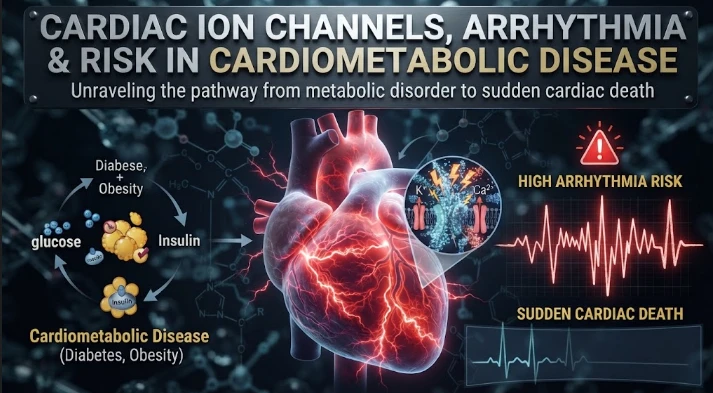
The article explains cardiometabolic arrhythmia risk as the product of interacting ion-channel, autonomic, structural, metabolic, mitochondrial, and inflammatory mechanisms. Genetic channelopathies demonstrate how relatively small disturbances in sodium, potassium, calcium, or channel-targeting proteins can produce major electrical consequences. Diabetes and obesity can add acquired stress to the same network, amplifying a previously mild susceptibility. The article advocates integrating molecular channel assays with electrocardiography, rhythm monitoring, metabolic phenotyping, imaging, and functional testing to identify the dominant mechanism in each individual. Chamber-specific differences, fibrosis, calcium-handling defects, and membrane trafficking are highlighted because not all arrhythmias share one pathway. Therapeutic translation requires strong electrophysiologic safety testing, dose-response evaluation, and mechanistic subgrouping rather than one antiarrhythmic strategy for all cardiometabolic disease. The overall precision framework aims to identify which part of the electrical network is becoming unstable before a catastrophic rhythm event occurs.
Cardiometabolic disease increases the risk of atrial and ventricular arrhythmias via multiple overlapping mechanisms. Diabetes and obesity can affect ion channel and autonomic function, myocardial structure, mitochondrial metabolism, inflammation and coronary disease. The difficulty in the challenge is that the question is which one is the dominant pathway? One mechanistic layer is the cardiac ion channel biology which can be the measured component from inherited variants all the way up to the electrocardiographic phenotype.
Precise electrical organisation is highlighted in genetic channelopathies. Arrythmia can be caused by variants in Nav1.5, potassium channels, calcium handling proteins, and by variants in ankyrin based targeting even in the absence of metabolic disease. A similar network is less stable when metabolic stress is added. An inherited mild defect can thus combine with diabetes or obesity to yield a greater clinical phenotype.
The case of ankylosing spondylitis (AS) is a good example of how membrane organization can be disrupted to produce a risk. When the ankyrin B is lost, the sodium calcium exchanger, the sodium potassium ATPase and other partners will be mislocalized, resulting in abnormal calcium balance and various rhythm disorders. This mechanism extends the channelopathy concept from a defect in the pore to a defect in the targeting system of the pore.
Diabetes is an additional regulator of posttranslational regulation. Hypoglycemia leads to an increase in O GlcNAcylation and oxidative stress, which may alter ion channels and signaling enzymes. Sodium and potassium currents may change, action potentials may lengthen, repolarization reserve may decrease. These effects foster an environment conducive to the occurrence of sustained arrhythmia in the case of premature beats.
The trigger can be the calcium overload. Spontaneous calcium release can result from altered sodium handling, activation of CaMKII, and from a sarcoplasmic reticulum instability. This creates membrane currents that produce delayed afterdepolarizations. Metabolic disease can thus accentuate the substrate and the trigger for the onset of Vtach.
Conduction heterogeneity comes from structural disease. Electrical waves are forced through discontinuous pathways in fibrosis, and there is altered cellular coupling and repolarization in hypertrophy. Further slowing of conduction can result from fat deposition and/or ischemic scar. The reentrant circuit is more likely to be sustained in a structurally heterogeneous heart where the ion channel changes are more hazardous.
These domains should be included in the risk assessment. Each of the electrocardiographic intervals, the burden of ectopy, the ambulatory rhythm, the imaging, the metabolic control, the electrolytes, the kidney function and the family history provides information. A molecular ion channel signature should provide an added value to those established features before it is implemented in clinical use.
Mechanistic intervention studies can determine whether or not changing a channel pathway will decrease risk. A candidate drug may be evaluated for action potential duration, calcium waves, conduction and induced arrhythmia in cellular or animal models. The validation of the tissue can be used to establish whether the target is expressed and changed in the disease condition of interest. If the whole heart arrhythmia does not improve with a favorable current change, then it is not enough.
Ion channels are vulnerable to off-target effects, and require more protection when used by humans. One drug that stabilizes one rhythm can destabilize another and establish a new proarrhythmic hazard. Extensive electrophysiology, dose response and pharmacokinetic studies are therefore critical prior to translation into the clinic.
Mechanistic intervention can be metabolic treatment itself. Autonomic tone and cardiac loading may be altered by improved glucose control or weight loss, or the treatment of sleep apnea. A drop in arrhythmia burden along with normalization of channel related biomarkers suggests a modifiable pathway. Randomized evidence is the strongest because patients who are metabolically improved can vary in many other respects.
It is significant to conduct an analysis of subgroups. Type 1 diabetes, type 2 diabetes, obesity without diabetes, and metabolic syndrome have similar, but distinct pathophysiology. Risk is further altered by the duration of the disease, the presence of neuropathy, kidney disease or coronary disease. Precision models should not lump all metabolic disease together and consider it a single exposure.
Sudden cardiac death, ventricular arrhythmia, atrial fibrillation and conduction disease should be listed as separate longitudinal endpoints. The mechanism of these outcomes are different. A biomarker that works well for AF may not do as well for VT. Disease-specific prediction will avoid triggering a general cardiac risk signal as an arrhythmia mechanism.
Family history may uncover hidden hereditary risk which can be discovered and made apparent by metabolic disease. In an individual with BCR, the disease may not present until it is overlaid with diabetes, electrolyte imbalance or drugs. The clinical phenotype and family pattern should support a possible channel disorder; genetic testing is most useful in this context to provide information, not as a blanket test for all patients.
Polypharmacy is a particular concern in metabolically ill populations with regards to medication safety. Repolarization may be prolonged by several antibiotics, psychiatric agents and antiemetics. So, a diabetic patient can cross a risk threshold with a prescription unrelated to diabetes. Metabolic and electrocardiographic risk can be added to a decision support system for flagging drug interactions.
Electrophysiology is also changed by inflammation. Cytokines are capable of changing the expression of ion channels and autonomic balance, and obesity leads to chronic low grade inflammatory signaling. Measurement of inflammatory markers can help ascertain if a channel phenotype reflects metabolic chemistry directly or an inflammatory intermediate.
Since there are differences in channel baseline repolarization and effects of hormones, sex should be taken into account. The risks estimated in one sex may not be the same for the other. There should be both sexes in preclinical studies if the mechanism is not sex limited.
Subtypes derived through the mechanisms will likely be most useful clinically. One group may have dominant fibrosis and substrate, another abnormal calcium handling and another conduction defects associated with channel trafficking. Targeting prevention for a given subtype is more realistic than using the same antiarrhythmic treatment for all the cardiometabolic pathways.
Another part of risk-reduction is to correct the reversible contributors prior to treating with an antiarrhythmic agent. This can be caused by electrolyte imbalance, severe hyperglycemia, ischemia and sleep apnea. These factors can be identified by a mechanism based assessment and be avoided, which also decreases the need for unnecessary exposure to drugs that also interact with ion channels in the body.
Cardiometabolic disease is a condition that may develop over many years and may be preventable. ECGs should be repeated to monitor for developing conduction or repolarization defects prior to the development of symptomatic arrhythmia. When combined with metabolic control, these trends can help to pinpoint times of increasing risk.
Genetic counselling can be offered if a pathogenic channel or ankyrin variant has been identified. Family screening can help determine if there is any latent susceptibility in relatives and avoid provoking medications. There is a need to adhere to the standards for clinical genetics classification as variants are often uncertain and may cause harm if classified as disease.
Population studies can help determine whether metabolic factors or structural heart disease account for more or less of the arrhythmia risks. If that residual risk can be clarified by a mechanistic biomarker, it is most useful. A biomarker that is highly associated with channel dysfunction, but not well known to occur with events, may still be useful for research but not for screening purposes.
The best prevention model is a combination of modifiable metabolic exposure, inherited susceptibility and direct electrical phenotype. This integration can help determine if metabolism, rhythm monitoring, medication management, or specialized electrophysiology treatment is the best path to take to reduce risk.
Preventive thresholds need to be validated against absolute event risk. A relative increase may seem to be significant even when the absolute risk is very low. Absolute risk will be helpful in deciding if intensive monitoring or intervention is warranted. This is necessary for heritable variants and metabolic markers that are capable of distinguishing between statistically different subgroups without adding a clinically significant difference.
This is the type of structure which enables prevention to be performed based on the major mechanism rather than on a single general response to all the metabolic arrhythmia risk signals.
The research of Peter J. Mohler on ion channels and molecular cardiology is related to the mechanistic approach of cardiometabolic risk. Cardiac disease results from the interaction of channel properties, targeting of the membrane, calcium homeostasis, metabolism and tissue structure. The most helpful precision strategy will be to detect what part of that network is unstable, before a catastrophic rhythm takes place. Ion channel measurements can make a contribution when tied to direct electrophysiology, clinically meaningful endpoints, and interventions that are shown to be reversible.
CITE THIS ARTICLE
Tasneem, S. (2025). Cardiac Disease Risk through Cardiac Ion Channels and Arrhythmia in Cardiometabolic Disease. https://www.sadiaresearchhub.com/article/e2e761d7-2132-54c7-8230-f1385c14d906
S. Tasneem, “Cardiac Disease Risk through Cardiac Ion Channels and Arrhythmia in Cardiometabolic Disease,” 2025. [Online]. Available: https://www.sadiaresearchhub.com/article/e2e761d7-2132-54c7-8230-f1385c14d906
Tasneem, S. (2025) ‘Cardiac Disease Risk through Cardiac Ion Channels and Arrhythmia in Cardiometabolic Disease’. Available at: https://www.sadiaresearchhub.com/article/e2e761d7-2132-54c7-8230-f1385c14d906
Tasneem, Sadia. “Cardiac Disease Risk through Cardiac Ion Channels and Arrhythmia in Cardiometabolic Disease.” 2025, https://www.sadiaresearchhub.com/article/e2e761d7-2132-54c7-8230-f1385c14d906.
Sadia Tasneem. “Cardiac Disease Risk through Cardiac Ion Channels and Arrhythmia in Cardiometabolic Disease.” (2025). https://www.sadiaresearchhub.com/article/e2e761d7-2132-54c7-8230-f1385c14d906.
Tasneem S. Cardiac Disease Risk through Cardiac Ion Channels and Arrhythmia in Cardiometabolic Disease. 2025. https://www.sadiaresearchhub.com/article/e2e761d7-2132-54c7-8230-f1385c14d906
@misc{article_e2e761d7213254c78230f1385c14d906,
  title = {Cardiac Disease Risk through Cardiac Ion Channels and Arrhythmia in Cardiometabolic Disease},
  author = {Sadia Tasneem},
  year = {2025},
  url = {https://www.sadiaresearchhub.com/article/e2e761d7-2132-54c7-8230-f1385c14d906},
}
TY  - GEN
AU  - Sadia Tasneem
TI  - Cardiac Disease Risk through Cardiac Ion Channels and Arrhythmia in Cardiometabolic Disease
PY  - 2025-03-16
UR  - https://www.sadiaresearchhub.com/article/e2e761d7-2132-54c7-8230-f1385c14d906
ER  -
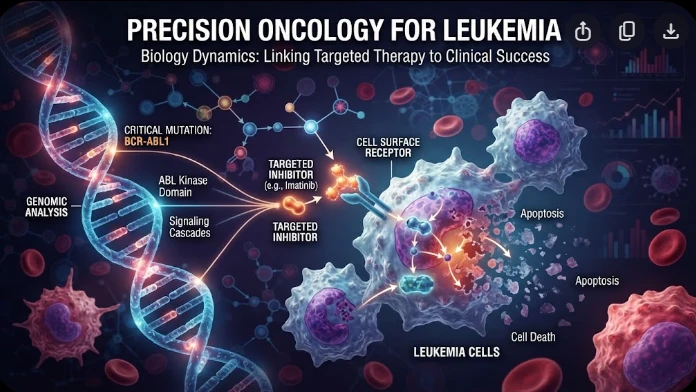
The article examines leukemia as an evolving population under targeted therapy, using chronic myeloid leukemia as the main example. BCR–ABL1 inhibition can produce deep responses, but every treatment changes the competitive environment among malignant clones. Quantitative transcript monitoring provides a continuous measure of disease burden, while deep sequencing can identify emerging resistance mechanisms before hematologic progression. A detected mutation is clinically meaningful only when its
The article examines how cardiovascular genetic risk becomes biologically active through cell-specific inflammatory signaling. Because many vascular-risk variants lie in regulatory DNA rather than coding regions, their effects may appear only in particular endothelial, macrophage, smooth-muscle, or lymphocyte states. Single-cell studies of human atherosclerotic lesions and multiomic endothelial experiments are used to illustrate this context dependence. The article also discusses IL6-related sig
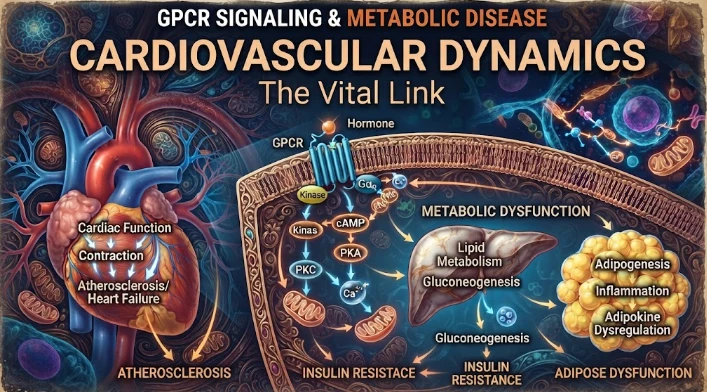
The article examines cardiovascular GPCR signaling as a dynamic response system whose abnormalities can remain hidden in resting measurements. Mechanical stretch, hormones, nutrients, sympathetic activity, and fluid balance can change the amplitude, duration, localization, and recovery of receptor signaling. Examples include mechanically activated angiotensin-receptor signaling, endosomal signaling, beta-arrestin-dependent trafficking, and biased glucagon-like peptide-one receptor responses. The