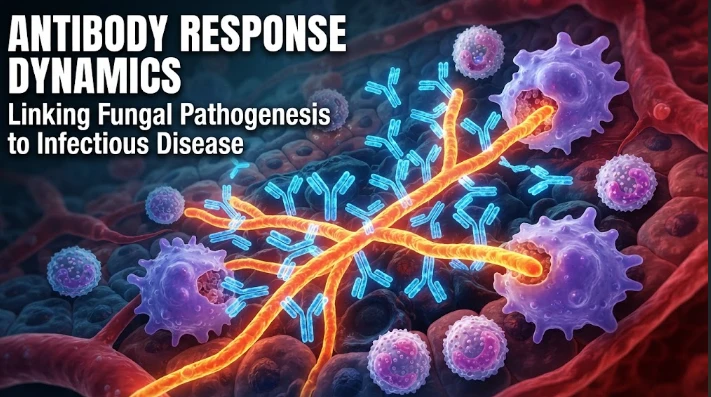
The article presents antifungal antibody immunity as a changing host–pathogen interaction rather than a fixed serological measurement. Using Cryptococcus neoformans, it explains how antibody class, epitope geometry, concentration, capsule thickness, fungal burden, tissue location, and receptor responsiveness can alter protection over time. Early and late antibody responses can have different meanings, while soluble antigen and changing fungal morphology can modify effective antibody availability. The article also discusses biofilms, tissue-specific immune environments, antibody affinity maturation, and differences between circulating and local responses. It argues that longitudinal sampling of serum and fungal isolates is essential for linking antibody trajectories with fungal burden, dissemination, treatment response, and relapse. Functional tests such as opsonophagocytosis, complement deposition, macrophage killing, and biofilm inhibition should accompany antibody measurements. This dynamic framework is proposed as more informative for vaccines, therapeutic antibodies, and clinical monitoring than single antibody titers.
be involved in uptake and containment, later antibodies can be a response to increasing antigen exposure, and continued antibodies can coexist with continued infection. So one measure of serum at any given time only reflects one-particulate snapshot of a dynamic process. The mechanism of pathogenicity is easier to be understood when the concentration of antibodies, their isotype, the type of epitope they recognize, and the functional activity is monitored as variables.
Cryptococcus neoformans is an excellent model for this as the capsule continually influences humoral interactions. Capsular polysaccharide is exposed during infection and may also spread through host tissues leading to high antigen levels and immunomodulatory properties. When this material is bound by antibody, some monoclonal antibodies induce complement activation and opsonization. In this way, the same fungal surface could induce similar antibody responses to bind tests, and act differently in functional assays.
One reason is Isotype. The classes of immunoglobulins have different properties of complement activation, engagement of Fc receptors, tissue distribution, and molecular structure. Experimental studies with anticryptococcal antibodies showed that the protective efficacy of antibody can be modified by replacement of the constant regions without changing its binding site for the antigen. The observations are biologically significant during fungal infection because of the antibody class switching. Even when responses are against related epitope in the capsule, there is the possibility of creating different immune environments depending on which isotype predominates the response.
There is an added level of complexity with epitope geometry. Capsular polysaccharide does not form a consistent thin layer and the access for the antibody may vary due to variations in capsule thickness, growth phase and capsule background strain. Protected and non-protected antibodies may bind at different levels within the capsule or give different patterns over the capsule. That spatial separation may impact complement deposition, receptor clustering, fungal agglutination and mechanical properties. The function of an antibody thus depends partly on the site of the binding, as well as its strength.
Another dynamic effect from concentration is developed. The antibody sometimes needs to be in a dose dependent manner, and sometimes very high doses of antibodies do not provide a correspondingly high level of protection. Prozone like phenomena lead to lower activity in some infectious models out of the optimal range. The ratio of antibody to antigen is also altered by fungal burden. The dose may be inadequate if the fungus grows rapidly and epitopes are cell associated, because the dose may be too low to saturate targets early in infection, or because abundant soluble polysaccharide may divert antibodies from cell associated epitopes.
Pathogen adaptation is taking place simultaneously. Capsule size and composition are manipulated by cryptococcal cells in response to variables in the host such as temperature, carbon dioxide, nutrient deprivation and immune pressure. Enlargement and phenotypic changes to the cells may alter phagocytosis and tissue persistence. Humoral immunity then is associated with fungal state if antibody access changes as the capsule changes. The same immune response can therefore have different impacts at different phases of an infection.
Such a dynamic interaction is also found in biofilms and tissue niches. The diffusion conditions between the fungal cells growing in structured communities and planktonic cells are different. The concentration of antibodies in the extracellular matrix may limit their accessibility to the target, or the local antibody concentrations in the lung, cerebrospinal fluid, or bloodstream may vary. There is still additional variation in the form of tissue specific Fc receptor populations and the presence of complement. These compartmentalized interactions cannot be completely captured by levels of antibody in the blood.
It is better to use a longitudinal measurement. Repeated serum samples allow for monitoring the antibody class, avidity, and breadth of epitopes over time, and paired fungal isolates permit monitoring of changes in the capsule phenotype, genotype, and antifungal susceptibility over time. For each time point, functional assays can be performed for opsonophagocytosis, complement deposition, fungal growth, biofilm inhibition and macrophage killing. This design would shift the meaning of antibody response from a correlate to a temporal mechanism that is linked to pathogen evolution.
The time line needs to be supplemented by clinical variables. An organism burden is changed with antifungal therapy and inflammatory responses can be altered dramatically with immune recovery. Besides the effects of corticosteroids, phagocyte function is also impaired by exposure to other immune suppressants, such as those used in transplantation, advanced HIV infection, and cancer treatment. The same antibody level in a patient may thus have varying significance among populations. Context is not an unwanted source of noise, it is part of the signal.
Another benefit of a dynamic framework is that interpretation of vaccines is enhanced. The main hurdle in vaccine development is the induction of antibodies that will be effective against variable surface structures and in different host states. A high post vaccination titer is not enough to provide durable protection. Important factors include epitope targeting, antibody affinity, Fc mediated functions and persistence of memory B cells. Longitudinal challenge studies can be used to determine if vaccine induced antibodies remain protective as fungal phenotypes change.
Therapeutic antibodies need to be similarly evaluated. Choosing a monoclonal antibody for its ability to bind well to an antigen may overlook undesirable effects on the physiology of the fungus or poor binding of the antibody to human effector pathways. Multiple strains and capsule states, as well as organism densities and immune cell backgrounds, are beneficial for candidate selection. Combination experiments with standard antifungal drugs can reveal if there is an increase in antifungal clearance, an antagonistic effect, or a shift in the emergence of resistant subpopulations.
Data analysis needs to be as complex as this. Mixed effects models could partition within-person variability from between-person variability and clustering analyses could reveal antibody response clusters that were not apparent in the mean antibody responses. Immune trajectories can be linked to fungal burden/dissemination and clinical outcomes in joint models. Causal mediation can be used to demonstrate whether a change in function of the antibody is a plausible mechanism of treatment effect or just a correlation. These methods are particularly useful when a biological timing is important.
The central concept is simple: that the antibody response in the face of fungal infection is directional, rapid and situational. As host and pathogen adapt, protective function can increase, decrease or shift. That trajectory is influenced by fungal pathogenesis, via antigen release, capsule remodeling, localization in tissues, and survival strategies. Humoral immunity affects pathogen via: opsonization, complement, direct surface effects, selection pressure.
Longitudinal analysis can be complicated by antibody affinity kinetics. B cell responses develop by somatic mutation and selection, which can generate subsequent antibodies capable of binding antigen in different geometries or with a different binding strength. Binding affinity does not necessarily lead to better protection if the binding involves a nonprotective epitope or if the binding creates an unfavorable Fc arrangement. The ability to sequence paired heavy and light chains of evolving B cell clones could correlate molecular maturation and fungus killing, phagocytosis and complement activity.
Effective antibody environment is also altered by antigen burden. During severe infection, cryptococcal polysaccharide can be present in the circulation at high levels, which may cause it to bind antibody away from the fungal surface or produce immune complexes. After treatment with antifungal drugs, these things can be altered if the antigen falls. Therefore it is important to measure the antibodies alongside the antigen to understand whether the detected antibody is of poor quality or is responding to a very high target abundance.
The study of serial serum, fungal isolates, and immune cell assays from diagnosis to treatment would be extremely useful in the clinic. Sequencing of antibody repertoire may be used to detect growing clones and functional assays may be used to assess opsonization and/or killing of the matched isolate. Those trajectories and fungal clearance would distinguish changes in antibody levels during recovery from those that are actively involved in recovery. This evidence would shift humoral immunity from descriptive serology towards a dynamic mechanism of disease control.
The repeated measurements may also show response turning points (such as when functional opsonization starts to increase more rapidly than antigen burden). A validated turning point may be more informative than either value alone, as it may indicate a shift in the balance between pathogen and humoral defence.
That reciprocal movement is more precise than a single titer and makes infectious disease research more precise. Studies correlating serial immune profiling with serial pathogen characterization and functional validation will represent the best evidence. This work might provide insights into response patterns that occur if containment is achieved, disseminated, relapsed or treatment fails. The dynamics of the antibodies then reflects a profile of the host-pathogen conflict rather than a trace of past exposure.
CITE THIS ARTICLE
Tasmeem, S. (2026). Antibody Response Dynamics Linking Fungal Pathogenesis to Infectious Disease. https://www.sadiaresearchhub.com/article/199c954f-9e3d-51e4-8f07-9be07b974958
S. Tasmeem, “Antibody Response Dynamics Linking Fungal Pathogenesis to Infectious Disease,” 2026. [Online]. Available: https://www.sadiaresearchhub.com/article/199c954f-9e3d-51e4-8f07-9be07b974958
Tasmeem, S. (2026) ‘Antibody Response Dynamics Linking Fungal Pathogenesis to Infectious Disease’. Available at: https://www.sadiaresearchhub.com/article/199c954f-9e3d-51e4-8f07-9be07b974958
Tasmeem S. Antibody Response Dynamics Linking Fungal Pathogenesis to Infectious Disease. 2026. https://www.sadiaresearchhub.com/article/199c954f-9e3d-51e4-8f07-9be07b974958
@misc{article_199c954f9e3d51e48f079be07b974958,
  title = {Antibody Response Dynamics Linking Fungal Pathogenesis to Infectious Disease},
  author = {Sadia Tasmeem},
  year = {2026},
  url = {https://www.sadiaresearchhub.com/article/199c954f-9e3d-51e4-8f07-9be07b974958},
}
TY  - GEN
AU  - Sadia Tasmeem
TI  - Antibody Response Dynamics Linking Fungal Pathogenesis to Infectious Disease
PY  - 2026-08-09
UR  - https://www.sadiaresearchhub.com/article/199c954f-9e3d-51e4-8f07-9be07b974958
ER  -
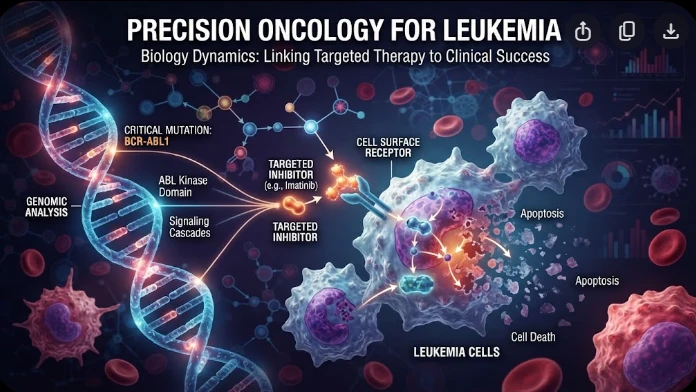
The article examines leukemia as an evolving population under targeted therapy, using chronic myeloid leukemia as the main example. BCR–ABL1 inhibition can produce deep responses, but every treatment changes the competitive environment among malignant clones. Quantitative transcript monitoring provides a continuous measure of disease burden, while deep sequencing can identify emerging resistance mechanisms before hematologic progression. A detected mutation is clinically meaningful only when its
The article examines how cardiovascular genetic risk becomes biologically active through cell-specific inflammatory signaling. Because many vascular-risk variants lie in regulatory DNA rather than coding regions, their effects may appear only in particular endothelial, macrophage, smooth-muscle, or lymphocyte states. Single-cell studies of human atherosclerotic lesions and multiomic endothelial experiments are used to illustrate this context dependence. The article also discusses IL6-related sig
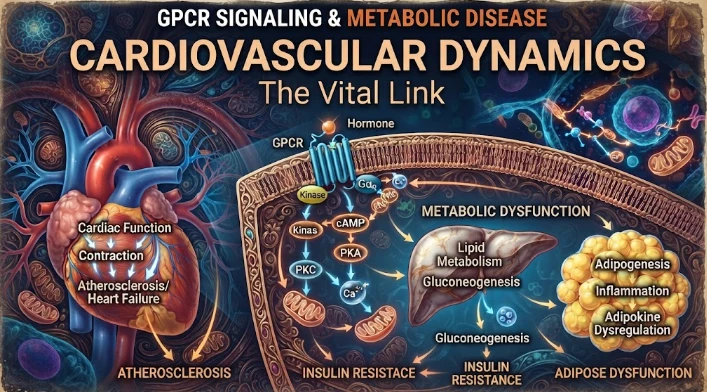
The article examines cardiovascular GPCR signaling as a dynamic response system whose abnormalities can remain hidden in resting measurements. Mechanical stretch, hormones, nutrients, sympathetic activity, and fluid balance can change the amplitude, duration, localization, and recovery of receptor signaling. Examples include mechanically activated angiotensin-receptor signaling, endosomal signaling, beta-arrestin-dependent trafficking, and biased glucagon-like peptide-one receptor responses. The