The article explores how gut-microbiome composition influences T-cell fate through microbial antigens, metabolites, epithelial interactions, and local cytokine environments. Segmented filamentous bacteria are discussed as strong inducers of intestinal T-helper-17 cells, while selected Clostridia and short-chain fatty acids can support regulatory T-cell programs. The article emphasizes that lineage labels do not fully determine function because commensal-specific T cells can acquire context-dependent regulatory properties. Microbiome changes in immune disease may be both cause and consequence of inflammation, making longitudinal design essential. Metagenomics, metabolomics, single-cell immune profiling, receptor sequencing, antigen-specific assays, and spatial tissue analysis are proposed to link organisms with responding T-cell clones and states. Controlled colonization, defined microbial consortia, metabolite manipulation, and organoid–immune models can test causality. Host genetics, diet, treatment, and tissue location modify effects. The article concludes that clinically useful mechanisms must connect microbial ecology to specific, durable immune-fate decisions.
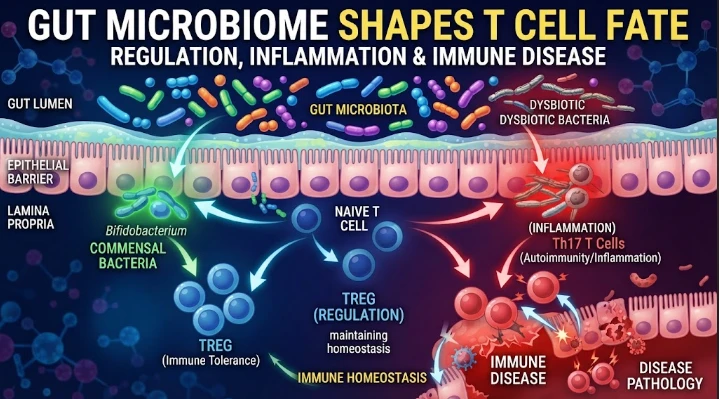
The gut microbiome is not just by the immune system. Following activation, microbial communities provide antigens, metabolites, and tissue signals that determine the developmental pathway of the activated, or naive, T cell. This cell choice can give rise to cells with inflammatory, regulatory, follicular helper, or mixed phenotypes with context-dependent functions. Therefore, immune disease can occur if microbial composition or local tissue state or both are skewed from the T cell programs that they are able to support.
One classic example was the segmented filamentous bacteria of mice. This commensal gut bacterium, which is highly adhesive, strongly facilitates differentiation of T helper 17 cells in the small intestine. The effect is not one that is general to the abundance of bacteria. Physical contact with the epithelium, the presentation of antigens in the vicinity and cytokine signals provide a niche that promotes a specific T cell program. This type of experimentation defined the parameter of composition as a teachable parameter and not a passive indicator of a state of immunity.
The role of microbes is not just limited to inflammatory differentiation. Clostridia strains have been selected that can expand colonic regulatory T cells, demonstrating a opposing pathway of tolerance. The short-chain fatty acids generated during fermentation, particularly butyrate, may be beneficial for regulatory programs via metabolic and epigenetic pathways. These results elucidate an important principle: a change in the balance between inflammatory and regulatory cell states can be achieved by different microbial consortia without altering the host genome.
There is an additional layer of antigen specificity. Microbial replacement has the potential to change the specific set of clones that are stimulated, as commensal antigens are often recognized by intestinal T cells. One community may favor another repertoire over another community which is also enriched for organisms carrying this other repertoire. This implies that the nature of the responding T cells and their transcriptional states once they are activated may vary depending on their composition.
T cell fate is also more malleable than is portrayed in older textbooks. Commensal-specific T helper 17 cells may have regulatory properties such as anti-inflammatory transcriptional attributes and production of the anti-inflammatory molecule, interleukin 10, under specific conditions. The biological function of a cytokine labeled cell may not be entirely predictable. The function can be changed after the initial differentiation decision, due to the tissue environment, repeated stimulation, metabolism, and neighboring immune cells.
Barrier tissues give the context to those decisions. Intestinal epithelial cells detect microbes, respond by secreting antimicrobial molecules and by interacting with dendritic cells, and with innate lymphoid cells. Dendritic cells then combine microbial products with local cytokines, before presenting antigen to T cells. The response elicited is not a one microbe to one T cell pathway but rather a network response. Any disruption to a node can redirect the final immune state.
Immune disease adds to this network. Microbiome differences have been repeatedly reported in inflammatory bowel disease, arthritis, psoriasis and several other immune mediated diseases, but association does not mean causation. Inflammation alters nutrient availability, epithelial permeability, production of antimicrobial peptides, and oxygen tension. The changes can shape the makeup of the microbes, and the resulting immune activation and dysbiosis can worsen the other.
A better method to test causality is by prospective immune phenotyping. A pre- and in-flare and post-treatment sampling may be conducted to determine if there are microbial shifts that precede the T cell states or follow. Single cell transcriptomics can be used to identify responding subsets of T cells and paired receptor sequencing can be used to identify and follow clonotypes over time. Metagenomics can be used to determine strain level changes and metabolomics to determine if functional products change with taxonomic composition.
Important because general cell counts might not detect the relevant biology, antigen specific assays are needed. It is possible for two individuals to have the same proportion of T helper 17 cells, yet to recognize completely different antigens. The tetramer based assays, activation induced marker tests and controlled stimulation with microbial antigens can distinguish which clones respond to which organisms. Sequencing data can then be connected to these responses, resulting in a testable immune mechanism.
This spatial profiling can refine the interpretation further. Stool sequencing is a reflection of microbes from many locations in the gut; immune education takes place in unique sites. The effect of organisms on the ileal epithelium may be different than that of organisms in the colonic lumen. For example, while the abundance of fecal microbes may reflect the entire ecosystem, biopsy-based microbial mapping, spatial transcriptomics, and imaging technologies can link local organisms to microbes that are in close proximity to antigen presenting cells and the state of the T cell.
The most convincing evidence of an instructive relationship is a perturbation. In experimental systems, defined microbial consortia, depletion or metabolite supplementation, or controlled colonization can ask whether changing the composition alters the direction of T cell differentiation. Observational cohorts may be supplemented with human tissue models or organoid immune co-cultures for additional translational relevance while maintaining more biological control. Results that are replicated across animal models, in human cells, and in prospective cohorts have a significant causal value.
Host genetics remains important. Changes in barrier function, antigen presentation, cytokine signaling, or innate sensing can impact the interpretation of the same microbiome. Tolerogenic microflora can cause inflammation in a different genetic background. Thus, universal lists of beneficial and harmful organisms are not sufficient for precision immunology, but need interaction models instead. The effects of microbiota should be assessed in relation to host genotype, drug exposure, diet, and disease stage and age.
A system can also be reshaped with treatment. Changes in microbial ecology or immune pressure, in some cases multiple, are achieved by antibiotics, biologic drugs, corticosteroids, and dietary changes. A post-treatment microbiome might appear healthier because of the reduction in inflammation, rather than due to microbial change leading to remission. When mediator and consequence of intervention are tracked in parallel as T cell clonotypes and functional state, repeated measurements before and after intervention can help distinguish mediator from consequence.
By also examining microbial products, human translation can be aided, not just organisms. Secondary bile acids have the ability to affect the differentiation of T cells via nuclear receptors and tryptophan metabolites via the aryl hydrocarbon receptor. These chemical pathways are appealing because they can share a common metabolite and thus multiple microbial communities can converge on the same pathway. This functional signal is then a "reproducible", and can therefore be used as a more reliable basis for intervening even if there are taxonomic differences between populations.
Diet is also a part of the causal chain. Changes in microbial metabolism and fermentation substrates due to fiber, fat, protein and micronutrient availability. One microbe does not necessarily equal one diet associated T cell effect. Controlled feeding studies can be used to differentiate dietary effects on immunity from microbial effects.
Clinical prediction should be geared towards transitions, rather than labels. A microbiome T-cell signature may be utilized to predict flare, response to biologic therapy or loss of tolerance. Performance should be evaluated on the basis of prospective assessments and predetermined thresholds. A signature that distinguishes disease from health does not necessarily foretell the future.
Mechanistic evidence also needs to be able to tell us whether the bacteria are necessary or sufficient. A removal of one organism can be a test of necessity within a defined community, and an addition of the same organism to another community can be a test of sufficiency. Context dependent results are informative as they inform about ecological interactions rather than falsifying the original mechanism.
Therefore, a robust causal conclusion requires a simultaneous association of all four components of the elements of ecology, antigen specificity, cell state, and functional perturbation, rather than one component association.
The best paradigm thus far is to see the fate of a T cell as an evolving consequence of the antigens encountered, the tissue where they interact, and the host's susceptibility. Dan R. Littman's research interests in T cell differentiation, microbiome biology, and immune regulation are aligned with this systems perspective. To advance future progress, links should be established between named organisms and antigen specific cell states and whether that relationship stays over time and tissues. Only when a mechanism is proposed to explain the change of a microbiome to a permanent immune decision does it become clinically relevant.
CITE THIS ARTICLE
Tasneem, S. (2025). T Cell Fate Regulation through Microbiome Composition in Immune Disease. https://www.sadiaresearchhub.com/article/1e4d0050-6cfd-5966-9c7d-499c2c048471
S. Tasneem, “T Cell Fate Regulation through Microbiome Composition in Immune Disease,” 2025. [Online]. Available: https://www.sadiaresearchhub.com/article/1e4d0050-6cfd-5966-9c7d-499c2c048471
Tasneem, S. (2025) ‘T Cell Fate Regulation through Microbiome Composition in Immune Disease’. Available at: https://www.sadiaresearchhub.com/article/1e4d0050-6cfd-5966-9c7d-499c2c048471
Tasneem, Sadia. “T Cell Fate Regulation through Microbiome Composition in Immune Disease.” 2025, https://www.sadiaresearchhub.com/article/1e4d0050-6cfd-5966-9c7d-499c2c048471.
Sadia Tasneem. “T Cell Fate Regulation through Microbiome Composition in Immune Disease.” (2025). https://www.sadiaresearchhub.com/article/1e4d0050-6cfd-5966-9c7d-499c2c048471.
Tasneem S. T Cell Fate Regulation through Microbiome Composition in Immune Disease. 2025. https://www.sadiaresearchhub.com/article/1e4d0050-6cfd-5966-9c7d-499c2c048471
@misc{article_1e4d00506cfd59669c7d499c2c048471,
  title = {T Cell Fate Regulation through Microbiome Composition in Immune Disease},
  author = {Sadia Tasneem},
  year = {2025},
  url = {https://www.sadiaresearchhub.com/article/1e4d0050-6cfd-5966-9c7d-499c2c048471},
}
TY  - GEN
AU  - Sadia Tasneem
TI  - T Cell Fate Regulation through Microbiome Composition in Immune Disease
PY  - 2025-08-24
UR  - https://www.sadiaresearchhub.com/article/1e4d0050-6cfd-5966-9c7d-499c2c048471
ER  -
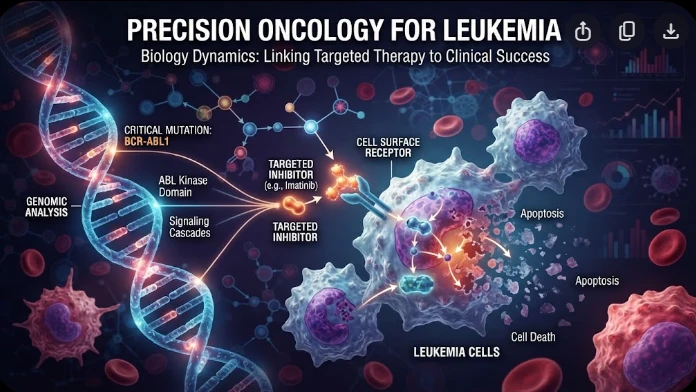
The article examines leukemia as an evolving population under targeted therapy, using chronic myeloid leukemia as the main example. BCR–ABL1 inhibition can produce deep responses, but every treatment changes the competitive environment among malignant clones. Quantitative transcript monitoring provides a continuous measure of disease burden, while deep sequencing can identify emerging resistance mechanisms before hematologic progression. A detected mutation is clinically meaningful only when its
The article examines how cardiovascular genetic risk becomes biologically active through cell-specific inflammatory signaling. Because many vascular-risk variants lie in regulatory DNA rather than coding regions, their effects may appear only in particular endothelial, macrophage, smooth-muscle, or lymphocyte states. Single-cell studies of human atherosclerotic lesions and multiomic endothelial experiments are used to illustrate this context dependence. The article also discusses IL6-related sig
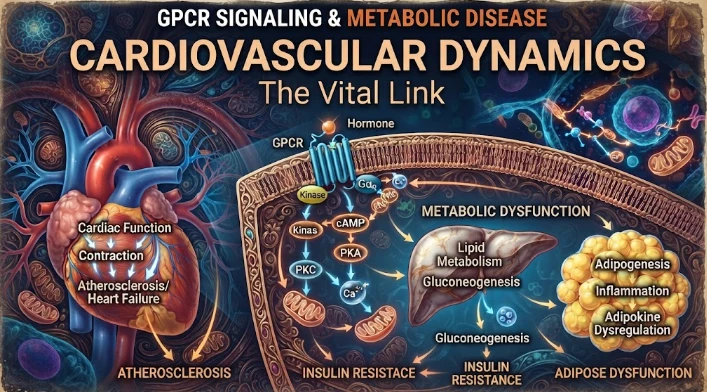
The article examines cardiovascular GPCR signaling as a dynamic response system whose abnormalities can remain hidden in resting measurements. Mechanical stretch, hormones, nutrients, sympathetic activity, and fluid balance can change the amplitude, duration, localization, and recovery of receptor signaling. Examples include mechanically activated angiotensin-receptor signaling, endosomal signaling, beta-arrestin-dependent trafficking, and biased glucagon-like peptide-one receptor responses. The