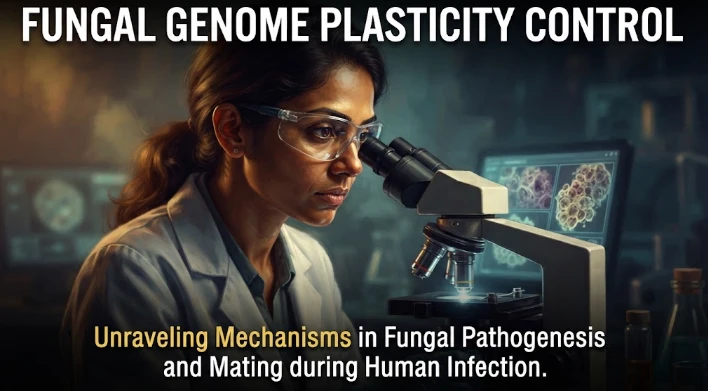
The article explains fungal genome plasticity as a controlled source of adaptation during human infection. Candida albicans can shift among diploid, tetraploid, aneuploid, and haploid states, while mating, parasexual chromosome loss, recombination, and loss of heterozygosity generate additional diversity. These mechanisms can rapidly change gene dosage, reveal recessive traits, and create phenotypes affecting stress tolerance, antifungal susceptibility, immune recognition, and tissue fitness. Host environments and drug exposure then select among the available genomic states, so diversity generation and selection are treated as separate but connected processes. The article proposes longitudinal sequencing of serial clinical isolates to track copy-number changes, ploidy, heterozygosity, and structural variation alongside treatment and immune recovery. Functional validation through isogenic reconstruction, competition assays, and infection models is emphasized because many genomic changes may be passengers. Overall, genome plasticity is presented as an evolutionary search space that can accelerate adaptation and treatment failure.
Controlling genome instability is seen as a prerequisite for cellular fitness, however, pathogenic fungi can harness controlled instability. Candida albicans has developed several mechanisms for generating variation, including changes in the number of copies of its chromosomes, loss of heterozygosity, shifts in ploidy, recombination and parasexual genome reduction. Fungal mating extends that flexibility, by producing high ploidy intermediates and new combinations of alleles. In humans, the genomic states that persist in infection and are cured constitute a plastic resource.
The genome of C. albicans typically exists in a diploid state, but can also be tetraploid or aneuploid and even haploid. The classic meiosis is not known to be the primary pathway of sexual reproduction. Rather, a mating may result in the formation of tetraploids which may revert to a lower ploidy level by chromosome loss. The resulting progeny may have an unusual chromosome combination, changing the dosage of genes, and thus uncovering new phenotypes.
Another significant mechanism is loss of heterozygosity. There are many loci where both copies of the alleles are present in a single diploid cell, giving a degree of redundancy and hiding some recessive variants. One allele may be removed and the other duplicated due to recombination or chromosome events. That alteration may uncover latent characteristics such as stress resistance, nutrient utilization, immune responses, or the sensitivity to fungi. There is thus no need for a new point mutation to change the phenotype in the case of genome plasticity.
When an extra chromosome is present, it acts quickly under stress, as it will alter the expression of many genes. These wide dosage responses tend to have fitness costs under normal circumstances, but not during exposure to antifungals. Multiple copies of genes that enhance resistance to drugs offer an instant benefit when the genes are on a chromosome. The response may be further improved by more mutations or changes in the chromosomes, in an adaptation that may follow.
Any mating will expand the number of paths to one of these states. Phenotypic switching results in compatible cells fusing and producing a tetraploid product that has an increased genetic load. A loss of the chromosomes that is parasexual can then result in the formation of many different descendants. This process of recombination produces combinations that are not possible by simple clonal mutation. One reproductive event can thus generate a population with several genomic experiments to be subjected to selection.
Studies of parameiosis indicated that C. albicans has the ability to produce recombination and genome reduction in a manner that is different from canonical meiosis. This extends the idea of sexual diversity of a once asexual pathogen. It is the evolutionary outcome rather than the label that is important - new environmental conditions may cause a reshuffle of the genetic information to alter the fitness of the population so quickly that the label, mating, and genome reduction do not adequately describe the evolutionary result.
Haploid strains are more flexible. Haploids may be maintained in the laboratory, are mated with high efficiency and can be propagated to higher ploidy. Recessive effects are first apparent to selection, as only a single allele copy is present. Haploidy can thus reveal genetic variation which isn't apparent in diploidy. The capacity for this tolerance indicates that ploidy is a variable in Candida biology.
That variation is subject to selective landscapes in host environments. The temperature, oxygen, carbon sources, pH, metal availability, immune activity and microbial competition vary among anatomical sites. It can be expensive to be a geneticist in the blood stream. Pathogenesis is thus locally selective, with fungal subpopulations evolving under various selective pressures within a single patient.
Increased selection with antifungal treatment. Aneuploid states, changes in the dosage of transporters, modulation of stress response, or other genomic configurations that allow survival can occur in the presence of drugs. After drug pressure is eliminated, expensive states of the chromosomes can either vanish or survive, depending upon the state of compensatory adaptation. These serial isolates can capture those transitions and give clues as to whether treatment failures are due to stable resistance or whether they are due to reversible genomic plasticity.
The process can be modified by immune pressure. Alteration in cell wall genes, secreted factors, metabolic pathways and stress regulators may alter the ability to be recognized or survive in phagocytes. Multiple of these systems can be modified simultaneously by genome rearrangement. Even if the genomic configuration is less competitive in the outside world, a lineage can survive immune attack and expand.
The control of plasticity is not accomplished by a single master regulator. The likelihood of genome change is regulated by DNA repair pathways, chromosome segregation, stress checkpoints, recombination machinery, cell cycle control and mating programs. The variants that remain are then dependent on environmental stress. The following is a useful model: generation of diversity and selection of diversity. Both mechanisms help to generate the pathogenic phenotype.
A direct study of this separation is feasible using longitudinal sequencing. Single nucleotide changes, loss of heterozygosity, copy number variation, ploidy and chromosome structure can be analyzed in serial isolates from infection. The time can be correlated with drug exposure, immune recovery, anatomical movement and clinical response. Genomic pathways that are repeatedly selected by the same pressures can be detected through recurrent changes across independent patients.
Functional validation is imperative as a lot of rearrangements may be passengers. The chromosome copy change, or allelic loss can be isogenically replicated, and then challenged with antifungal, immune and host-like conditions. Relative fitness can be measured by competition experiments. The effects of infection models on dissemination, tissue burden, and treatment response are determined. These tests link plasticity directly to pathogenesis vs. assuming that all genomic changes are adaptive.
The genome plasticity can be expressed numerically, not just qualitatively. Definable stress conditions can be used to measure rates of chromosome loss, copy number change and loss of heterozygosity. Those rates can be compared to other strains to find backgrounds which have an unusually high adaptive potential. An evolved strain which is able to create diversity quickly may be a different treatment problem from an evolved strain which has the same basic susceptibility but a less flexible evolutionary history.
Epigenetic alterations can affect differential survival of genomic variants. The chromatin state regulates DNA repair, DNA recombination, and duplicated gene expression, which could help smoothen or aggravate the impact of aneuploidy. Combining chromatin profiling with genome sequencing may reveal the mechanisms underlying the phenotypic differences of the same change in the same chromosome across different lineages. When predicting the consequence of copy number variation, such context is crucial.
Rare events can be amplified when population bottlenecks occur within an infection. Dissemination to a new organ may be limited to a subset of fungal cells, with an unusual genotype getting the upper hand by chance and local selection getting under way. Bottlenecks in each of the stages of tissue spread can then have an interaction with mating generated diversity. The reconstruction of the phylogenetic landscape across organs may be useful to determine whether selection and founder effects are responsible for the rapid expansion of a new genomic state.
Markers of instability could be eventually incorporated in clinical surveillance. Increased aneuploidy, recurrent LOH around resistance genes or increased ploidy variation during treatment may indicate higher adaptive risk even prior to the emergence of a resistant phenotype. This would necessitate a uniform sequencing depth and thresholds that have been established. To not predict evolution exactly, but to identify infections where the genomic search space is growing under treatment pressure.
Even though the killing of fungi by treatment sequences may seem equivalent in terms of short-term effects, it may affect genomic evolution in different ways. A very strong population bottlenecking drug will cause a loss of diversity, and another will leave a larger number of survivors from which chromosome variants will be generated. Combination therapy can limit or focus that search space. Thus, comparisons of evolutionary outcomes should be made after repeated exposure, rather than minimum inhibitory concentrations upon a single encounter.
This evolutionary approach is not new to susceptibility and instead of asking simply if a strain is susceptible to a certain therapy, asks whether its genome can readily adapt the next step in response to the pressure of continued therapy.
Thus, the genome plasticity of fungi is best understood as a range of genome states that are tightly controlled, not as a mere instability. Diversity is provided by mating, parasexual recombination, chromosome loss, aneuploidy, haploidy, and loss of heterozygosity and human infection provides the selection that makes some variants clinically important. The two sides of that process can be mapped and account for the rapid adaptation and failure of treatment. It also detects genomic shifts that may herald new resistance before detectable resistance occurs, and can therefore be used as markers of emerging resistance.
CITE THIS ARTICLE
Tasmeem, S. (2026). Fungal Genome Plasticity Control through Fungal Pathogenesis and Fungal Mating in Human Infection. https://www.sadiaresearchhub.com/article/22f137aa-5dbf-5f57-9d41-582f7a1b9f76
S. Tasmeem, “Fungal Genome Plasticity Control through Fungal Pathogenesis and Fungal Mating in Human Infection,” 2026. [Online]. Available: https://www.sadiaresearchhub.com/article/22f137aa-5dbf-5f57-9d41-582f7a1b9f76
Tasmeem, S. (2026) ‘Fungal Genome Plasticity Control through Fungal Pathogenesis and Fungal Mating in Human Infection’. Available at: https://www.sadiaresearchhub.com/article/22f137aa-5dbf-5f57-9d41-582f7a1b9f76
Tasmeem, Sadia. “Fungal Genome Plasticity Control through Fungal Pathogenesis and Fungal Mating in Human Infection.” 2026, https://www.sadiaresearchhub.com/article/22f137aa-5dbf-5f57-9d41-582f7a1b9f76.
Sadia Tasmeem. “Fungal Genome Plasticity Control through Fungal Pathogenesis and Fungal Mating in Human Infection.” (2026). https://www.sadiaresearchhub.com/article/22f137aa-5dbf-5f57-9d41-582f7a1b9f76.
Tasmeem S. Fungal Genome Plasticity Control through Fungal Pathogenesis and Fungal Mating in Human Infection. 2026. https://www.sadiaresearchhub.com/article/22f137aa-5dbf-5f57-9d41-582f7a1b9f76
@misc{article_22f137aa5dbf5f579d41582f7a1b9f76,
  title = {Fungal Genome Plasticity Control through Fungal Pathogenesis and Fungal Mating in Human Infection},
  author = {Sadia Tasmeem},
  year = {2026},
  url = {https://www.sadiaresearchhub.com/article/22f137aa-5dbf-5f57-9d41-582f7a1b9f76},
}
TY  - GEN
AU  - Sadia Tasmeem
TI  - Fungal Genome Plasticity Control through Fungal Pathogenesis and Fungal Mating in Human Infection
PY  - 2026-05-10
UR  - https://www.sadiaresearchhub.com/article/22f137aa-5dbf-5f57-9d41-582f7a1b9f76
ER  -
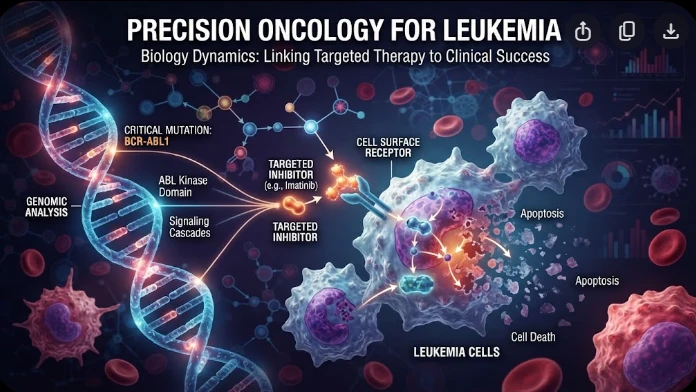
The article examines leukemia as an evolving population under targeted therapy, using chronic myeloid leukemia as the main example. BCR–ABL1 inhibition can produce deep responses, but every treatment changes the competitive environment among malignant clones. Quantitative transcript monitoring provides a continuous measure of disease burden, while deep sequencing can identify emerging resistance mechanisms before hematologic progression. A detected mutation is clinically meaningful only when its
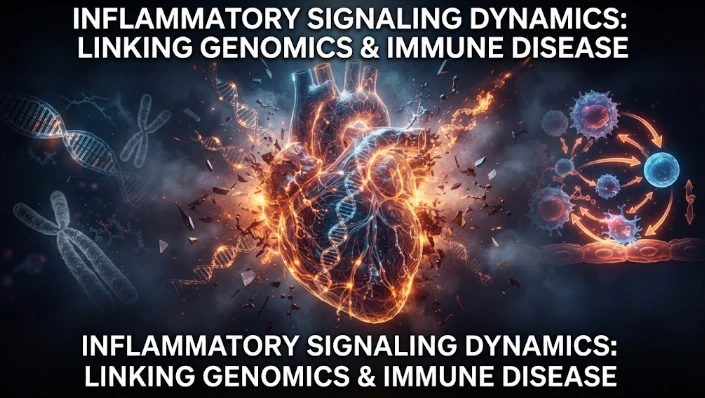
The article examines how cardiovascular genetic risk becomes biologically active through cell-specific inflammatory signaling. Because many vascular-risk variants lie in regulatory DNA rather than coding regions, their effects may appear only in particular endothelial, macrophage, smooth-muscle, or lymphocyte states. Single-cell studies of human atherosclerotic lesions and multiomic endothelial experiments are used to illustrate this context dependence. The article also discusses IL6-related sig
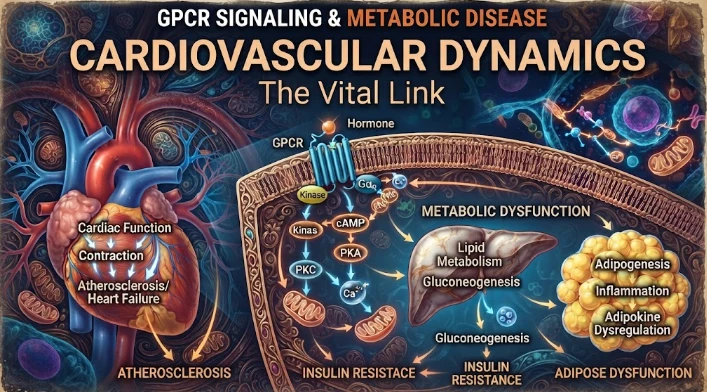
The article examines cardiovascular GPCR signaling as a dynamic response system whose abnormalities can remain hidden in resting measurements. Mechanical stretch, hormones, nutrients, sympathetic activity, and fluid balance can change the amplitude, duration, localization, and recovery of receptor signaling. Examples include mechanically activated angiotensin-receptor signaling, endosomal signaling, beta-arrestin-dependent trafficking, and biased glucagon-like peptide-one receptor responses. The