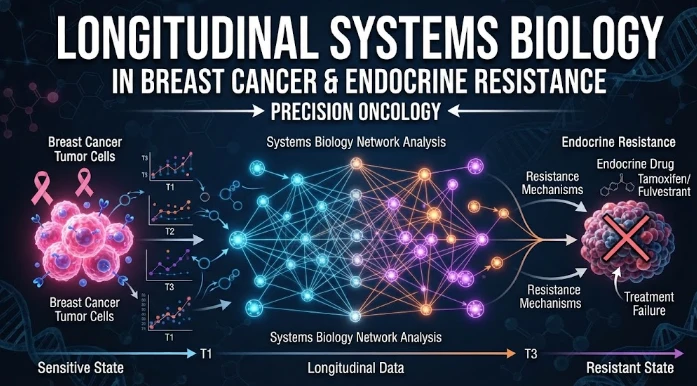
The article describes endocrine-resistant breast cancer through longitudinal systems-biology networks rather than isolated resistance genes. Estrogen-receptor signaling depends on chromatin accessibility, cofactors, enhancer contacts, metabolic pathways, cell-cycle programs, and microenvironmental signals, all of which can be rewired under therapy. CoREST- and AP1-associated chromatin changes and large integrated estrogen-response resources illustrate how regulatory relationships vary across models and conditions. Serial patient sampling adds the time dimension needed to separate early adaptation, transient stress, stable reprogramming, and progression. Functional-genomic screens can identify dependencies unique to resistant states, while organoids, xenografts, and coculture systems test whether those dependencies persist in patient-relevant environments. The article emphasizes treatment-specific networks, metabolic–transcriptional coupling, single-cell resistance modules, external replication, and clinically practical reduced signatures. Causality requires perturbation, not connectivity alone. Ultimately, the most valuable network is one whose transition can be reproducibly altered by a defined intervention that changes resistant behavior.
a consequence of interactions between receptors, transcription factors, chromatin regulators, metabolic pathways, cell cycle mechanisms and the tumour microenvironment. Systems biology considers those interactions as a network, instead of individual changes. While a lot of the components of a longitudinal network may remain unchanged, its shape can still vary. Precision oncology therefore requires the ability to find reconfigured regulatory relationships during treatment, and to identify network nodes that are required for survival.
Estrogen receptor signaling is a networkable process. The binding of receptors is related to the chromatin accessibility, pioneer factors, cofactors, enhancer contacts, and cellular signaling. Endocrine therapy disrupts that system and can send the signal off in alternate directions via alternate regulators. One transcription factor can modify the activity of hundreds of loci. A coordinated movement that single gene thresholds fail to capture can be captured by network analysis, particularly when resistance is generated by plasticity, not by a dominant mutation.
One example is the associated chromatin reprogramming by coREST. In experimental studies using endocrine resistant models redistribution of regulatory activity to AP1 associated sites and involvement of chromatin remodeling machinery was observed. This change would be significant because it would alter a gene's responsiveness without altering the sequence of the gene at each locus. While each of these is considered as a distinct biomarker, they can all be encompassed by a single regulatory transition in a network model.
Improved network inference with large multiomic resources. EstroGene2.0 brought together hundreds of estrogen receptor related experiments from many different studies and cell models, allowing for comparison of transcriptional, genomic and epigenomic responses. The resource also shows heterogeneity, that is, the estrogen signaling is not identical in all cell lines or experimental conditions. Indeed, it is important for systems models to learn conserved relationships while preserving context specific edges, instead of building one universal endocrine network.
Longitudinal Patient Sampling: a dimension which is not included in experimental atlases. These modules can be seen to change first in tissue and blood before, during and after therapy and at progression. A pathway that is not triggered until progress has been made may be a consequence, and one that changes as part of early response may be an adaptation pathway. Serial measurements are particularly useful in identifying the transient stress responses from stable reprogramming that enhances resistance to growth.
Functional genomics translates network inference to causal testing. Network analysis can identify potential drivers for disruption by individual or multiple CRISPR screens. A high node connectivity value does not necessarily mean a therapeutic target as connectivity can also be indicative of correlation. The information provided by essentiality under endocrine pressure is more informative. Direct comparisons of screenings in untreated and resistant cells can reveal dependencies that are unique to adaptation, which could be a path towards synthetic lethal combinations.
Patient-specific drug response can be maintained in an organoid system compared to conventional monolayer systems. Multiple tumor types can be generated into organoids to be profiled and treated with endocrine agents and candidate network inhibitors. A functional test is provided by the concordance of predicted network state and drug response. Failure is also informative, as failure signifies the absence of biology, such as stromal signaling or immune interactions that were not included in the organoid system.
Those missing things can be added by using co culture and patient derived xenograft models. Growth factors can be provided by fibroblasts, cytokines can be modified by immune cells, and ECM can modify receptor activity. The network dependency that is seen with a single isolated cell can be lost in a more comprehensive environment. Multimodel validation can thus be useful in differentiating between cell intrinsic mechanisms and dependencies on a specific microenvironment.
The problem of overfitting is a serious one in high dimensional networks and is why independent cohort replication is important for systems models. A model may be a good fit for one set of data and be poor for another set in another lab or treatment group. Network edges, module scores and predicted drug sensitivities should be fixed prior to external testing. Consistency is enhanced if the same core module can forecast resistance across platforms despite small variations in individual gene measurements.The more consistent the same core module is at predicting resistance across platforms, even in the face of minor variations in individual gene measurements, the more reproducible.
There should be also treatment specific networks. Aromatase inhibitors, receptor degraders, and with cell cycle inhibitors, exert different pressures. A module that is related to the resistance to estrogen deprivation can be different from a module that will emerge after receptor degradation. All the endocrine therapies can make these differences difficult to distinguish. Stratified analysis reveals common core adaptations and therapy specific branches, which can aid in more precise therapy sequencing.
Metabolic networks may intersect with the transcriptional networks. Resistant cells have the potential to modulate fatty acid oxidation or oxidative phosphorylation, which can constitute feedback loops between nutrient state and chromatin regulation. Metabolites may affect enzyme activity and stress response, and transcription factors act on metabolic genes. The combination of metabolomics with RNA and chromatin data can reveal coupled modules, which would not be apparent in a transcript only model.
Network medicine also alters the selection of biomarkers. A biomarker can be the activity of a pathway as a whole rather than the activity of the most important gene. Module scores can be more robust to noise if several components move together. There is still a need for simplicity in clinical use. One can only reduce the assay to a smaller panel after demonstrating that the reduced panel maintains prediction and calibration in external cohorts.
The most difficult problem is temporal causality. Network inference can suggest direction, but due to feedback loops there is uncertainty in the direction observed. If more than one regulator is perturbed at the same time, it can be seen whether one regulator is driving the other or if both are responding to a third signal. Early perturbation can test for prevention of resistance and late perturbation can test for dependency after resistance has been achieved. Other results would imply a transition driver that is not a dependency to maintain.
Clinical translation should be used to link network state with outcome and treatment benefit. The resistant module may be prognostic, but not predictive of benefit from a target combination. Trials should thus assess biomarker by treatment interactions, and confirm pharmacodynamic inhibition of the target network. Also toxicity is an issue: highly connected nodes can control normal cell functions. The resistant state is more appealing than universally required regulators because of selective dependencies created by it.
The design of a combination may be directed by the network topology. Blocking a compensatory escape with two drugs working on parallel routes can be more effective than blocking with two drugs working on the same route, and blocking a feedback loop can prevent rebound signaling. Combinations can be ranked through computational simulation, but there will need to be experimental testing as network edges are subject to change in the face of drug pressure. Sequential perturbation is very informative, as it shows if blocking one node unveils a new dependency that was not observed at baseline.
Single cell network inference can capture population sizes that are neglected by bulk data. A few percent of cells, a subclone resistant to the drug, may harbor a regulatory module that is of great importance in the future. Monitoring this module throughout treatment can reveal that it does not go away, stays present or grows. If coupled with regulatory state, clonotype/genomic identity can be used to distinguish a rare clone from a reversible state represented by many clones, thereby directly affecting the choice of treatment to target the lineage or the pathway.
Any network that is usefully clinical should be testable. Prospective testing can be done to see if a pathway is going to be activated next, if a perturbation will make a pathway more or less sensitive, or if a biomarker will change after treatment. All predictions should be based on the model, not just the successful ones, and if a prediction fails, the model should be revised, not selective reporting of the successful predictions. This is an iterative process, making systems biology more than visualization. Repeated predictions, perturbations, and external repetitions make the network a credible working causal model.
Longitudinal network analysis is a natural precision oncology strategy and is a passion of Robert Clarke's work related to breast cancer, endocrine resistance and systems biology. Multiomic observation can identify evolving modules, functional genomics can determine causal relationships, and organoid or patient derived models can assess the therapeutic implications. Then, external replication decides if the network goes beyond one system. A denser map of resistance is not the strongest result, it is a network transition that could be reproduced with a particular intervention aimed at altering resistant behavior.
CITE THIS ARTICLE
Tasmeem, S. (2025). Longitudinal Systems Biology Network Roles in Precision Oncology through Breast Cancer and Endocrine Resistance. https://www.sadiaresearchhub.com/article/57b41dab-739e-57fb-b4c4-b5865d69d077
S. Tasmeem, “Longitudinal Systems Biology Network Roles in Precision Oncology through Breast Cancer and Endocrine Resistance,” 2025. [Online]. Available: https://www.sadiaresearchhub.com/article/57b41dab-739e-57fb-b4c4-b5865d69d077
Tasmeem, S. (2025) ‘Longitudinal Systems Biology Network Roles in Precision Oncology through Breast Cancer and Endocrine Resistance’. Available at: https://www.sadiaresearchhub.com/article/57b41dab-739e-57fb-b4c4-b5865d69d077
Tasmeem, Sadia. “Longitudinal Systems Biology Network Roles in Precision Oncology through Breast Cancer and Endocrine Resistance.” 2025, https://www.sadiaresearchhub.com/article/57b41dab-739e-57fb-b4c4-b5865d69d077.
Sadia Tasmeem. “Longitudinal Systems Biology Network Roles in Precision Oncology through Breast Cancer and Endocrine Resistance.” (2025). https://www.sadiaresearchhub.com/article/57b41dab-739e-57fb-b4c4-b5865d69d077.
Tasmeem S. Longitudinal Systems Biology Network Roles in Precision Oncology through Breast Cancer and Endocrine Resistance. 2025. https://www.sadiaresearchhub.com/article/57b41dab-739e-57fb-b4c4-b5865d69d077
@misc{article_57b41dab739e57fbb4c4b5865d69d077,
  title = {Longitudinal Systems Biology Network Roles in Precision Oncology through Breast Cancer and Endocrine Resistance},
  author = {Sadia Tasmeem},
  year = {2025},
  url = {https://www.sadiaresearchhub.com/article/57b41dab-739e-57fb-b4c4-b5865d69d077},
}
TY  - GEN
AU  - Sadia Tasmeem
TI  - Longitudinal Systems Biology Network Roles in Precision Oncology through Breast Cancer and Endocrine Resistance
PY  - 2025-12-14
UR  - https://www.sadiaresearchhub.com/article/57b41dab-739e-57fb-b4c4-b5865d69d077
ER  -
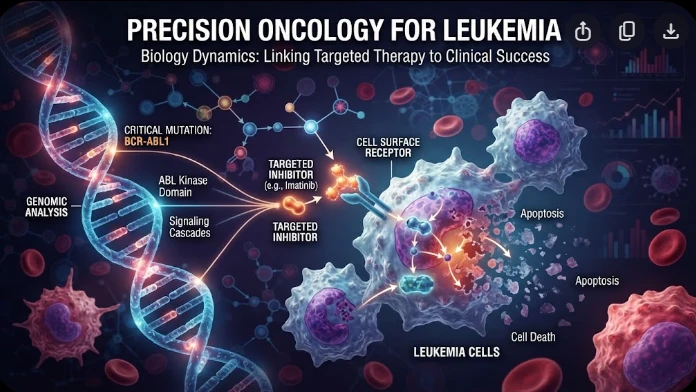
The article examines leukemia as an evolving population under targeted therapy, using chronic myeloid leukemia as the main example. BCR–ABL1 inhibition can produce deep responses, but every treatment changes the competitive environment among malignant clones. Quantitative transcript monitoring provides a continuous measure of disease burden, while deep sequencing can identify emerging resistance mechanisms before hematologic progression. A detected mutation is clinically meaningful only when its
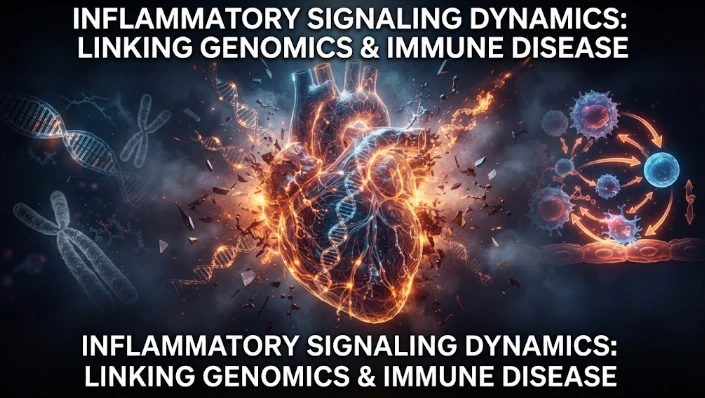
The article examines how cardiovascular genetic risk becomes biologically active through cell-specific inflammatory signaling. Because many vascular-risk variants lie in regulatory DNA rather than coding regions, their effects may appear only in particular endothelial, macrophage, smooth-muscle, or lymphocyte states. Single-cell studies of human atherosclerotic lesions and multiomic endothelial experiments are used to illustrate this context dependence. The article also discusses IL6-related sig
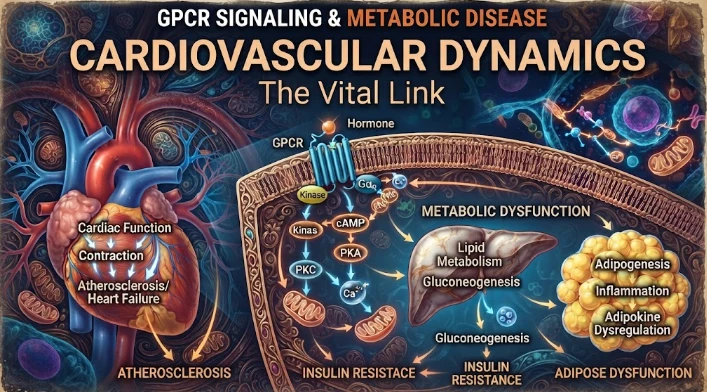
The article examines cardiovascular GPCR signaling as a dynamic response system whose abnormalities can remain hidden in resting measurements. Mechanical stretch, hormones, nutrients, sympathetic activity, and fluid balance can change the amplitude, duration, localization, and recovery of receptor signaling. Examples include mechanically activated angiotensin-receptor signaling, endosomal signaling, beta-arrestin-dependent trafficking, and biased glucagon-like peptide-one receptor responses. The