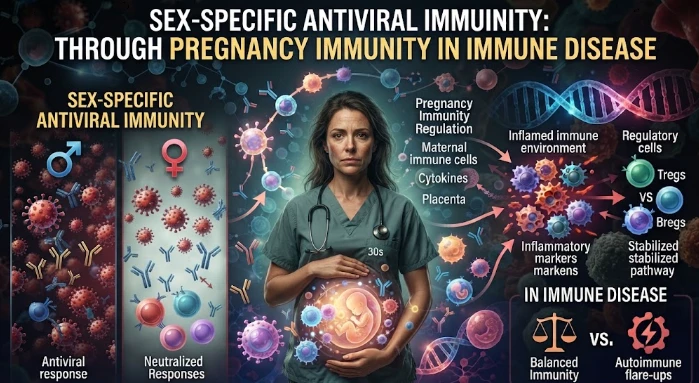
The article examines sex-specific antiviral immunity and the additional regulatory changes introduced by pregnancy. It describes how interferon signaling, antibodies, T-cell responses, sex chromosomes, hormones, age, and immune-cell composition can create biological differences in antiviral defense. Pregnancy is treated as a changing immune state rather than a uniform period because endocrine, placental, and maternal immune conditions vary across gestation. Studies of respiratory-virus responses and SARS-CoV-2 are used to illustrate sex-related innate immunity and possible fetal-sex effects on placental interferon programs and antibody transfer. The article recommends prospective maternal immune profiling, single-cell multiomics, antigen-specific antibody and T-cell assays, placental and cord-blood analysis, and carefully timed vaccination studies. Hormonal and genetic mechanisms require experimental testing. Clinical endpoints should separate antiviral control from inflammatory injury. Overall, the article argues for mechanism-based, longitudinal analysis of sex, gestational timing, placental function, and fetal context rather than simple binary comparisons.
Sex based antiviral immunity is apparent in numerous infections, and mechanisms are complex. Interferon signaling, antibody production and T cell responses can be affected by sex chromosomes, gonadal hormones, age, prior exposure, metabolism, and immune cell composition. Pregnancy brings another regulatory state where maternal immunity must regulate infection in the face of fetal tolerance and placental function. It would thus be useful to take on board the differences between biological sex effects and gestational adaptation to pregnancy, and not consider pregnancy as a single form of immune modulation.
The innate antiviral signaling is a first hit differentiator. A birth cohort study assessing interferon related responses to respiratory viruses and innate stimuli reported decreased interferon related responses in male infants compared to female infants for several challenges, with males having increased hospitalisation for respiratory infection. The study indicates that sex related variation is present before decades of behavioral exposure, suggesting that there is a biological contribution to antiviral defense in infancy.
Further outcome may also be influenced by the immune state at the time of infection. Prior to infection, studies of SARS-CoV-2 revealed sex differences in the antiviral innate immune response that were linked to the subsequent immune response. This is significant because the measurement can only post-dating infection lead to the confusion of cause and effect. A robust interferon program during baseline may help to lower viral load, and it may also be important for markers of inflammation to be higher during severe infection in complex ways.
The changes during pregnancy alter that base line. Hormonal levels vary greatly throughout gestation and placental tissue secretes cytokines and growth factors, while maternal immune cell populations undergo changes throughout the process. These changes do not happen at a steady rate throughout the first trimester to delivery. The time of pregnancy should then be recorded exactly in antiviral studies and all of the pregnancy samples should not be combined into one group.
The placenta is an immunocompetent organ. It modulates maternal fetal exchange, has antiviral sensing functions, and regulates transport of antibodies. Mother-to-fetus transmission of SARS-CoV-2 infection has been shown to be related to placental immune responses, which are reported to vary between male and female fetuses, such as interferon stimulated genes and the transfer of antibodies. In one study, it was found that fewer selected virus antibodies were transferred to pregnancies of male fetuses. The immune environment at the maternal fetal interface may then be modulated by fetal sex.
The fetal sex effect does not occur in every infection; it just means that it occurs in some. Response may be modified by viral type, maternal disease severity, timing of infection, preexisting immunity, vaccination, and placental health. Replication of cohorts is crucial. Analysis by sex should be preplanned as post hoc analysis may yield unstable results with small sample sizes.
Temporal order can be resolved as long as prospective immune phenotyping can be performed. Maternal blood can be used to monitor interferon responses, cytokines, antibodies, and T cell state changes before, during, after infection, and after vaccination. A tissue endpoint is provided at delivery with placental tissue and cord blood. These samples can be correlated to determine if an early maternal immune phenotype correlates with the placental response or with transfer of antibody months later.
Single cell multiomics analysis can determine the maternal or placental cell populations that contain sex associated signals. Different cells such as monocytes, natural killer cells, T cells, trophoblasts, endothelial cells, and placental macrophages may have different responses to antiviral signals. The accessibility of chromatin can be informative of programs of regulation that remain even after cytokines normalize. The use of RNA, surface proteins and chromatin can help to distinguish transient activation from a more persistent immune state.
There is still value in antigen specific assays since widespread inflammation does not necessarily indicate protection against viruses. Different arms of immunity are measured by different types of antibody; the antibody arm is measured by neutralising antibodies, the Fc arm is measured by Fc mediated function, the T cell arm is measured by virus specific CD4 and CD8 T cells, and the memory B cell arm is measured by memory B cells. Each can be affected differently during pregnancy. One antibody titre based study cannot detect compensatory cellular immunity or changes in antibody function.
It is possible to test hormonal mechanisms in an experiment. Physiological levels and timing of signaling by estrogen, progesterone and androgen are important regulators of immune cell transcription and receptor expression. Ex vivo studies of cells from pregnant and non-pregnant women can investigate the effects of hormone manipulation on antiviral pathways. The results of such studies should be confirmed during intact pregnancy as these signals are added by placental physiology and the systemic environment.
Genetic variation may also modify the effects of sex. Responses can be shaped by variations in the X chromosome-linked immune genes, escape from X chromosome inactivation and variants in auto-somal genes involved in interferon pathways. Interaction should also be tested with great care in genetic association studies and should be done with a diverse population background. Models which assume equal effects for all participants may overlook a variation with a stronger effect in one sex.
Treatment should replicate the mechanism to be studied in the clinic. These parameters of viral load, clinical disease, hospital admission, pathological examination of the placenta, preterm delivery, transfer of antibodies, and risk of infection in the neonates are not synonymous. Maternal interferon signature could inhibit viral replication, while high levels of inflammation can aggravate tissue damage. It is important, therefore, to distinguish the effects of antiviral activity from the effects of inflammation in analyses.
Vaccination provides a controlled antigen exposure to help separate some of the mechanisms. Comparing immune response before and after vaccination in pregnant and nonpregnant groups reduces variability due to uncontrolled when/if the infection occurred. The variant specific neutralization, T cell responses, and antibody transfer can be measured over time. The differences can then be correlated with gestation length and sex, with no assumptions that differences in infection severity influenced the immune phenotype.
Instead of deterministic sex rules, time and stratigraphy should be emphasized in translation. If a reproducible immune state correlates with decreased response at a specific gestational time, timed and/or monitored booster timing/immune response might be tuned. Such recommendations must be based on direct clinical data, not on predictions of mechanism. Biological sex is one of the many factors that ranges with age, previous infection, vaccine status, comorbidity and gestational physiology.
Sex differences also may occur in adaptive immunity. The antibody response may be greater in females to certain vaccines, and T cell pattern is antigen, age and hormone dependent. These tendencies can be modified during pregnancy by changes in both the hormone levels of estrogen and progesterone and in the trafficking of lymphocytes. In this regard, studies of innate, humoral and cellular arms of the immune response should be evaluated in a comprehensive manner, not by assuming that a single sex-linked pattern is applicable to the whole immune response.
Menstrual and reproductive history affect comparisons not-pregnancy related. The endocrine context can be changed by hormonal contraception, menopause, fertility treatments, or postpartum status. Research that includes only a binary classification of gender may overlook biologically relevant variation among females. The great strength of pregnancy research is that the period of gestation can be directly timed, and immune trajectories can be correlated with a known transition period.
In the context of placental pathologies, concurrent assessment is needed since sub-optimal transfer could be due to tissue dysfunction and not from a lack of maternal immunity. Changes in transport, including vascular malperfusion and inflammation, may occur in the placenta. The difference in cord blood antibody levels between two pregnancies with similar maternal antibody levels can therefore be explained from a histology and molecular profiling of the placenta. To interpret the mechanisms, the production of the mother must be separated from the placental transfer.
Immunopathology should be considered when weighing antiviral benefit. More robust interferon or inflammatory responses may inhibit viral replication, but also cause tissue injury if they persist. Sex-specific immunity should not be represented as a dichotomy of 'more' or 'less'. The clinically relevant question is whether there is a timely, targeted, and resolved response. Dynamic sampling may be able to differentiate between a fast protective activation and a prolonged activation of inflammation in the setting of maternal or placental complications.
Sex disaggregated data should also be reported for immune research even when there is no apparent difference. Shared mechanisms dominate and publication bias is reduced by null findings. Reporting is consistent, creating a cumulative evidence base that can differentiate strong sex effects from context specific variation.
Sabra L. Klein's research interests include sex differences in antiviral immunity, pregnancy, and vaccines, and the need for sex as a biological variable in immune research. These studies of single cells and antigens can reveal when sex-associated pathways are important, how they change during pregnancy, and if these changes have an impact on clinical protection. The best model is one that is free from stereotypes and that charts specific immune mechanisms over time, tissue, gestation and fetal context.
CITE THIS ARTICLE
Tasmeem, S. (2025). Sex Specific Antiviral Immunity Regulation through Pregnancy Immunity in Immune Disease. https://www.sadiaresearchhub.com/article/7ac51c36-de2c-5a27-9b4e-00f0ef91313e
S. Tasmeem, “Sex Specific Antiviral Immunity Regulation through Pregnancy Immunity in Immune Disease,” 2025. [Online]. Available: https://www.sadiaresearchhub.com/article/7ac51c36-de2c-5a27-9b4e-00f0ef91313e
Tasmeem, S. (2025) ‘Sex Specific Antiviral Immunity Regulation through Pregnancy Immunity in Immune Disease’. Available at: https://www.sadiaresearchhub.com/article/7ac51c36-de2c-5a27-9b4e-00f0ef91313e
Tasmeem, Sadia. “Sex Specific Antiviral Immunity Regulation through Pregnancy Immunity in Immune Disease.” 2025, https://www.sadiaresearchhub.com/article/7ac51c36-de2c-5a27-9b4e-00f0ef91313e.
Sadia Tasmeem. “Sex Specific Antiviral Immunity Regulation through Pregnancy Immunity in Immune Disease.” (2025). https://www.sadiaresearchhub.com/article/7ac51c36-de2c-5a27-9b4e-00f0ef91313e.
Tasmeem S. Sex Specific Antiviral Immunity Regulation through Pregnancy Immunity in Immune Disease. 2025. https://www.sadiaresearchhub.com/article/7ac51c36-de2c-5a27-9b4e-00f0ef91313e
@misc{article_7ac51c36de2c5a279b4e00f0ef91313e,
  title = {Sex Specific Antiviral Immunity Regulation through Pregnancy Immunity in Immune Disease},
  author = {Sadia Tasmeem},
  year = {2025},
  url = {https://www.sadiaresearchhub.com/article/7ac51c36-de2c-5a27-9b4e-00f0ef91313e},
}
TY  - GEN
AU  - Sadia Tasmeem
TI  - Sex Specific Antiviral Immunity Regulation through Pregnancy Immunity in Immune Disease
PY  - 2025-10-05
UR  - https://www.sadiaresearchhub.com/article/7ac51c36-de2c-5a27-9b4e-00f0ef91313e
ER  -
The article examines leukemia as an evolving population under targeted therapy, using chronic myeloid leukemia as the main example. BCR–ABL1 inhibition can produce deep responses, but every treatment changes the competitive environment among malignant clones. Quantitative transcript monitoring provides a continuous measure of disease burden, while deep sequencing can identify emerging resistance mechanisms before hematologic progression. A detected mutation is clinically meaningful only when its
The article examines how cardiovascular genetic risk becomes biologically active through cell-specific inflammatory signaling. Because many vascular-risk variants lie in regulatory DNA rather than coding regions, their effects may appear only in particular endothelial, macrophage, smooth-muscle, or lymphocyte states. Single-cell studies of human atherosclerotic lesions and multiomic endothelial experiments are used to illustrate this context dependence. The article also discusses IL6-related sig
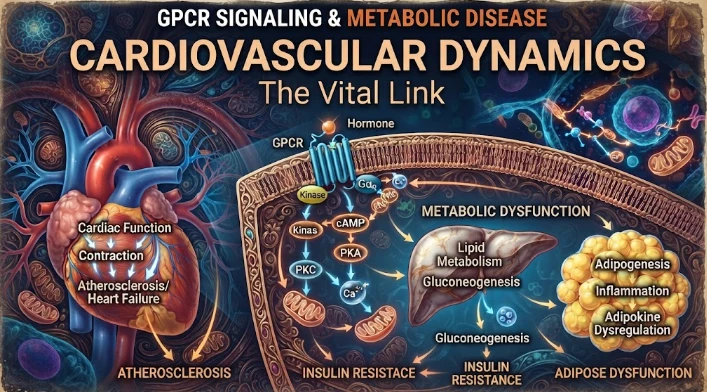
The article examines cardiovascular GPCR signaling as a dynamic response system whose abnormalities can remain hidden in resting measurements. Mechanical stretch, hormones, nutrients, sympathetic activity, and fluid balance can change the amplitude, duration, localization, and recovery of receptor signaling. Examples include mechanically activated angiotensin-receptor signaling, endosomal signaling, beta-arrestin-dependent trafficking, and biased glucagon-like peptide-one receptor responses. The