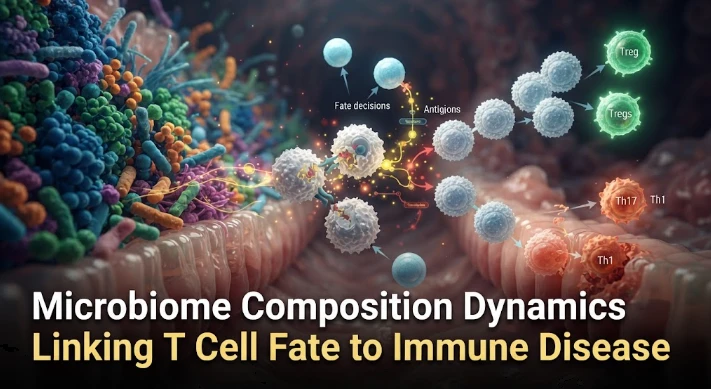
The article treats microbiome composition and T-cell fate as a coupled dynamic system rather than static disease markers. Microbial communities change with antibiotics, diet, infection, medication, and inflammation, while T-cell clones expand, contract, migrate, and reprogram. Experimental evidence from segmented filamentous bacteria and Clostridia shows that microbes can influence inflammatory and regulatory differentiation, but natural ecosystems contain far more complex interactions. The article argues that dense longitudinal sampling is needed to determine whether microbial changes precede immune transitions or follow them. Shotgun metagenomics, metabolomics, single-cell profiling, receptor sequencing, and spatial tissue analysis can identify strain-level changes, functional metabolites, clonotype expansion, and local immune niches. Perturbation in organoids, tissues, or defined microbial systems can test necessity and sufficiency. Medication, diet, geography, and host genetics require careful modeling. The central concept is resilience: disease emerges when microbial and immune systems fail to return to a stable tolerant state after disturbance.
While a microbiome snapshot can characterize the organisms present, immune disease unfolds over time. T cells and their populations grow larger, shrink, travel and take on new roles as do microbial communities in response to diet, infection, medication and inflammation. So the central question remains dynamic: does a change of microbiome composition shift T cell fate, a change of immunity remodels the microbiome, or changes in both occur in conjunction under another driver? That sequence can't be sorted with static comparison.
Experimental colonization studies offer a good starting point. Selected Clostridia can lead to an accumulation of regulatory T cells, while segmented filamentous bacteria can induce strong responses of intestinal T helper 17 cells in mice. The effects indicate that composition influences differentiation of the immune system. But, natural communities consist of hundreds of organisms interacting, and disease dynamics are much more complicated than a microbe experiment.
Microbial ecosystems are resilient, too. Many taxa may recover to baseline following an antibiotic perturbation; others may not recover for months, and resistance genes may persist. Recovery is not merely 'the same numbers'. A community may appear similar on the surface, but may have different strains, metabolic rates, and competitive relationships and may give the immune system different cues.
T cells exhibit similar history dependence. Cytokine capacity, migration programs, receptor signaling thresholds and chromatin accessibility are altered upon repeat antigen exposure. The environment experienced during one microbial state may be very different during the next. Regulatory properties can be acquired in tissue and chronic stimulation can result in dysfunctional and exhausted phenotypes of effector cells. Thus, immune state has memory of immunity from past exposure.
This results in a coupled dynamical system. The effect of microbes on epithelial signaling and antigen presentation effects T cell states. T cells then change the levels of cytokines, immunoglobulin A, barrier integrity, and antimicrobial pressure which then impact the microbial community. It is when the loop settles into a state of inflammation, not into homeostasis after a disturbance that the disease becomes apparent.
The concepts of “first” and “last” are important lines of evidence. The repeated occurrence of a strain level microbial shift before expression of a specific T cell clonotype in flares is more convincing evidence of causality. Dysbiosis is likely to be a consequence or amplifier if a change in the immune system is seen first and microbial composition is seen later. This is because dense longitudinal sampling is more informative than comparing one sample of the disease with one sample of the controls.
Functional resolution should also be used to measure composition. The antigenic proteins, metabolic pathways, and ability to colonize mucosa may differ in two strains of bacteria of the same species. Shotgun metagenomics is better suited to resolve genes and strains than broad taxonomic profiling. Even small changes in species may result in changes in their abundances that are detectable by metabolomics and that directly affect immune signaling.
Single cell immune profiling offers the same level of resolution. Transcriptomic and protein measurements can identify regulatory, inflammatory, follicular, cytotoxic and transitional states, rather than total CD4 cells. Sequencing of the T cell receptor can identify whether a state shift is due to an increase in the frequency of pre-existing T cell clones or due to intraclonal reprogramming. Cell state and clonotype can be used to distinguish population turnover from true fate plasticity.
The spatial context is also vital. The intestinal microbial communities are different along the intestinal lumen, mucus layer, crypts and different regions of the bowel. The signals received by T cells in the lamina propria are not well reproduced by fecal sequencing. Biopsy based spatial profiling allows the linkage of epithelial damage, microbial localization, activation of dendritic cells, and adjacent T cell programs. These maps may reveal local circuits that cannot be seen from the whole tissue averages.
These circuits can be tested by perturbation based immune mapping. Human organoid systems, ex vivo tissue, defined microbial products and controlled immune co-culture can affect one component and steady other components relatively. Blocking a receptor or signaling pathway, which can test mechanism, can restore a specific T cell program if the cell has been altered by a microbial metabolite. Restoration of a missing metabolite or regulatory signal will be able to test if the phenotype can be reversed in rescue experiments.
Special attention is needed with regards to medication exposure, as many medications used to treat immune disorders have an impact on both sides of the loop. Change the microbial habitat by indirectly reducing inflammation using biologic therapy. Modifying pathogen burden is achieved both by direct change in the composition of the microflora and by modifying the microbial burden. Diet changes substrate availability, causing metabolic changes in the bacteria without significant taxonomic changes. In the longitudinal models these exposures must be treated as time varying covariates instead of background information.
Population heterogeneity can otherwise obscure real effects. The microbiome and immune repertoire of an organism is established by the early environment (nature, nurture, early exposures, and host genetics) and baseline diet. An organism shift in one group that is successful in one, may fail in the other group because they fill the same niche. As a result, pathway-level and metabolite level signals are able to generalize better than a strict taxonomy.
The complexity should be captured in the causal modeling and not as certainty in the correlation. Each of the four types of time lagged analysis, mediation models, perturbation experiments, and external replication can provide different types of evidence. None of the one-way shows is the entire journey. Having multiple lines of evidence linking microbiome dynamics to cell fates, including across temporality, functional assays, and across spatial and independent cohorts, constitutes the strongest evidence that this is the case.
Immune recovery should be examined in conjunction with ecological recovery. Species richness may return to normal following a perturbation, but the antigenic composition and the productivity of metabolites may not. There is a similar pattern for T cell populations, with normalization of total counts, but persistence of altered clonotype or function. This comparison of both recovery curves may suggest whether a persistent immune phenotype occurs in the absence of clear ecological change, or in the presence of it.
Experimental timing can identify the distinction between priming and maintenance. Pre-differentiating T cells with a microbial signal before they differentiate will determine if it affects fate choice; and introducing the same signal after T cell differentiation will determine if it maintains or reproprogrammes an established state. They're different mechanisms. Maturified tissue resident population will not always be reversed by a therapy that blocks the pathogenic differentiation.
Another good effect is network stability. In experimental systems, multiple small-scale perturbations can be used to determine if a return to the same community and immune status occurs after each challenge. A healthy system should recover within a finite range. The bigger the deviation from normal is after each perturbation, the more vulnerable the system is and the more likely it is to develop inflammatory disease before it manifests.
Often false temporal conclusions can be avoided by multi-site sampling. Sometimes a microbial population will not be present in the stool, but still present in the mucosa and reappear later without recolonization. When ethically possible, paired stool and tissue measurements are a more accurate record of the movement of microbes. The same applies to blood and tissue T cells, which do not necessarily have the same distribution of states.
The sampling intervals should be equal to the rate of the process. Microbial remodeling can occur daily after an antibiotic and T cell remodeling can occur over weeks. Coordinated models are less likely to capture cause and effect when they are required to schedule both layers on the same sparse schedule. Multi-timescale analysis can capture rapid ecological events and evaluate delayed immune consequences.
Repeatedly sampling after remission will ascertain whether the ecosystem returns to an earlier attractor or whether a new stable ecosystem with alternative immune outcomes emerges.
Practical: it is not to "freeze" the microbiome in an optimal composition. Ecosystems can be very different from person to person and very healthy. A more achievable aim is to characterise vulnerable transitions that herald detrimental immune states and the signals which maintain them. Dan R.
Littman's research interests in cell differentiation of T cells and regulation of the microbiome align with this emphasis on mechanism rather than only taxonomy. Immune disease is easier to understand when viewed as a response to a changing ecological input (microbial composition) and a response that is adaptive, history dependent (T cell fate).
CITE THIS ARTICLE
Tasneem, S. (2025). Microbiome Composition Dynamics Linking T Cell Fate to Immune Disease. https://www.sadiaresearchhub.com/article/7f5c35a5-527d-5e58-9882-a50561c8bd50
S. Tasneem, “Microbiome Composition Dynamics Linking T Cell Fate to Immune Disease,” 2025. [Online]. Available: https://www.sadiaresearchhub.com/article/7f5c35a5-527d-5e58-9882-a50561c8bd50
Tasneem, S. (2025) ‘Microbiome Composition Dynamics Linking T Cell Fate to Immune Disease’. Available at: https://www.sadiaresearchhub.com/article/7f5c35a5-527d-5e58-9882-a50561c8bd50
Tasneem, Sadia. “Microbiome Composition Dynamics Linking T Cell Fate to Immune Disease.” 2025, https://www.sadiaresearchhub.com/article/7f5c35a5-527d-5e58-9882-a50561c8bd50.
Sadia Tasneem. “Microbiome Composition Dynamics Linking T Cell Fate to Immune Disease.” (2025). https://www.sadiaresearchhub.com/article/7f5c35a5-527d-5e58-9882-a50561c8bd50.
Tasneem S. Microbiome Composition Dynamics Linking T Cell Fate to Immune Disease. 2025. https://www.sadiaresearchhub.com/article/7f5c35a5-527d-5e58-9882-a50561c8bd50
@misc{article_7f5c35a5527d5e589882a50561c8bd50,
  title = {Microbiome Composition Dynamics Linking T Cell Fate to Immune Disease},
  author = {Sadia Tasneem},
  year = {2025},
  url = {https://www.sadiaresearchhub.com/article/7f5c35a5-527d-5e58-9882-a50561c8bd50},
}
TY  - GEN
AU  - Sadia Tasneem
TI  - Microbiome Composition Dynamics Linking T Cell Fate to Immune Disease
PY  - 2025-08-17
UR  - https://www.sadiaresearchhub.com/article/7f5c35a5-527d-5e58-9882-a50561c8bd50
ER  -
The article examines leukemia as an evolving population under targeted therapy, using chronic myeloid leukemia as the main example. BCR–ABL1 inhibition can produce deep responses, but every treatment changes the competitive environment among malignant clones. Quantitative transcript monitoring provides a continuous measure of disease burden, while deep sequencing can identify emerging resistance mechanisms before hematologic progression. A detected mutation is clinically meaningful only when its
The article examines how cardiovascular genetic risk becomes biologically active through cell-specific inflammatory signaling. Because many vascular-risk variants lie in regulatory DNA rather than coding regions, their effects may appear only in particular endothelial, macrophage, smooth-muscle, or lymphocyte states. Single-cell studies of human atherosclerotic lesions and multiomic endothelial experiments are used to illustrate this context dependence. The article also discusses IL6-related sig
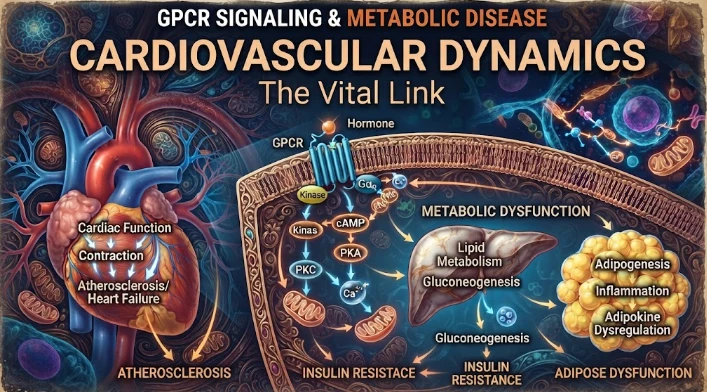
The article examines cardiovascular GPCR signaling as a dynamic response system whose abnormalities can remain hidden in resting measurements. Mechanical stretch, hormones, nutrients, sympathetic activity, and fluid balance can change the amplitude, duration, localization, and recovery of receptor signaling. Examples include mechanically activated angiotensin-receptor signaling, endosomal signaling, beta-arrestin-dependent trafficking, and biased glucagon-like peptide-one receptor responses. The