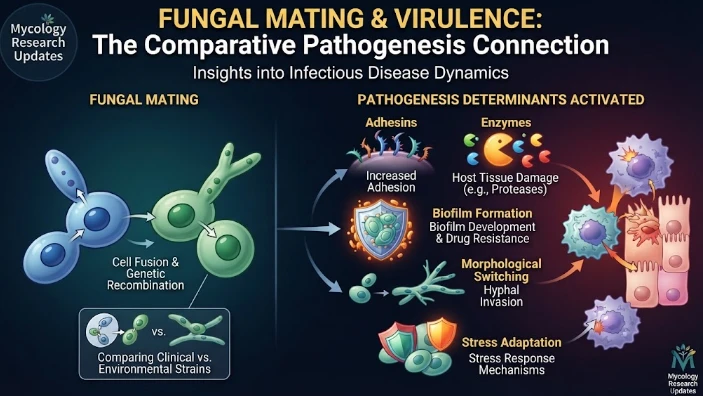
The article investigates how fungal mating can generate variation that influences pathogenesis, using Candida albicans as the principal example. It explains that white–opaque switching, mating-type compatibility, parasexual chromosome loss, recombination, aneuploidy, and loss of heterozygosity can create genetically diverse offspring without a conventional meiotic cycle. Environmental cues such as nutrients, temperature, carbon dioxide, and host conditions regulate mating competence, while pheromone signaling can also affect adhesion and biofilm behavior. These reproductive events matter clinically because new genomic combinations can alter antifungal susceptibility, stress tolerance, immune interaction, persistence, and virulence. The article proposes comparing mating states and progeny through genomics, infection models, immune assays, and competitive fitness experiments. Population genomics can test for recombination signatures in clinical lineages. Overall, mating is presented as an evolutionary mechanism that expands the pathogen’s adaptive possibilities, with host immunity and treatment determining which variants become clinically important.
In pathogenic fungi, mating can lead to diversification of the fungus, which is sometimes considered as reproduction, but in fungi it is also considered as something shaping the fungus infection. Candida albicans is a particularly interesting case since mating, ploidy change, phenotypic switching and genome rearrangement do not require a conventional meiotic cycle. Insights into reproductive flexibility and the implications for adaptation to host environments, exposure to antifungals, immune pressure, and transmission-related traits can be gained through the comparison of mating states and pathways.
C. albicans was thought of as exclusively asexual. That was changed when mating type loci and mating competent cell states were discovered. When cells are induced to become opaque (a specialized state that is very sensitive to mating pheromone), a diploid cell with a different mating type information can mate. The need to undergo phenotypic switching makes reproduction directly tied to a program of other gene expression and cell behaviour.
The resulting tetraploids rarely revert to diploids by normal meiosis. Rather, a parasexual cycle can decrease chromosome number by a coordinated loss of chromosomes. In the process, recombination may take place and create new combinations of alleles. This route will give rise to genetic diversity, as well as aneuploidy and loss of heterozygosity. Each genomic outcome may impact traits that are important to pathogenesis.
The comparative analysis is particularly informative as mating can be done in more than one way. The compatible cells of opposite mating type are called heterothallic mating; under specific conditions, homothallic processes may allow genetically related cells to mate. Research has shown that both strategies can be employed by C. albicans. Reproductive flexibility may thus continue even if there is restricted access to a genetically different partner in the host niche.
These pathways are controlled by environmental factors. Factors that may affect mate's competence or mate attractiveness include nutrient signaling, carbon source, temperature, carbon dioxide, and host associated cues. G protein signaling components, like Gpa2, are associated with nutrient regulation of mating. This type of regulation removes the possibility of reproduction being considered a one-off occurrence. Mating is part of a system of environmental sensing that is also important for survival in fungi.
The community behaviors are also influenced by pheromone signaling. Biofilm related states can be influenced and stimulated by mating pheromones in competitive cells. Structured communities that enhance cell to cell contact through the inclusion of adhesion proteins that mediate cell attachment can be important to help establish and maintain mating associated biofilms. Additionally, the immune exposure and antifungal susceptibility of biofilms can be altered, bridging reproductive signaling to clinically relevant fungal phenotypes.
Pathogen fitness can be altered by genome change resulting from mating. A loss of heterozygosity may uncover recessive alleles, imbalance of chromosomes may alter the dosage of the genes, and recombination may merge adaptive variants. Some outcomes can decrease fitness, others can increase stress survival. Antifungal therapy provides a strong selective pressure, under which an uncommon genome can proliferate when it provides better tolerance or resistance.
Another source of selection is host immunity. Immune recognition can be changed by changes in the composition of cell walls, the presence of surface adhesins, and the cell's response to stress. A genotype with a mating derived genotype will have an advantage in a particular niche if it is more resistant to phagocyte attack. On the other hand, there may be costs associated with reproductive states, which may diminish virulence. Comparative infection models will need to account for adaptive genomic diversity or variability as well as those that occur as a result of mating.
This was further extended with the discovery of mating competent haploid C. albicans. Haploid cells proved they could withstand higher ploidy levels than previously thought. Haploids are capable of mating and are also capable of reverting to higher ploidy levels. This flexibility widens options for evolution when under stress and gives experimental systems to study recessive traits genetically.
The fact is there is yet another layer: parameiosis. Analysis of parasexual progeny revealed recombination and genome reduction mechanisms that can drive diversity without classical meiosis. These processes make it hard to distinguish between sexual and asexual evolution. The clinical implications of infectious disease are that important genetic variation can occur by reproductive processes that may not be anticipated by traditional epidemiological assumptions.
These mechanisms can be correlated with pathogenesis through comparative genomics. Different mating types, ploidies, chromosome configurations and host sources can be sequenced and evaluated for growth, stress tolerance, biofilm formation, antifungal susceptibility and interaction with the immune system. Repeated genomic changes are identified by phylogenetic analysis in clinical environments. Then functional perturbation can be performed to see if those change the disease phenotype directly.
If possible, experimental infection models should include genetically matched parental and mating derived strains that are compared. Such designs minimize the effect of confounds from other strain backgrounds. Outcomes may range from tissue burden, dissemination, inflammatory response, survival or effectiveness of treatment. The relative fitness of a genotype in a host can be estimated by competition experiment which determine whether the genotype has an advantage only under the drug pressure or under the immune pressure.
The theoretical frame is not reproductive only but an evolutionary one. Mating increases the diversity of possible genotypes, environments of the host and treatment will be the determinants of which of these genotypes will be realized, and successful states will influence pathogen population structure. The genome plasticity becomes a pool of possibilities, which can be retried many times during infection. A rare reproductive event, combined with selection of the resulting phenotype, can have a clinical significance.
Transmission within host niches can also be influenced by mating related phenotypes. Adhesion, biofilm formation and cell surface remodeling influence mucosal and medical device survival. Reproductive biology can change opportunities for persistence prior to the onset of invasive disease if a mating program changes these traits. Therefore, it is important to have colonization models included in comparative studies with bloodstream or systemic infection models.
The population genomic data can test for the presence of recombination signal in clinical lineages. Allele sharing, loss of heterozygosity, and aneuploidy can provide a window into deviation from strict clonality. This inference is still challenging due to the fact that genome plasticity can create some signatures of the recombination process. Population analysis combined with experimentally defined mating products provides better patterns for interpretation.
There is a need to measure fitness costs explicitly. A mating deriving aneuploid state may be beneficial for drug tolerance, and may also be detrimental for growth in drug free conditions. Competitive assays under variable conditions can indicate if the advantage is permanent or temporary or treatment related. This has clinical significance because when the pressure is removed after the treatment, the resistant genotype may disappear but then reappear quickly upon re-exposure to the same pressure.
Diversity of immune relevant surface molecules can also be induced via mating without any direct change in classic virulence genes. Alteration of chromosome dosage and/or combinations of alleles can alter cell wall synthesis, secreted enzymes, or stress signaling. Routine growth assays do not detect immune phenotypes that can be detected by measuring antibody binding, complement deposition, killing by neutrophils and/or survival of macrophages within mating progeny. Comparisons of such characteristics show reproductive variation to host outcome, with traits measured experimentally.
The expression of genes can also be modified independently of the inherited sequence by reproductive state. Prior to any mating event, there are differences in transposition between white and opaque cells, with phenotype differences in virulence but not in genomic content. Comparative studies require the ability to distinguish the effects of cell state from the effects of recombined progeny. Matched experiments between white, opaque, tetraploid and parasexual descendants are able to distinguish between those pathogenesis characteristics which can be transiently regulated and those which are genetically fixed after mating.
A final comparison should also incorporate the relatedness to the fitness of the mating product, as the establishment of a mating product in the population that is not treated but is not well spread can have minimal population impact. Expansion, persistence, and competitive propagation can be measured in addition to invasive virulence to provide a more comprehensive understanding of evolutionary success.
Fungal mating should thus be placed within the patho- rather than beyond the pathogenesis research. The phenotypic switching, pheromone signaling, parasexual recombination, ploidy change and biofilm biology of C. albicans can link reproduction to infection relevant traits relevant. Comparative studies which link mating genetics to host responses can help pinpoint the most significant forms of diversity. This method illuminates adaptation, treatment resistance and evolutionary fitness of human pathogenic fungi through the lens of fungal reproduction.
CITE THIS ARTICLE
Tasmeem, S. (2026). Comparative Fungal Pathogenesis Determinants through Fungal Mating in Infectious Disease. https://www.sadiaresearchhub.com/article/baaba533-ccfe-55c6-a273-3bb1f3e25be6
S. Tasmeem, “Comparative Fungal Pathogenesis Determinants through Fungal Mating in Infectious Disease,” 2026. [Online]. Available: https://www.sadiaresearchhub.com/article/baaba533-ccfe-55c6-a273-3bb1f3e25be6
Tasmeem, S. (2026) ‘Comparative Fungal Pathogenesis Determinants through Fungal Mating in Infectious Disease’. Available at: https://www.sadiaresearchhub.com/article/baaba533-ccfe-55c6-a273-3bb1f3e25be6
Tasmeem, Sadia. “Comparative Fungal Pathogenesis Determinants through Fungal Mating in Infectious Disease.” 2026, https://www.sadiaresearchhub.com/article/baaba533-ccfe-55c6-a273-3bb1f3e25be6.
Sadia Tasmeem. “Comparative Fungal Pathogenesis Determinants through Fungal Mating in Infectious Disease.” (2026). https://www.sadiaresearchhub.com/article/baaba533-ccfe-55c6-a273-3bb1f3e25be6.
Tasmeem S. Comparative Fungal Pathogenesis Determinants through Fungal Mating in Infectious Disease. 2026. https://www.sadiaresearchhub.com/article/baaba533-ccfe-55c6-a273-3bb1f3e25be6
@misc{article_baaba533ccfe55c6a2733bb1f3e25be6,
  title = {Comparative Fungal Pathogenesis Determinants through Fungal Mating in Infectious Disease},
  author = {Sadia Tasmeem},
  year = {2026},
  url = {https://www.sadiaresearchhub.com/article/baaba533-ccfe-55c6-a273-3bb1f3e25be6},
}
TY  - GEN
AU  - Sadia Tasmeem
TI  - Comparative Fungal Pathogenesis Determinants through Fungal Mating in Infectious Disease
PY  - 2026-05-24
UR  - https://www.sadiaresearchhub.com/article/baaba533-ccfe-55c6-a273-3bb1f3e25be6
ER  -
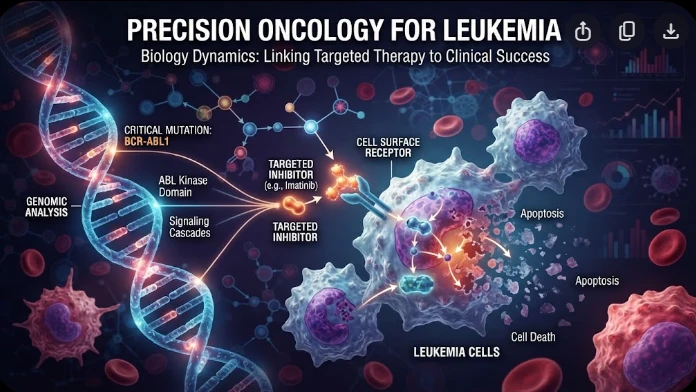
The article examines leukemia as an evolving population under targeted therapy, using chronic myeloid leukemia as the main example. BCR–ABL1 inhibition can produce deep responses, but every treatment changes the competitive environment among malignant clones. Quantitative transcript monitoring provides a continuous measure of disease burden, while deep sequencing can identify emerging resistance mechanisms before hematologic progression. A detected mutation is clinically meaningful only when its
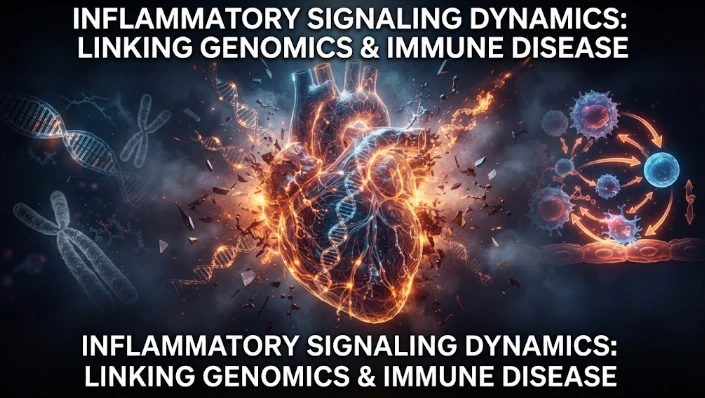
The article examines how cardiovascular genetic risk becomes biologically active through cell-specific inflammatory signaling. Because many vascular-risk variants lie in regulatory DNA rather than coding regions, their effects may appear only in particular endothelial, macrophage, smooth-muscle, or lymphocyte states. Single-cell studies of human atherosclerotic lesions and multiomic endothelial experiments are used to illustrate this context dependence. The article also discusses IL6-related sig
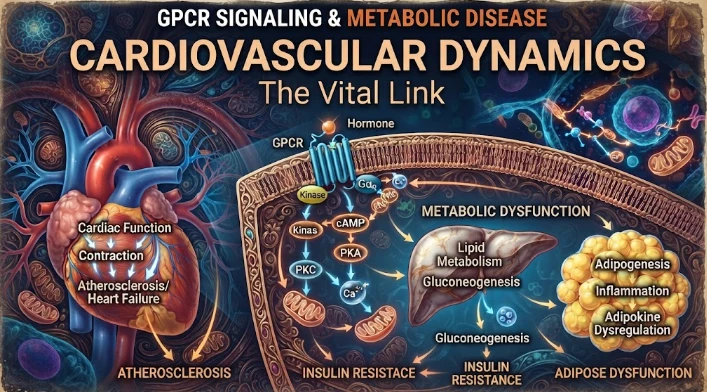
The article examines cardiovascular GPCR signaling as a dynamic response system whose abnormalities can remain hidden in resting measurements. Mechanical stretch, hormones, nutrients, sympathetic activity, and fluid balance can change the amplitude, duration, localization, and recovery of receptor signaling. Examples include mechanically activated angiotensin-receptor signaling, endosomal signaling, beta-arrestin-dependent trafficking, and biased glucagon-like peptide-one receptor responses. The