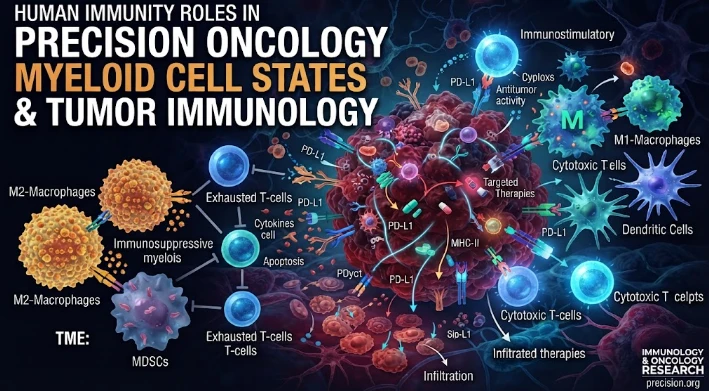
The article examines myeloid-cell programs across cancer types to determine which immune mechanisms are broadly conserved and which are tissue specific. Pan-cancer atlases reveal distinct macrophage states, including FOLR2-, TREM2-, and SPP1-associated populations, whose meaning depends strongly on spatial niche and surrounding immune architecture. Examples involving tertiary lymphoid structures, bone-marrow myelopoiesis, and TIM3–VISTA coexpression illustrate how myeloid biology can operate locally and systemically. Functional genomics, CRISPR screening, organoids, cocultures, and patient-derived models are proposed to test whether conserved states are true therapeutic dependencies. Independent replication is essential because single-cell clusters can vary with processing and annotation. Tumor genetics, inherited variation, treatment stage, and normal-tissue expression influence translation and safety. The article concludes that a useful cross-cancer myeloid target must show reproducible identity, spatial context, causal function, treatment relevance, and an acceptable therapeutic index rather than merely recurring transcript expression.
Cytotoxic T cells are not the only cells that are essential for human antitumor immunity. Myeloid cells regulate antigen presentation, cytokine balance, tissue repair, vascular growth, phagocytosis and the physical structure of immune niches. The functions can aid in tumour control or inhibit tumour control, depending on the state and location. This means, along with the other issues mentioned above, that precision oncology also has a classification issue; which myeloid programs are conserved across cancers and which are tissue specific adaptations that shouldn't be extrapolated beyond one cancer type?
They show both patterns in pan cancer atlases. The abundance and prognostic significance of some macrophage programs is repeated in many malignancies. Macrophages with FOLR2 expression, TREM2 enriched states, SPP1 enriched populations, inflammatory and dendritic cell subsets have distinct niches. One spatial context may show immunity and another context may show suppression. Comparisons of complete states should therefore be carried out instead of comparing individual genes in cross cancer analysis.
The importance of location is demonstrated by FOLR2 and TIM4 positive macrophages. Several cancer types were studied and such a population was identified that was localized within tertiary lymphoid structures and correlated with active immune infiltration. The non-lymphoid macrophages displayed a more suppressor-like phenotype. This broad marker combination may then have varying significance in different tissue architectures. The spatial context is part of the identity of a cell for translation.
Myeloid cells can influence characteristics of the tumor before they even reach it by bone marrow signaling. In experimental and human non small cell lung cancer, interleukin four was found to be a component of pro tumorigenic myelopoiesis, relating tumour associated signals to the alteration in bone marrow output. This systemic mechanism is a mechanism of spreading the tumor beyond the lesion. These cells that replenish suppressive niches are produced upstream and targeting only intratumoral macrophages could be missed.
Other studies have found conserved TIM3 coexpressed with VISTA in tumor associated macrophages, and tried combined targeting as a way to overcome resistance to immunotherapy. These discoveries point to the possibility of cross cancer therapeutic opportunities arising from the development of shared myeloid programs. This is not enough, however, for expressions to be conserved. Target engagement should impact their function and result in an improved antitumor response without causing harm to normal tissues in which they function.
Functional genomics can determine which regulators are responsible for preserving these states. CRISPR screens can be performed in myeloid cells to discover transcription factors, receptors, metabolic enzymes, or signaling nodes that are necessary for suppressive function. Dependencies can be lost in regular cell culture, so screens should be done in the presence of tumor relevant cytokines and metabolites. Candidate genes are subsequently tested in co culture with tumor cells and T cells, to validate effects on immune control.
There is another pathway: organoid systems. Myeloid targeted intervention and patient-derived tumor organoids can be used to determine if a myeloid intervention enhances T cell killing in individual tumors. Ecological realism can be enhanced by adding fibroblasts or endothelial components. Before making a cross cancer claim, the same intervention should be tested in multiple types of cancer. If the benefits were the same in different tumor genotypes, this would lend credence to a conserved immunity dependency.
Independent cohort replication is particularly important for single cell signatures. The high dimensional clusters may change when using different tissue processing, sequencing depth, batch effects and annotation strategy. A conserved myeloid state should be identifiable based on a lock-definition of a gene or protein in a new data set. Other than transcriptional similarity, spatial location and clinical association should also replicate.
Human genetics can provide tools to discover variants that affect myeloid response or inflammatory signaling. Baseline differences in the proportions of cells and/or their responsiveness to cytokines in the blood can be due to germline variation and may influence the outcome of immunotherapies. These effects need to be large and carefully controlled for ancestry. The use of genetic evidence to support causality can be particularly useful when an inherited variant that affects a myeloid pathway also affects cancer outcome in the direction predicted by experiments on perturbation.
The genetics of the tumor is also a key factor. Oncogenic pathways may influence the recruitment and polarization of myeloid cells. Thus, the conserved macrophage state may be caused by various tumor drivers in distinct cancers. The mapping upstream tumor signals allows to avoid the erroneous notion that similar immune states have similar causes. Therapy may aim at the myeloid state itself or at interrupting the tumour signal that generates the myeloid state.
Temporal analysis can help to determine maintenance needs. Different pathway may support a myeloid program at diagnosis and the same pathway may support the same program after therapy. Multiple biopsies can be performed and perturbations in matched models can be used to assess the change in dependency. This is important when used in combination therapy, as a target that was identified prior to therapy may become irrelevant following the shift in the microenvironment associated with checkpoint blockade or chemotherapy.
Predictive and prognostic functions should be differentiated in clinical translation. A macrophage phenotype with a shorter survival may not denote that a patient will not benefit from a myeloid-targeted combination treatment, but rather aggressive disease. Prospective trials should be performed in order to evaluate if the treatment effect varies depending on the biomarker. Pharmacodynamic samples should verify that the desired changes in the state have been achieved as a result of treatment. If there is no evidence, a state is a risk marker instead of a precision treatment guide.
Cross cancer myeloid targets are set high in safety. Macrophages and monocytes are involved in the process of antimicrobial defense, wound repair, and organ homeostasis. Even though the tumor models indicate good therapeutic potential, a broad tumor target can lead to unacceptable toxicity in healthy tissue. Therapeutic index can be improved by spatially restricted ligands or by the delivery of drugs to the tumor only or by using state selective receptors. Human tissue atlases could be used to determine the normal locations of candidate targets.
The generalizability of a cross cancer should thus be established on multiple levels: in the definition, in the spatial niche, in the causal dependency, therapeutic response, and safety. It's not an agreement at the transcription level, this is not sufficient. A conserved signature is compelling when perturbation has the same functional impact in independent tumor models, and associations with treatment outcome are the same in patient cohorts.
State selective delivery might enhance therapeutic index. The approach can be targeted to the tumor or to cells with a particular receptor combination by using nanoparticles, antibody conjugates, or local delivery. The process of delivery must be validated as there can be more uptake by liver, spleen, or healthy macrophages than delivery. Appropriate immune profiling should be done with a pharmacokinetic and tissue distribution study to confirm, rather than presume, apparent selectivity.
Standards for Cross Cancer can enhance the meaning of replication. Technical disagreement can be minimized by using shared reference samples, harmonized tissue processing, panels of markers, and pre-defined classifiers of cell state. As much as possible, computational labels should correspond to measurable proteins or functions. The more clearly defined the conserved state, the more likely it is to be advanced to multicenter trials, both by the single cell sequencing and practical clinical assay.
Mechanistic biomarkers can be used to integrate tumor and immune data. A suppressive myeloid state may be most important in the presence of a secreting tumor or where T cells reveal the inhibitory program. Combined signatures can then be more effective than cell numbers. Validation should be performed to determine if the interaction in combination can predict treatment benefit and if the interaction on either side alone is sufficient to alter the outcome in functional models.
Longitudinal cross cancer studies are able to separate conservation from convergence. The myeloid landscape of two tumors can be different at the outset, but becomes similar after checkpoint therapy in the context of suppression. Convergent endpoint may indicate a common resistance mechanism when baseline biology is different. But at the same time, there can be large differences in response to treatment between similar baseline states. Comparing pretreatment atlases alone is less indicative of conserved therapeutic opportunity than following state transitions.
Miriam Merad's research area focuses on human myeloid biology in a context of tumor immunology. That attitude is the one that precision oncology can take into account and take beyond the simple classifications of macrophages. Which myeloid programs truly cross cancers can be identified using functional genomics, organoid testing, spatial profiling and independent replication. The most useful target would be an immune state that has been conserved and which can be modulated in a predictable manner without compromising protective myeloid responses against tumor.
CITE THIS ARTICLE
Tasmeem, S. (2025). Human Immunity Roles in Precision Oncology through Myeloid Cell States and Tumor Immunology. https://www.sadiaresearchhub.com/article/bd1de93a-504e-53ea-aa57-37e21339d1bc
S. Tasmeem, “Human Immunity Roles in Precision Oncology through Myeloid Cell States and Tumor Immunology,” 2025. [Online]. Available: https://www.sadiaresearchhub.com/article/bd1de93a-504e-53ea-aa57-37e21339d1bc
Tasmeem, S. (2025) ‘Human Immunity Roles in Precision Oncology through Myeloid Cell States and Tumor Immunology’. Available at: https://www.sadiaresearchhub.com/article/bd1de93a-504e-53ea-aa57-37e21339d1bc
Tasmeem, Sadia. “Human Immunity Roles in Precision Oncology through Myeloid Cell States and Tumor Immunology.” 2025, https://www.sadiaresearchhub.com/article/bd1de93a-504e-53ea-aa57-37e21339d1bc.
Sadia Tasmeem. “Human Immunity Roles in Precision Oncology through Myeloid Cell States and Tumor Immunology.” (2025). https://www.sadiaresearchhub.com/article/bd1de93a-504e-53ea-aa57-37e21339d1bc.
Tasmeem S. Human Immunity Roles in Precision Oncology through Myeloid Cell States and Tumor Immunology. 2025. https://www.sadiaresearchhub.com/article/bd1de93a-504e-53ea-aa57-37e21339d1bc
@misc{article_bd1de93a504e53eaaa5737e21339d1bc,
  title = {Human Immunity Roles in Precision Oncology through Myeloid Cell States and Tumor Immunology},
  author = {Sadia Tasmeem},
  year = {2025},
  url = {https://www.sadiaresearchhub.com/article/bd1de93a-504e-53ea-aa57-37e21339d1bc},
}
TY  - GEN
AU  - Sadia Tasmeem
TI  - Human Immunity Roles in Precision Oncology through Myeloid Cell States and Tumor Immunology
PY  - 2025-11-02
UR  - https://www.sadiaresearchhub.com/article/bd1de93a-504e-53ea-aa57-37e21339d1bc
ER  -
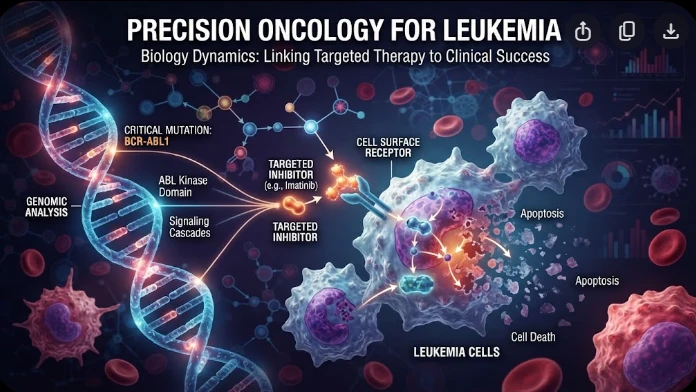
The article examines leukemia as an evolving population under targeted therapy, using chronic myeloid leukemia as the main example. BCR–ABL1 inhibition can produce deep responses, but every treatment changes the competitive environment among malignant clones. Quantitative transcript monitoring provides a continuous measure of disease burden, while deep sequencing can identify emerging resistance mechanisms before hematologic progression. A detected mutation is clinically meaningful only when its
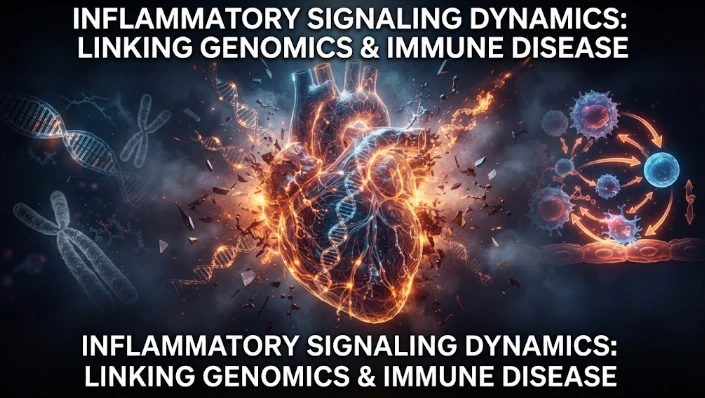
The article examines how cardiovascular genetic risk becomes biologically active through cell-specific inflammatory signaling. Because many vascular-risk variants lie in regulatory DNA rather than coding regions, their effects may appear only in particular endothelial, macrophage, smooth-muscle, or lymphocyte states. Single-cell studies of human atherosclerotic lesions and multiomic endothelial experiments are used to illustrate this context dependence. The article also discusses IL6-related sig
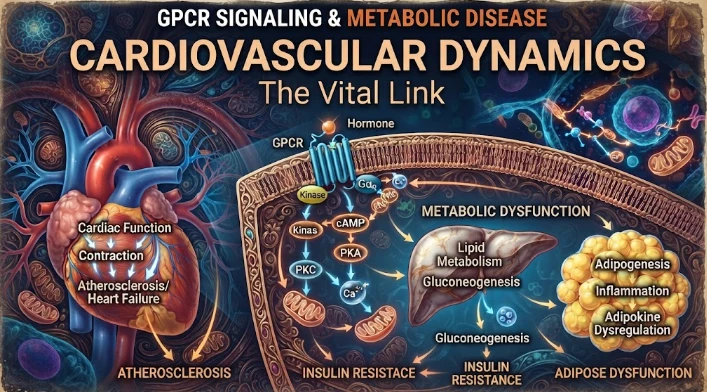
The article examines cardiovascular GPCR signaling as a dynamic response system whose abnormalities can remain hidden in resting measurements. Mechanical stretch, hormones, nutrients, sympathetic activity, and fluid balance can change the amplitude, duration, localization, and recovery of receptor signaling. Examples include mechanically activated angiotensin-receptor signaling, endosomal signaling, beta-arrestin-dependent trafficking, and biased glucagon-like peptide-one receptor responses. The