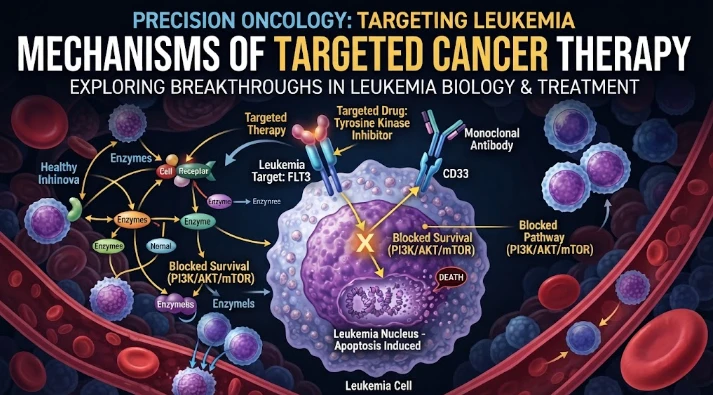
The article uses chronic myeloid leukemia to explain the mechanism and evolutionary consequences of targeted cancer therapy. BCR–ABL1 creates a clear oncogenic dependency that can be inhibited by imatinib and later tyrosine-kinase inhibitors, while quantitative molecular monitoring tracks residual disease. Resistance demonstrates that targeted treatment reshapes the leukemic population: kinase-domain mutations such as T315I, amplification, bypass signaling, cytogenetic evolution, and stem-cell persistence can all permit escape. The article recommends longitudinal single-cell DNA and RNA profiling to identify rare resistant subclones and distinguish pre-existing from treatment-emergent states. Bone-marrow niches and leukemia stem cells are also considered because resistance is not purely genetic. CRISPR, ex vivo primary cells, marrow-mimetic cultures, and xenografts can test new dependencies. Molecular monitoring should be linked to outcome thresholds. Overall, targeted therapy is presented as both treatment and evolutionary pressure, requiring continuous mechanistic surveillance to guide rational next-line intervention.
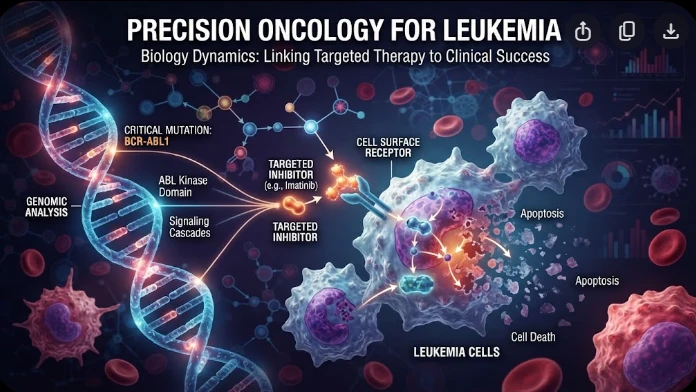
CML was revolutionized by the discovery of targeted cancer therapy because the disease has a molecular engine that can be directly targeted. The BCR ABL1 fusion results in a constantly active tyrosine kinase, which led to the hypothesis that kinase inhibition would be a model for precision oncology. This drug, imatinib, demonstrated that a drug designed to target an oncogenic driver can lead to long-term disease control, but it also uncovered a second rule: pressure of a targeted agent alters the biology of leukemia and favors the emergence of resistant clones.
BCR ABL1 inhibition is able to block both proliferative and survival signaling and kill the leukemic population, while normal hematopoiesis can replenish. Molecular monitoring is then used to quantify the remaining fusion transcript, in addition to blood counts. This correlation between a causal driver, a targeted inhibitor, and a quantitative biomarker resulted in a very complete and well-rounded treatment model.
A single target strategy was shown to be inadequate through resistance. Point mutations in the kinase domain may lead to a decrease in inhibitor binding, but maintain catalytic activity. The T315I change was a famous example, as it gives resistance to a few earlier tyrosine-kinase inhibitors. Other mutations change how sensitive the drug is to different extents and when molecular response is lost or progression happens, mutation testing becomes relevant.
Resistance may also occur in the absence of a mutation in the kinase domain. Leaks through BCR ABL1 amplification, blocked drug target, activation of bypass target, further cytogenetic changes, and evolution into more complex disease can all let them out of their dependence on the original target. In the case of a resistant leukemia, therefore, it should be studied as a dynamic ecosystem instead of the original clone with one new mutation.
Inhibitors of the 2nd generation and beyond expanded treatment options by binding to the kinase differently, or with greater potency. As a result of their availability, resistance became a matching problem: mutation, disease phase, treatment history, and drug properties. Rarely does precision oncology truly work best when looking at molecular monitoring after clinical deterioration has occurred, it is best done before.
That logic can be taken a step further with longitudinal single cell approaches. Bulk sequencing refers to the average mutation rate in a large number of cells; however, resistant disease may include rare subclones that are not detected at normal levels. Single cell DNA and RNA Profiling can map mutations, transcriptional state and lineage. Repeated sampling can determine if a resistant clone was present prior to therapy, developed during therapy or increased after a suppression of another population.
The concept of spatial multiomics is less clear in a blood cancer than in a solid tumor, but tissue niches remain relevant. Survival of leukemia stem cells is regulated by bone marrow stromal cells, cytokines, oxygen gradients, and immune cells. Cells in a niche can survive strong target inhibition in the system. Therefore, mapping signaling states in marrow may be able to detect resistance which is not necessarily genetic.
The importance of leukemic stem cells is their role in deep molecular response, but not complete eradication. Some primitive cells may be able to survive without the need for ongoing BCR/ABL1 signaling. This is their reason for surviving and why many patients need long-term therapy despite achieving great molecular control. In selected patients, treatment free remission is also demonstrating that long-term control can be maintained following a period of drug withdrawal when disease is not at a level that requires drugs to be maintained.
The CRISPR perturbation can be used to test potential resistance genes that have been sequenced. The absence of a suspected regulator in leukemia cells can show if sensitivity is altered, and its introduction can be used to test sufficiency. Screens can also reveal synthetic lethal relationships, which is the case when a second pathway is selectively inhibited when it is required to compensate for the primary pathway.
Patient derived models are another layer of validation. Ex vivo testing of resistant disease cells with alternative inhibitors and/or drug combinations. These assays retain more of the intact genetic background than do conventional cell lines. For many solid tumors, organoid style systems are less established than marrow mimetic cultures and xenograft models can be used to assess response in a more relevant microenvironment.
One of the most important design considerations is longitudinal design, which recognizes that resistance mechanisms vary along treatment lines. If the mutation is discovered after inhibitor, it may die out if the other clone grows. Sequential samples can detect clonal competition and allow the avoidance of the assumption that the most recently observed mutation is responsible for all subsequent failures. Treatment history is added to the biological model.
In order to be clinically translatable, molecular depth must be coupled with patient outcome. A highly sensitive assay may be used to detect BCR ABL1 transcripts but does not necessarily mean that survival is improved if treatment is immediately changed. There is a need for evidence to connect molecular kinetics to progression risk for thresholds. The most effective monitoring strategies detect change in time to allow action to be taken, but do not lead to unnecessary switchovers that occur due to biological noise.
The structural information has been used to overcome a hard to clear up resistance mutation as exemplified by the development of ponatinib. The drug is intended to be active against T315I, offering more choices for patients whose disease has not responded to previous inhibitors. In the future, the concept of toxicity and potency were found to be inseparable as well due to later cardiovascular safety concerns. A balance needs to be established between molecular coverage and individual risk for precision therapy.
Another approach taken by Asciminib was the manipulation of the myristoyl pocket which was not the ATP binding site. This allosteric mechanism presents the opportunity to combine two different ways of BCR ABL1 inhibition and may help to maintain activity against some resistance patterns. The overall lesson is that there can be multiple pharmacologic designs (and not a permanent drug solution) that can exploit a validated oncogenic dependency.
The choice of treatment will also be based on the stage of the disease. Chronic phase leukemia may be very BCR ABL1 dependent, and blast phase disease may have other abnormalities and act more like an acute leukemia. If the chronic phase is broadly transformed, a mutation which can predict inhibitor response may be less useful. Molecular interpretation needs to always be tied to stage.
Deep sequencing needs to be associated with functional thresholds. Very rare variants can be identified before they reach a fitness level to affect treatment. However, looking at changes over time can help determine which variants are growing. A rise over serial samples is more compelling evidence of evolution than a single low frequency detection.
Combination therapy should be based upon evolutionary logic. If two drugs block separate routes of resistance, then the chances of one clone being resistant to both are decreased. The benefit is dependent on the toxicity and pharmacokinetics, and if there is an actual sealing of escape pathways. Clonal models of sequential versus simultaneous schedules can be compared prior to clinical testing.
Another benefit of molecular monitoring is that it provides the opportunity for early intervention. Rising resistant clone can be identified before hematologic relapse. Treatment changes at that molecular level can be evaluated in prospective studies to determine if patients benefit more from such treatment changes than from waiting for clinical progression. Such trials transform surveillance from being a passive activity to a strategy with defined clinical value.
Compound mutations of the same BCR ABL1 molecule should also be investigated through resistance surveillance. Two substitutions can have different effects than either one on its own on inhibitor sensitivity. Long-read or ‘phased' sequencing can reveal if mutations are shared or if they are different – and, when a standard mutation table offers ambiguous predictions, functional testing can guide therapy.
Therapy design should therefore be designed with escape routes in mind, and their prospective monitoring, as well as maintaining sufficient safety margins, should maintain the course of treatment.
The overarching message of CML is that precision therapy isn't over once the driver is discovered, and this is the reason for Brian J. Druker's focus on targeted therapy, leukemia, and translational oncology. The target, resistant clones, stem cell reserve, marrow environment and treatment exposure are still changing. Longitudinal multiomics and functional perturbation will be able to uncover how those layers interact, making resistance an expected failure rather than a surprise and making it a measurable evolutionary process that can be predicted and tested.
This will help to turn molecular surveillance into treatment design instead of a record of failure.
Clinical context matters.
CITE THIS ARTICLE
Tasneem, S. (2025). Targeted Cancer Therapy Mechanisms through Leukemia Biology in Precision Oncology. https://www.sadiaresearchhub.com/article/d1101a23-fb8a-5290-8fff-92f644c72bb8
S. Tasneem, “Targeted Cancer Therapy Mechanisms through Leukemia Biology in Precision Oncology,” 2025. [Online]. Available: https://www.sadiaresearchhub.com/article/d1101a23-fb8a-5290-8fff-92f644c72bb8
Tasneem, S. (2025) ‘Targeted Cancer Therapy Mechanisms through Leukemia Biology in Precision Oncology’. Available at: https://www.sadiaresearchhub.com/article/d1101a23-fb8a-5290-8fff-92f644c72bb8
Tasneem, Sadia. “Targeted Cancer Therapy Mechanisms through Leukemia Biology in Precision Oncology.” 2025, https://www.sadiaresearchhub.com/article/d1101a23-fb8a-5290-8fff-92f644c72bb8.
Sadia Tasneem. “Targeted Cancer Therapy Mechanisms through Leukemia Biology in Precision Oncology.” (2025). https://www.sadiaresearchhub.com/article/d1101a23-fb8a-5290-8fff-92f644c72bb8.
Tasneem S. Targeted Cancer Therapy Mechanisms through Leukemia Biology in Precision Oncology. 2025. https://www.sadiaresearchhub.com/article/d1101a23-fb8a-5290-8fff-92f644c72bb8
@misc{article_d1101a23fb8a52908fff92f644c72bb8,
  title = {Targeted Cancer Therapy Mechanisms through Leukemia Biology in Precision Oncology},
  author = {Sadia Tasneem},
  year = {2025},
  url = {https://www.sadiaresearchhub.com/article/d1101a23-fb8a-5290-8fff-92f644c72bb8},
}
TY  - GEN
AU  - Sadia Tasneem
TI  - Targeted Cancer Therapy Mechanisms through Leukemia Biology in Precision Oncology
PY  - 2025-07-13
UR  - https://www.sadiaresearchhub.com/article/d1101a23-fb8a-5290-8fff-92f644c72bb8
ER  -
The article examines leukemia as an evolving population under targeted therapy, using chronic myeloid leukemia as the main example. BCR–ABL1 inhibition can produce deep responses, but every treatment changes the competitive environment among malignant clones. Quantitative transcript monitoring provides a continuous measure of disease burden, while deep sequencing can identify emerging resistance mechanisms before hematologic progression. A detected mutation is clinically meaningful only when its
The article examines how cardiovascular genetic risk becomes biologically active through cell-specific inflammatory signaling. Because many vascular-risk variants lie in regulatory DNA rather than coding regions, their effects may appear only in particular endothelial, macrophage, smooth-muscle, or lymphocyte states. Single-cell studies of human atherosclerotic lesions and multiomic endothelial experiments are used to illustrate this context dependence. The article also discusses IL6-related sig
The article examines cardiovascular GPCR signaling as a dynamic response system whose abnormalities can remain hidden in resting measurements. Mechanical stretch, hormones, nutrients, sympathetic activity, and fluid balance can change the amplitude, duration, localization, and recovery of receptor signaling. Examples include mechanically activated angiotensin-receptor signaling, endosomal signaling, beta-arrestin-dependent trafficking, and biased glucagon-like peptide-one receptor responses. The