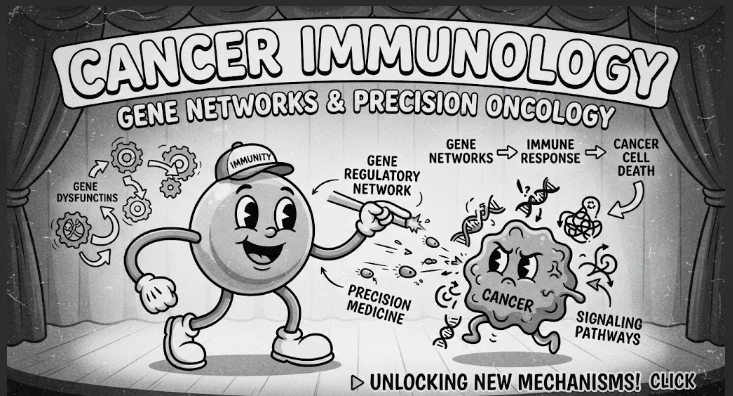
The article examines cancer immunology through gene-regulatory mechanisms operating in both tumor and immune cells. It describes how antigen presentation, interferon signaling, chemokines, checkpoint ligands, cell-death pathways, metabolism, and lineage identity can be altered by mutation, epigenetic repression, or adaptive transcriptional change. Gene-regulatory networks are proposed for identifying coordinated immune-control modules rather than isolated differentially expressed genes. Preclinical models, CRISPR screens, single-cell sequencing, spatial profiling, and longitudinal biopsies are used to distinguish causal immune-escape mechanisms from descriptive associations. The article also discusses immunoproteasome biology, epigenetic therapy, tumor mutation burden, metabolic competition, and regulated cell death as potential contributors to treatment response. Translation requires validation across human and model systems and careful toxicity assessment because immune pathways also protect normal tissues. Ultimately, precision immuno-oncology should integrate tumor-intrinsic and immune-cell regulatory states to identify mechanisms that can restore effective antitumor immunity.
The regulation of genes within cancer cells and immune cells are both crucial for tumor immunity. Therapeutic pressure can alter regulatory networks that lead to antigen presentation, interferon response, cytokine production, expression of checkpoints, cell death pathways, and lineage identity. When immune response is regarded as a dynamic transcriptional system and not just a simple denumerable number of infiltrating lymphocytes, precision oncology becomes more mechanistic.
Cancer cells have been shown to alter the expression of inhibitory ligands, chemokines, antigen processing genes and major histocompatibility complex molecules. These changes may be the result of mutation, epigenetic repression, modified activity of transcription factors or adaptation of signaling pathways. A tumor can thus escape immune pressure without its loss of all of its antigens. A decrease in presentation or alterations in inflammatory signaling might be enough to decrease recognition.
The interferon system is focused in the middle of this process. Activated can trigger antigen presentation machinery and chemokines which recruit immune cells. Resistant states can also be selected by persistent or altered interferon responses, which carries the consequence of enhanced inhibitory programs. This pathway can be activated early to make the body immune to the pathogen and later to impart adaptive resistance. The ultimate impact is dependent on the regulatory context and timing.
Transcription factors that control these changes can be identified by gene regulatory networks. Network analysis can predict modules involved in controlling antigen presentation, inflammatory signaling, proliferation, or immune exclusion, instead of measuring each immune gene individually. A single differentially expressed gene may not be as good of a mechanistic candidate as a regulator that affects multiple immune relevant targets.
Such candidates can be tested in a controlled environment using preclinical models. Inducible transgenic tumour systems offer the possibility of inducing and studying tumour initiation and immune response in an immunocompetent host. Genetically controlled tumors were shown to be induced in inducible breast cancer models, with a viable and functional immune system. These are useful for dissecting the influence of host immune processes versus tumor intrinsic regulatory mechanisms.
However, syngeneic tumour models are also available as they have a compatible genetic background. Immune therapies can be tested without affecting host immunity. Changes in gene expression can be examined in parallel with nanoparticle or viral like immunotherapies, combinations of antibody to the tumor necrosis factor and to the T-cell receptor, and combinations of costimulatory strategies. The caveat is that the mutation patterns and architecture of the transplantable tumor may differ from that of spontaneous human disease.
Inside immune cells, gene regulatory processes are important as well. The activation of T cells relies on tightly orchestrated transcription regulation of effector molecules, expansion, metabolism, memory, and exhaustion. The myeloid cells can be switched between inflammatory and suppressive states by different programs. A tumor that alters the production of cytokines may drive other immune cells to adopt a growth-promoting state. To treat tumors, networks are required on both sides of the tumor immune interface: precision immunology.
Immune escape may become fixed via epigenetic state. There can be epigenetic changes that affect the expression of antigen presentation or inflammatory genes without altering the DNA sequence—such as DNA methylation, histone modification, and chromatin remodeling. This can sometimes be turned around with repressive means. Epigenetic agents are attractive for use in combination with immunotherapies, as functional data indicate that chromatin modification can restore immune recognition; however, chromatin modification is a broad-based process that may impact normal immune cells.
Another level of mechanism is the Proteasome biology. The immunoproteasome is involved in peptide processing for antigen presentation and/or in stress pathways. In preclinical systems, experimental treatment with immunoproteasome inhibitors (IPi) had shown anti-tumor activity in AML. Results such as these indicate that immune related protein processing can have direct effects on those cells that survive to form a cancer and offer therapeutic possibilities outside checkpoint pathways.
Regulatory heterogeneity can be identified by single cell sequencing that cannot be detected in bulk tissue. Antigen presenting cancer cells may be found in one area of the tumor, cells with suppressed interferon programs in a second area, and exhausted T cells or suppressive myeloid cells in a third area. Within each population the network inferences can help to identify specific regulators. Then, spatial profiling enables to correlate these states with physical proximity and tissue niches.
Immune regulatory genes can be tested at scale using CRISPR screens. The tumor cells can be edited on thousands of genes, followed by T cells or immune therapy. Loss of the function of these genes could result in a difference between killing and survival and consequently be considered candidates for immunity or susceptibility. Also, analogous screens in immune cells can be used to discover persistentiators and effectors. Screen results are merged with patient network data to provide better prioritisation.
Immunotherapy involves altering selection pressure, so longitudinal sampling is required. A pretreatment population of tumor cells may be immune visible and will be eradicated by therapy, such as leaving cells with altered cytokine signaling and/or antigen presentation in the tumor. The transition to regulation can be seen with serial biopsies. Although tissue context is important when assigning a mechanism, circulating biomarkers can be used to supplement tissue.
Translation needs to be validated between models. Regulatory dependency observed in one type of mouse tumour may reflect species specific immunity or represent model specific antigenicity. Ex vivo tumor slices, independent patient cohorts and human organoids, which are cultured together with autologous immune cells, can provide further evidence. Since a gene network is hypothesized to regulate clinically relevant immune behavior, the more concordant the systems, the more likely the hypothesis will be accepted.
Proposed mechanisms that involve tumor mutation burden and neoantigen load may affect immune recognition; regulation determines whether potential antigens become visible. A tumor may harbor numerous candidate neoantigens and may be deficient in presentation machinery or may exclude the presence of effector cells. This allows genomic immunogenicity to be interpreted through the gene network analysis to explain why genomic immunogenicity does not always correspond to an immune response. A comprehensive model can be constructed by incorporating neoantigen prediction with antigen presentation and interferon modules.
Thus, regulation of immunity is also determined by metabolism. Lactate is produced by cancer cells and they compete with lymphocytes for glucose and amino acids, and change the level of oxygen. These change the transcription in T cells and myeloid cells, which may further contribute to dysfunction. Metabolic properties of the microenvironment can then be responsible for maintaining a regulatory network involved in immune escape. The effects of metabolic correction on restoring the predicted immune program should be assessed in perturbation studies.
Cell death mode is important for immune consequences. Different signals are released during the different forms of regulated cell death such as apoptosis, necrosis, pyroptosis, and may differ in immunogenicity. Stress and death related gene networks may play a role in the inflammatory response to therapy, or in silent clearance. The measurement of immune activation following tumor killing can segregate direct cytotoxicity from activation of the immune response due to the improvement in antigen release and presentation.
These mechanisms should be linked with response biomarkers for precision oncology. The candidate signature may include tumor antigen presentation, interferon activity, suppressive myeloid state and T cell effector programs. Prospective testing can be used to identify the ability of the combined network to predict benefit from checkpoint therapy or a rational combination versus any single marker. The aim is to compress the machine as much as possible, not to maximise molecular complexity.
The immunotoxicity should continue to be considered as part of mechanism based development. If the same regulatory program is acting in all tissues, an enhanced pathway for recognizing tumors can also also enhance inflammation in normal tissue. Before combination therapy, this risk can be detected using human tissue assays and immune competent models. Rather than targeting a shared immune effector mechanism, sometimes it is better to target a tumor restricted upstream signal.
Repeated blood measurements can be used as an aid to tissue when biopsy is not feasible. Circulating immune cell states, tumor derived nucleic acids and cytokines can give clues to changing immunity. These signals require anchoring in tissue as peripheral changes are not necessarily reflective of the tumor microenvironment. Developmental paired sampling can create a reliable developmental blood marker for monitoring, if it is accurate enough.
Thus, in precision oncology, there is no distinction between cancer immunology and gene regulation. The recognition of the tumors relies on transcriptional programs within tumor cells, and the efficacy of the immune response relies on programs within lymphoid and myeloid cells. Network analysis can be used to determine the regulators that link those programs and reveal where therapy can re-establish immune pressure. The best approach is to use single cell mapping, perturbation screens, spatial context and longitudinal validation to reveal true immune control mechanisms and not static correlations.
CITE THIS ARTICLE
Tasmeem, S. (2026). Cancer Immunology Mechanisms through Gene Regulatory Networks in Precision Oncology. https://www.sadiaresearchhub.com/article/d539ad35-c58e-51bd-9eef-1cd7a55dd40b
S. Tasmeem, “Cancer Immunology Mechanisms through Gene Regulatory Networks in Precision Oncology,” 2026. [Online]. Available: https://www.sadiaresearchhub.com/article/d539ad35-c58e-51bd-9eef-1cd7a55dd40b
Tasmeem, S. (2026) ‘Cancer Immunology Mechanisms through Gene Regulatory Networks in Precision Oncology’. Available at: https://www.sadiaresearchhub.com/article/d539ad35-c58e-51bd-9eef-1cd7a55dd40b
Tasmeem, Sadia. “Cancer Immunology Mechanisms through Gene Regulatory Networks in Precision Oncology.” 2026, https://www.sadiaresearchhub.com/article/d539ad35-c58e-51bd-9eef-1cd7a55dd40b.
Sadia Tasmeem. “Cancer Immunology Mechanisms through Gene Regulatory Networks in Precision Oncology.” (2026). https://www.sadiaresearchhub.com/article/d539ad35-c58e-51bd-9eef-1cd7a55dd40b.
Tasmeem S. Cancer Immunology Mechanisms through Gene Regulatory Networks in Precision Oncology. 2026. https://www.sadiaresearchhub.com/article/d539ad35-c58e-51bd-9eef-1cd7a55dd40b
@misc{article_d539ad35c58e51bd9eef1cd7a55dd40b,
  title = {Cancer Immunology Mechanisms through Gene Regulatory Networks in Precision Oncology},
  author = {Sadia Tasmeem},
  year = {2026},
  url = {https://www.sadiaresearchhub.com/article/d539ad35-c58e-51bd-9eef-1cd7a55dd40b},
}
TY  - GEN
AU  - Sadia Tasmeem
TI  - Cancer Immunology Mechanisms through Gene Regulatory Networks in Precision Oncology
PY  - 2026-03-22
UR  - https://www.sadiaresearchhub.com/article/d539ad35-c58e-51bd-9eef-1cd7a55dd40b
ER  -
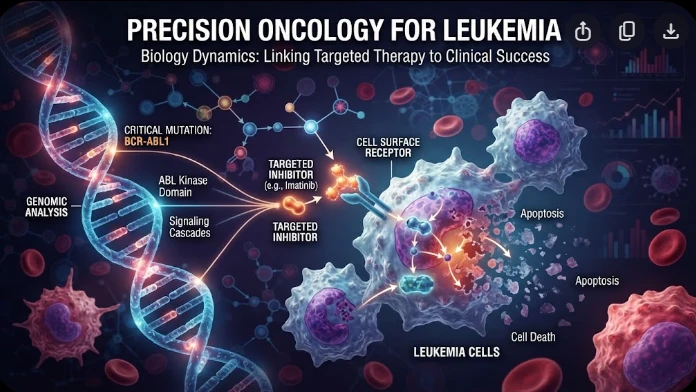
The article examines leukemia as an evolving population under targeted therapy, using chronic myeloid leukemia as the main example. BCR–ABL1 inhibition can produce deep responses, but every treatment changes the competitive environment among malignant clones. Quantitative transcript monitoring provides a continuous measure of disease burden, while deep sequencing can identify emerging resistance mechanisms before hematologic progression. A detected mutation is clinically meaningful only when its
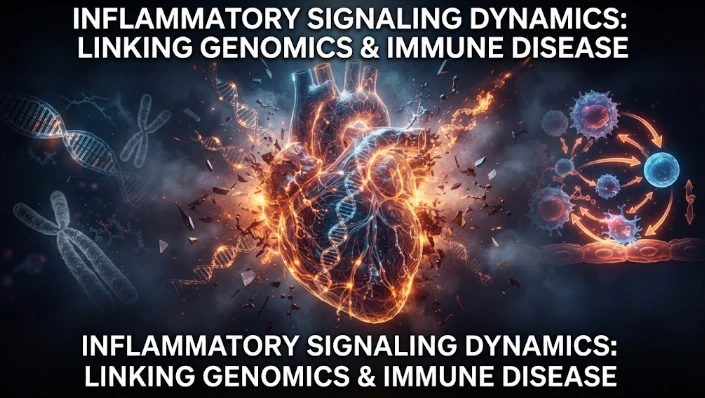
The article examines how cardiovascular genetic risk becomes biologically active through cell-specific inflammatory signaling. Because many vascular-risk variants lie in regulatory DNA rather than coding regions, their effects may appear only in particular endothelial, macrophage, smooth-muscle, or lymphocyte states. Single-cell studies of human atherosclerotic lesions and multiomic endothelial experiments are used to illustrate this context dependence. The article also discusses IL6-related sig
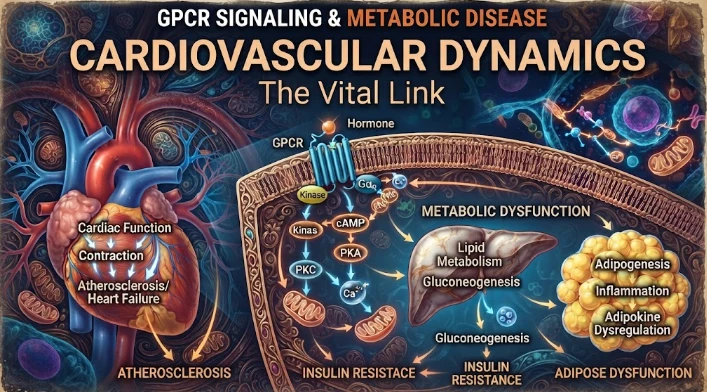
The article examines cardiovascular GPCR signaling as a dynamic response system whose abnormalities can remain hidden in resting measurements. Mechanical stretch, hormones, nutrients, sympathetic activity, and fluid balance can change the amplitude, duration, localization, and recovery of receptor signaling. Examples include mechanically activated angiotensin-receptor signaling, endosomal signaling, beta-arrestin-dependent trafficking, and biased glucagon-like peptide-one receptor responses. The