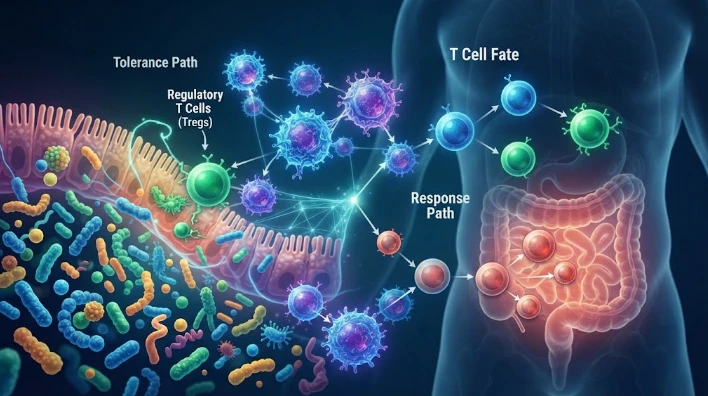
The article describes intestinal immune tolerance as an active balance among T-cell fate, microbial composition, epithelial integrity, antibodies, and metabolic signaling. Selected bacterial groups and fermentation products can promote regulatory T cells, while other commensals support strong T-helper-17 responses that can remain context dependent rather than uniformly inflammatory. Regulatory T-cell sensing, immunoglobulin A, barrier function, dendritic-cell communication, and microbial metabolites form reciprocal circuits that maintain controlled exposure without eliminating commensal stimulation. The article emphasizes that dysbiosis alone does not establish causality because host genetics, diet, medication, age, and inflammation can reshape the same ecosystem. Longitudinal systems immunology, spatial profiling, functional suppression assays, and mechanistic perturbation are proposed to distinguish durable tolerance from temporary suppression. Candidate interventions should preserve pathogen defense and tissue repair. Overall, successful tolerance is defined as selective restraint, stable barriers, and preserved protective immunity rather than generalized immunosuppression or a particular microbial composition.
Intestinal immune tolerance is an active process. The surface is inhabited by trillions of microbe cells and a constant flow of antigens from food that must be receptive to antigens from pathogens and yet not respond to harmless ones with chronic inflammation. The fate of the T cells is at the heart of that balance. Regulatory T cells, commensal-specific effector cells, follicular helper populations and tissue resident states work together with antibodies and epithelial defenses to maintain microbial exposure that is compatible with tissue integrity.
This tolerant state is developed with the help of the microbiome. Fermentation metabolites play a role in the promotion of regulatory T (Treg) cell differentiation in the colon via specific bacterial groups. The short chain fatty acids are able to modify the cellular metabolism and/or chromatin, which favors programmes linked to the expression and suppressive function of Foxp3. Microbial composition thus affects the chemical context in which T cell fate decisions are made.
Tolerance is not defined as immune silence. Segmented filamentous bacteria are a good example to consider as they induce robust T helper 17 (Th17) responses during colonization. These cells are typically found in the context of inflammation but can also gain regulatory properties and produce IL-10, as do commensal specific T helper 17 cells. Function is context, location, antigen, and transcriptional state dependent and not based on a single lineage label.
Regulatory T cells also directly sense signals from microbes. Specific deletion of the adaptor MyD88 in regulatory T cells leads to dysregulation of regulatory intestinal populations, loss of immunoglobulin A control over intestinal commensals, enhanced T helper 17 responses, and inflammation in mouse models. The outcome combines the innate sensing of microbes within a regulatory compartment with community control. Tolerance develops on the basis of communicating with each other, not from one-sided suppression.
The immunoglobulin A is an important component of that system. Secretory immunoglobulin A, which is a coating of intestinal microbes, is capable of reducing access of the epithelium to microbes but without killing them. T follicular helper and regulatory cells regulate the selection of antibody in gut lymphoid tissues. The signals returned to the T cells when this antibody layer changes may cause microbial localization or community structure to shift. Humoral and cellular tolerance is thus closely linked.
Barrier integrity is another method of control. Most microbes are separated from deep tissue by a healthy epithelium and there is controlled sampling of antigens. Damage can lead to increase in microbial products and increase inflammatory cytokines that promote the differentiation of effectors. Then inflammation changes the oxygen and nutrient environment and favours the growth of organisms that can thrive in the new environment. The barrier defect can then transform a tolerant circuit into an inflammatory one that reinforces itself.
The probability of that transition is dependent on the composition of the microbiome, but the composition of the microbiome does not determine tolerance. The same species can have different metabolic functions in different communities and strains can have different metabolic functions in the same community or nutrient condition. Relative abundance is not always the most important functional readout, for example, if it is one of metabolite production, mucosal attachment, antigenicity, and resistance to colonization.
There is also a degree of disease heterogeneity, as human immune disease adds. Host genetic variation in HLA molecules, cytokine receptors, epithelial proteins or innate sensing may alter the perception of microbial signals. All of the above, including medication, diet, age, and history of infection, affect the same network. The tissue context of a bacterium is different from one place to another, therefore, a bacterium that participates in a regulatory response in one location can be involved in inflammatory response in another.
Longitudinal systems immunology allows to distinguish permanent tolerance from transient suppression. Multiple sampling can monitor for the presence or absence of regulatory clonotypes, the shrinkage of effector populations following antigen reduction, and recovery of microbial functions following treatment. To achieve stable remission, reducing inflammatory markers should not occur at a single visit. A tolerant resilient state should be able to withstand normal disturbances and should not become disease activity rapidly.
CMA can help test for causality between an intervention and an immune outcome when there is microbial change in between the two. Assume that a diet change affects the metabolites of the microbes and the number of regulatory T cells. To determine if metabolite change statistically explains some of the immune effects, one can use a mediation model, but mechanistic experiments remain to be conducted. Controlled systems can be used to provide the complementary evidence necessary for a causal interpretation by blocking the metabolite receptor or by increasing the metabolite in controlled systems.
External validation is important since mechanisms of tolerance may only be cohort-specific. Geography, diet, sequencing pipelines and medication patterns are all factors that greatly influence microbiome studies. A signal that is identified in one clinical center should be evaluated in independent populations that are separately analyzed with a prespecified analysis. A pathway level finding that is reproducible will have greater translational value than a taxonomic finding that goes away if the cohort changes.
Spatial measurements can provide information on whether tolerant cells and microbes are in-situ and if they are in the expected niche. Regulatory cells in the vicinity of epithelial areas in contact with specific microbial cues can be identified by tissue imaging and spatial transcriptomics. Microbial localization can be used to assess relative localization of pairs of microorganisms within the lumen or in direct contact with mucosa. This data can help identify a non-pathogenic resident from a potentially inflammatory organism that has the same abundance of fecal bacteria.
The network logic should be maintained in therapeutic approaches. Broad microbial depletion will not only remove harmful organisms, but also remove organisms that help regulate metabolites as well. Moving a microbial community without knowledge of the host context can yield variable results. However, more targeted approaches may be possible, including defined strains, metabolites, phages, diet-dependent functions, or immune pathways, which each need to be tested for safety and durability.
Limiting inappropriate responses to food antigens also helps achieve tolerance. Intestinal proteins are exposed to the same environment as microbial antigens, but most exposures do not result in destructive intestinal immunity. This restriction is partly due to the induction of regulatory T cells in the gut draining lymph nodes and in the local tissues. Microbial metabolites can alter that process, resulting in a community metabolism/diet antigen interaction.
Loss of tolerance may thus be possible without the loss of regulatory T cells. The functional deficiency of suppressive cells may occur through several mechanisms, either numerically (due to changes to the number of cells) or functionally (due to changes to their function), as inflammatory cytokines alter the stability of suppressive cells, or effector cells grow at a faster rate. Counting of Foxp3+ cells alone is not sufficient to assess the function of Tregs, which must be determined by using functional assays that measure suppression, cytokine production, and lineage stability.
The system changes as well with age. Early life microbial colonization is during development of immune repertoires and barrier tissues while later adulthood is a more mature network. Different developmental stages can be affected differently by the same organism. Longitudinal birth cohorts can evaluate whether early microbial functions are predictive of later tolerance phenotypes; however, interpretations of causality remain to be carefully controlled for feeding, infection, and medication.
A translational endpoint should provide a measure of continuing protection. However, more regulation will not help if pathogen defense decreases significantly. Measures of vaccine responses, susceptibility to infection, and tissue repair in addition to inflammatory outcomes should be measured in candidate interventions. Successful tolerance does not cause widespread immunosuppression, but rather discrimination between harmless and dangerous stimuli.
It is also important to have a clear failure phenotype when using tolerance research. Different forms of breakdown are increased intestinal permeability, antigen specific cytokine production, loss of suppressive function and tissue inflammation. Several outcomes can be used to determine if an intervention is capable of achieving a true balance in regulation or if it simply helps to manage one inflammatory marker.
This balance is tested post controlled challenge. A tolerant system should inhibit harmless antigens, but allow for the proper response to vaccination or infection, with the ability to discriminate and not suppress.
Selective restraint, barrier stability and preserved defense can therefore best be assessed together over time as measures of mucosal tolerance.
The key message is that immune tolerance is generated by orchestrated T cell decisions in an ecological landscape. Those decisions are influenced by changes in the composition of the microbiome via antigens, metabolites, barrier interactions, and innate signals, and by changes in the microbiome by T cells via cytokines and antibody regulation. The reciprocal model is consistent with Dan R. Littman's research on T cell differentiation and the microbiome biology. Rather than eliminating microbial stimulation, long-lasting human immunity relies on a regulatory architecture that reads the constant stimulation without losing protection.
CITE THIS ARTICLE
Tasneem, S. (2025). Immune Tolerance Responses through T Cell Fate and Microbiome Composition in Human Immunity. https://www.sadiaresearchhub.com/article/001fbc33-d559-590f-9a22-b1e874477f04
S. Tasneem, “Immune Tolerance Responses through T Cell Fate and Microbiome Composition in Human Immunity,” 2025. [Online]. Available: https://www.sadiaresearchhub.com/article/001fbc33-d559-590f-9a22-b1e874477f04
Tasneem, S. (2025) ‘Immune Tolerance Responses through T Cell Fate and Microbiome Composition in Human Immunity’. Available at: https://www.sadiaresearchhub.com/article/001fbc33-d559-590f-9a22-b1e874477f04
Tasneem, Sadia. “Immune Tolerance Responses through T Cell Fate and Microbiome Composition in Human Immunity.” 2025, https://www.sadiaresearchhub.com/article/001fbc33-d559-590f-9a22-b1e874477f04.
Sadia Tasneem. “Immune Tolerance Responses through T Cell Fate and Microbiome Composition in Human Immunity.” (2025). https://www.sadiaresearchhub.com/article/001fbc33-d559-590f-9a22-b1e874477f04.
Tasneem S. Immune Tolerance Responses through T Cell Fate and Microbiome Composition in Human Immunity. 2025. https://www.sadiaresearchhub.com/article/001fbc33-d559-590f-9a22-b1e874477f04
@misc{article_001fbc33d559590f9a22b1e874477f04,
  title = {Immune Tolerance Responses through T Cell Fate and Microbiome Composition in Human Immunity},
  author = {Sadia Tasneem},
  year = {2025},
  url = {https://www.sadiaresearchhub.com/article/001fbc33-d559-590f-9a22-b1e874477f04},
}
TY  - GEN
AU  - Sadia Tasneem
TI  - Immune Tolerance Responses through T Cell Fate and Microbiome Composition in Human Immunity
PY  - 2025-08-10
UR  - https://www.sadiaresearchhub.com/article/001fbc33-d559-590f-9a22-b1e874477f04
ER  -
The article examines leukemia as an evolving population under targeted therapy, using chronic myeloid leukemia as the main example. BCR–ABL1 inhibition can produce deep responses, but every treatment changes the competitive environment among malignant clones. Quantitative transcript monitoring provides a continuous measure of disease burden, while deep sequencing can identify emerging resistance mechanisms before hematologic progression. A detected mutation is clinically meaningful only when its
The article examines how cardiovascular genetic risk becomes biologically active through cell-specific inflammatory signaling. Because many vascular-risk variants lie in regulatory DNA rather than coding regions, their effects may appear only in particular endothelial, macrophage, smooth-muscle, or lymphocyte states. Single-cell studies of human atherosclerotic lesions and multiomic endothelial experiments are used to illustrate this context dependence. The article also discusses IL6-related sig
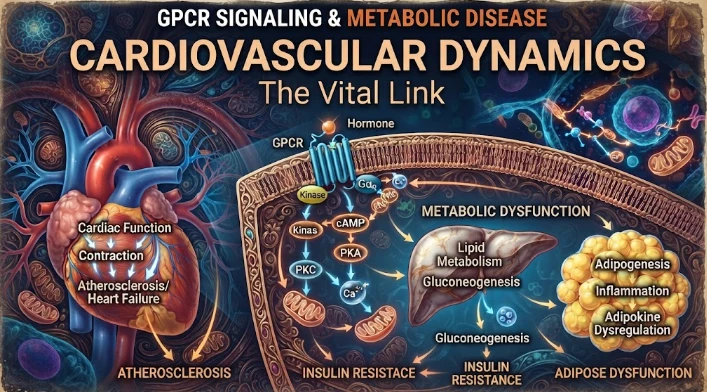
The article examines cardiovascular GPCR signaling as a dynamic response system whose abnormalities can remain hidden in resting measurements. Mechanical stretch, hormones, nutrients, sympathetic activity, and fluid balance can change the amplitude, duration, localization, and recovery of receptor signaling. Examples include mechanically activated angiotensin-receptor signaling, endosomal signaling, beta-arrestin-dependent trafficking, and biased glucagon-like peptide-one receptor responses. The