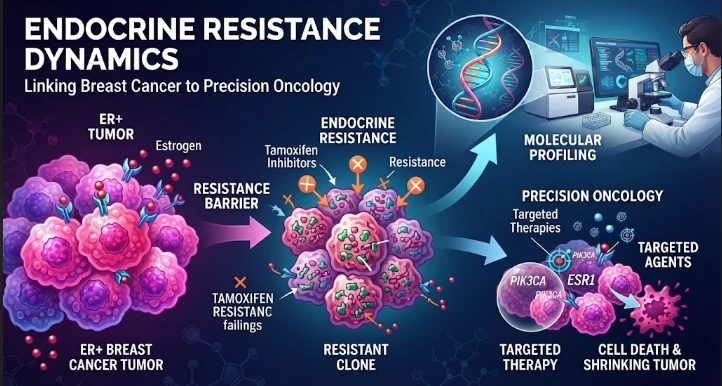
The article describes endocrine-resistant breast cancer through longitudinal systems-biology networks rather than isolated resistance genes. Estrogen-receptor signaling depends on chromatin accessibility, cofactors, enhancer contacts, metabolic pathways, cell-cycle programs, and microenvironmental signals, all of which can be rewired under therapy. CoREST- and AP1-associated chromatin changes and large integrated estrogen-response resources illustrate how regulatory relationships vary across models and conditions. Serial patient sampling adds the time dimension needed to separate early adaptation, transient stress, stable reprogramming, and progression. Functional-genomic screens can identify dependencies unique to resistant states, while organoids, xenografts, and coculture systems test whether those dependencies persist in patient-relevant environments. The article emphasizes treatment-specific networks, metabolic–transcriptional coupling, single-cell resistance modules, external replication, and clinically practical reduced signatures. Causality requires perturbation, not connectivity alone. Ultimately, the most valuable network is one whose transition can be reproducibly altered by a defined intervention that changes resistant behavior.
Endocrine resistance does not occur in a flash in breast cancer. Changes at the molecular level may occur without any changes being seen in imaging. This period not only poses a challenge but also an opportunity for precision oncology. A biomarker obtained at a time of radiographic progression reflects resistance once the transition has happened. Instead, serial molecular monitoring can pose questions regarding when the resistant clones or adaptive programs appear in a detectable fashion, how rapidly they grow, and whether intervention can be initiated prior to a detectable change in tumor burden.
The circulating tumour DNA is one indicator of the process. Tumour cell fragments may contain mutations linked to endocrine resistance, such as ESR1 mutations that are enriched following aromatase inhibitor treatment. The repeated blood samples can be used to monitor variants allele fractions throughout therapy. Conventional progression can be followed by a rising resistant clone, but this depends on the background noise, the sensitivity of the assay, the location of the disease, and on shedding of the tumor. The lack of detection does not equate with lack of resistant disease.
Resistance is extended beyond ESR1. The use of integrated DNA and RNA sequencing of endocrine resistant breast cancer have revealed heterogeneous changes in estrogen receptor signaling, GATA3, HER2, AKT, RAS and other pathways. Sometimes, transcriptional states can switch even in the absence of a new dominant mutation. Thus, a combination of circulating DNA, proteins (when possible) and RNA and imaging and, in some cases, tissue biopsy is advantageous for serial monitoring. The various layers may show complementary types of evolution.
One such recent mechanistic example is VGLL1 and TEAD signaling. Experimental studies revealed that estrogen receptor targeted therapy can activate VGLL1 which allows TEAD-dependent growth in endocrine resistant models. Blocking the interaction between VGLL1 and TEAD4 affected the growth of resistant cells. The study provides an example of an adaptive route that would not necessarily be identified by a conventional mutation panel. Even if the genomic sequence is not very different, druggable dependencies can be created by transcriptional rewiring.
Clonal heterogeneity makes serial interpretation difficult. A blood sample is a mixture of DNA from many metastatic sites, each of which may have evolved in a different local environment. Within one lesion an emerging resistant clone can exist while another is sensitive. In addition, the number of tumor shedders may change without affecting the size of the clone. Longitudinal models should thus take into account multiple mutations, imaging burden, and should not assume that a single allele trajectory represents a full map of the cancer.
Even though tissue biopsy is not very useful, it still provides cell identity, RNA, protein and spatial context. A circulating alteration that is first detected by biopsy may determine if the clone is present in a growing lesion and provide information on related regulatory pathways. If a matched baseline and progression tissue are available, they can show if an organ was present before the disease advanced or if it was acquired during the disease. If repeated biopsy is done only on a subset, that subset can help to calibrate the biopsy interpretations based on more frequent blood sampling.
Clonal evolution models in mathematics can be used to attempt to reconstruct hidden dynamics. Variants can be tracked over time to estimate growth rates and infer competition between variants. Treatment changes can be made as perturbations and the behaviour of the clones before and after a treatment change can be compared. Uncertainty should be explicitly reported in such models, as they rely on assumptions regarding shedding and sampling. If the measurement process is not modeled, then the precision looking growth curve can be biologically ambiguous.
Prospective outcome validation is crucial. A molecular rise should be compared to time to radiographic progression, symptom progression or treatment failure. The length of the lead time is not sufficient. Clinically, earlier detection is valuable only when based on that information, outcomes are improved. Trials of biomarker guided therapy can be carried out to compare switching and/or adding therapy at molecular progression versus waiting for conventional progression with monitoring of toxicity and quality of life.
The calibration of sites across diseases should be a focus. Bone dominant metastatic disease can release less circulating tumour DNA than liver or visceral disease. An optimum threshold set in a high shedding group might not capture clinically significant resistance in a different environment. Performance of the assays should be therefore be stratified by metastatic pattern and tumor burden. Liver enzyme testing with imaging can help minimize reliance on a single biological source.
Type of endocrine therapy also influences the evolution. Aromatase inhibitors decrease the production of estrogen, receptor degraders change the number of receptors, while combinations of CDK4 and CDK6 inhibitors provide cell cycle pressure. Clones resistant to one treatment regimen may not be resistant to another. Treatment sequence, treatment dose, adherence, and prior exposure are all important factors to be included in longitudinal biomarker models. A mutation that confers resistance in one setting may have a different predictive value when the history of treatment is different.
Nongenetic adaptation can be indirectly assessed via proteomic or transcriptomic markers. A change in growth factor signaling, metabolic state or transcription factor activity may increase prior to the emergence of a new clone as a genetic majority. In addition to the DNA, functional data can be provided by the liquid biopsy technologies employed with circulating proteins, extracellular vesicles or tumor derived RNA, but they are more challenging. They can only be used in conjunction with locked assays and external validation as analytical variability can show a change in the sample and not a real biological change.
Radiographic imaging shouldn't be used as the last comparison tool! Quantitative imaging allows for the monitoring of lesion specific growth, metabolic activity and heterogeneity between sites. The integration of those trajectories and the blood clonal signals can allow to identify the lesions that are driving molecular progress. A progressive mutation, which is associated with the growth of one lesion and not another, can direct targeted biopsy and aid in mechanistic attribution.
There is also opportunity for the identification of transient vulnerability in a longitudinal approach. An emerging resistant clone can still coexist with a large sensitive population. Combination therapy given during that mixed phase may be able to reduce the dominance of the resistant lineage without benefit, or may be toxic with no benefit. Further studies in preclinical competition models and future trials are required to establish when early intervention affects the outcome of evolution rather than the timing of the biomarkers.
Decision thresholds are needed for clinical implementation. If a small detected clone, there is no need to change treatment. Growth rate, assay confidence, disease burden, treatment options and expected benefit should be included in thresholds. The false alarm versus missed opportunity can be compared using decision analysis. When a molecular surveillance program results in prespecified action rather than more and more sensitive signals that are less credible, it's a credibility moment for precision oncology.
The analytical sensitivity may be a clinical problem. Technical errors, clonal hematopoiesis in the blood cells, and low level shedding of tumor cells can make it hard to interpret ultra sensitive assays. Matched white blood cell sequencing is useful to distinguish hematopoietic mutations from tumor derived variants. Reduced false positives through replicate testing and error corrected sequencing. Clinical thresholds must be based on future outcome data, not on the lowest signal that a platform is able to detect.
Another endpoint can be molecular response following a treatment change. Pharmacodynamic evidence that the mechanism chosen is important comes from a resistant clone that collapses quickly after targeted therapy. If a treatment is not making an impact and a clone continues to increase, then this means there is either insufficient engagement of the target or that the clone is not independent of the treatment. Prediction and response can thus be tested through serial measurement. The feedback loop makes liquid biopsy from a passive surveillance modality into a tool to assess if assumptions about evolution were correct.
Uncertainty in the lead-time is more appropriate than one average lead-time. Detection is possible at an early stage of high shedding disease and at a late stage of low shedding lesions. Stratified by disease site, assay depth and tumor burden, the lead time of molecular surveillance could indicate where it can be relied upon for clinical decision making.
Robert Clarke's systems approach to endocrine resistant breast cancer is a model that sees progression as a measurable evolution. A serial liquid biopsy, tissue verification, clone modelling and prospective outcomes can provide resistance information before radiographic failure, and maintain biological context. The purpose for detecting the center is not the earliest possible detection regardless of the cost. It is sensitive and early enough to see a shift in the state of the tumor that there is a more effective or safer intervention available.
CITE THIS ARTICLE
Tasmeem, S. (2025). Endocrine Resistance Dynamics Linking Breast Cancer to Precision Oncology. https://www.sadiaresearchhub.com/article/1e9abaeb-1367-5968-8c88-9f675a222902
S. Tasmeem, “Endocrine Resistance Dynamics Linking Breast Cancer to Precision Oncology,” 2025. [Online]. Available: https://www.sadiaresearchhub.com/article/1e9abaeb-1367-5968-8c88-9f675a222902
Tasmeem, S. (2025) ‘Endocrine Resistance Dynamics Linking Breast Cancer to Precision Oncology’. Available at: https://www.sadiaresearchhub.com/article/1e9abaeb-1367-5968-8c88-9f675a222902
Tasmeem, Sadia. “Endocrine Resistance Dynamics Linking Breast Cancer to Precision Oncology.” 2025, https://www.sadiaresearchhub.com/article/1e9abaeb-1367-5968-8c88-9f675a222902.
Sadia Tasmeem. “Endocrine Resistance Dynamics Linking Breast Cancer to Precision Oncology.” (2025). https://www.sadiaresearchhub.com/article/1e9abaeb-1367-5968-8c88-9f675a222902.
Tasmeem S. Endocrine Resistance Dynamics Linking Breast Cancer to Precision Oncology. 2025. https://www.sadiaresearchhub.com/article/1e9abaeb-1367-5968-8c88-9f675a222902
@misc{article_1e9abaeb136759688c889f675a222902,
  title = {Endocrine Resistance Dynamics Linking Breast Cancer to Precision Oncology},
  author = {Sadia Tasmeem},
  year = {2025},
  url = {https://www.sadiaresearchhub.com/article/1e9abaeb-1367-5968-8c88-9f675a222902},
}
TY  - GEN
AU  - Sadia Tasmeem
TI  - Endocrine Resistance Dynamics Linking Breast Cancer to Precision Oncology
PY  - 2025-12-21
UR  - https://www.sadiaresearchhub.com/article/1e9abaeb-1367-5968-8c88-9f675a222902
ER  -
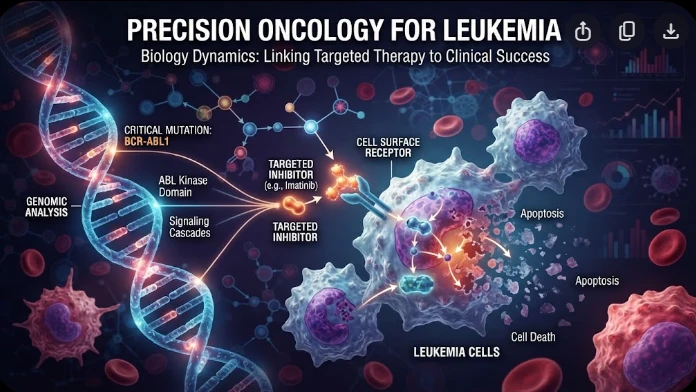
The article examines leukemia as an evolving population under targeted therapy, using chronic myeloid leukemia as the main example. BCR–ABL1 inhibition can produce deep responses, but every treatment changes the competitive environment among malignant clones. Quantitative transcript monitoring provides a continuous measure of disease burden, while deep sequencing can identify emerging resistance mechanisms before hematologic progression. A detected mutation is clinically meaningful only when its
The article examines how cardiovascular genetic risk becomes biologically active through cell-specific inflammatory signaling. Because many vascular-risk variants lie in regulatory DNA rather than coding regions, their effects may appear only in particular endothelial, macrophage, smooth-muscle, or lymphocyte states. Single-cell studies of human atherosclerotic lesions and multiomic endothelial experiments are used to illustrate this context dependence. The article also discusses IL6-related sig
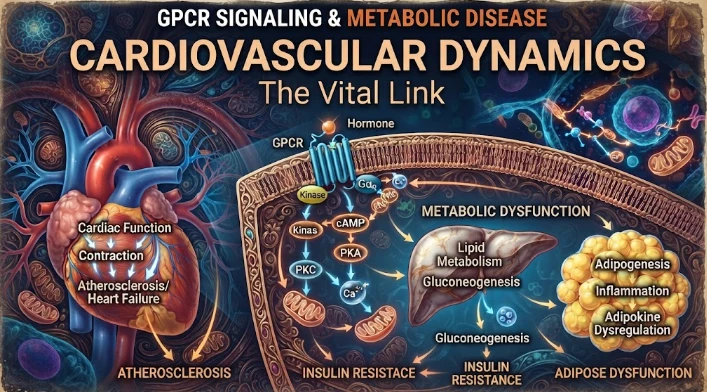
The article examines cardiovascular GPCR signaling as a dynamic response system whose abnormalities can remain hidden in resting measurements. Mechanical stretch, hormones, nutrients, sympathetic activity, and fluid balance can change the amplitude, duration, localization, and recovery of receptor signaling. Examples include mechanically activated angiotensin-receptor signaling, endosomal signaling, beta-arrestin-dependent trafficking, and biased glucagon-like peptide-one receptor responses. The