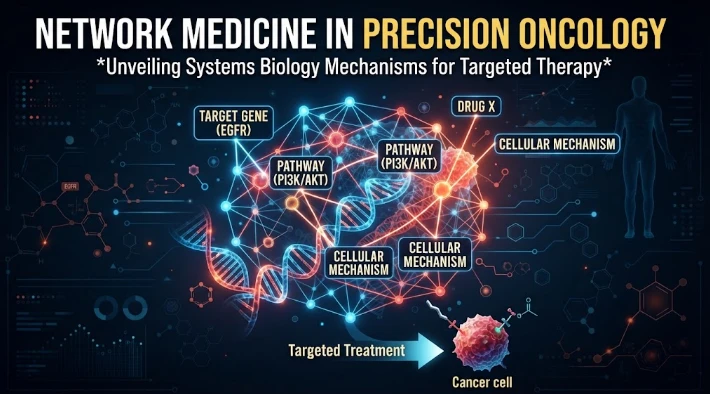
The article describes network medicine as a way to identify the regulatory systems that sustain cancer states beyond individual mutations. Gene-regulatory networks infer relationships between transcriptional regulators and their targets, while master-regulator approaches such as VIPER estimate functional protein activity from coordinated expression patterns. This allows genetically different tumors to converge on similar regulatory dependencies and genetically similar tumors to behave differently. The article discusses drug-perturbation signatures, cancer plasticity, single-cell states, spatial niches, patient-derived models, and CRISPR validation as tools for moving from computational prediction to causal dependency. Longitudinal profiling can reveal regulatory modules that appear during treatment before clinical progression. Independent validation, uncertainty estimates, normal-tissue comparisons, and practical clinical assays are emphasized. Overall, the article argues that precision oncology should ask which control system currently sustains the malignant phenotype and which actionable network node can destabilize that state, rather than relying only on mutation–drug matching.
copy number changes, epigenetic states, signaling pathways, and transcription factors. Network medicine attempts to model that identity as a regulatory system. Precision oncology is about more than just identifying abnormalities, it's about finding the handful of network controllers that keep a tumour alive and can identify vulnerabilities that are not apparent by mutation-based matching.
One pathway to that is via gene regulatory networks. Large expression datasets can be used to infer relationships between transcriptional regulators and target genes. The resulting network describes the set of regulators whose activation or repression is likely to activate or repress given expression programs in a specific tissue context. The context is very important as the same transcription factor can activate different targets in melanoma, prostate cancer or lymphoma.
Master regulator analysis is based on this structure. Algorithms can determine if a tumor will exhibit an overall activation or repression of the predicted targets of a regulator rather than whether the regulator is highly expressed. The activity can then be deduced from the activity of the regulon. This is important as the amount of protein of transcription factors does not necessarily correspond to their functionality following their phosphorylation, movement, or protein-protein interactions.
VIPER and network based approaches were developed to estimate regulator activity from gene expression. These approaches can detect proteins that are downstream to a variety of genomic changes but share a common tumor phenotype. Hence, different mutations can give rise to 2 different tumors that rely on the same master regulators. On the other hand, two tumours with the same driver mutation can be in different regulatory states and respond to treatment differently.
This state based view takes precision oncology beyond the scope of direct drug mutation pairs. A mutation may be significant because of the network program it generates, and a drug may be useful because it negates the network program that resulted from the mutation, even if the drug does not specifically target the mutated gene. Drug perturbation signatures can be used to compare with tumor regulatory states to predict the compounds that will be likely to flip the master regulator activity.
Network analysis is particularly important in the case of cancer plasticity. Treatment can kill the dominant population and the surviving cells are reprogrammed to make them resistant. That transition may have no new mutations; it may be by transcriptional change. Network models can be used to compare resistant and pre-treatment samples to find regulators that are activated during adaptation. These types of regulators may serve as targets for combination therapy or interception.
In various cancer types, modular landscapes of master regulators associated with different tumor states have been identified. These modules can be recurrent with different tissue types and/or genomic backgrounds. A network module is then a functional phenotype that links numerous upstream changes to downstream behavior. Conventional labels of patient subtypes cannot be captured through mapping of modules across patients.
Validating cause is still critical. There may be false-positive connections in network inference in cases of indirect effects. To determine if a predicted regulator is essential for survival or state maintenance, it can be tested using CRISPR perturbation, RNA interference, or small molecule inhibition. Rescue experiments can provide clues as to whether restoration of downstream activity can reverse the effect. Functional evidence is a computational prediction that is converted to a mechanistic dependency.
Predicted therapies can be tested on patient derived models. Imortalized cell lines have less biological context than organoids, xenografts, and ex vivo tumor cultures. A network model built from a patient can nominate a drug, combination, and then tested in the matched model. A match between the predicted regulator reversal and the tumor response bolsters the argument for treatment that is network guided.
Resolution is further enhanced with single cell data. Average expression of malignant cells, immune cells, stromal cells and combine different cancer states in bulk tumor. Using single cell network analysis, master regulators in rare resistant subpopulations can be identified. Spatial profiling can reveal if those states fill hypoxic niches, immune excluded niches or invasive niches. Network medicine then is no longer a map of one average tumor, but a map of multiple states of a tumor.
Treatment evolution is treated in a longitudinal analysis. The validation of a liquid biopsy surrogate or serial biopsies can reveal the response of a regulatory module following therapy, in terms of disappearance, persistence, or replacement. A progressive resistant state prior to radiographic progression may be the earliest indication for treatment adaptation. This monitoring needs to be based on assays that can be reproduced and thresholds that have been validated to ensure that the alarm does not trigger false alarms due to transient noise.
External validation of network models is also required. Regulatory relationships derived from one cohort may be platform dependent, tumor type dependent or quality dependent. Independent datasets should be used to test if the same phenotype and response is predicted by master regulator activity. It is especially important to ensure cross platform reproductivity when a model is planned to be used in clinical practice. Biological validation should be accompanied by calibration and prospective evaluation.
OncoLoop and network-based frameworks similar to it take this concept further to connect the tumor state, regulatory circuits and therapeutic hypotheses. The central idea is iterative: make an inference about the regulatory program, make a perturbation to the predicted dependencies, make an observation, and update the model. The kind of loops observed by cancer mimic, and precision treatment is a dynamic learning problem and not a genomic classification once and done.
When reconstructing the network, it is important to consider previous knowledge of processes, but not let previous knowledge bias the data. Given a protein interaction map, chromatin binding data and pathway annotations can limit which regulators are plausible targets of particular proteins. Those relationships can then be further informed by data driven inference in the context of the cancer. A hybrid model may yield more “explainable” results than a network constructed from scratch using correlation.
Uncertainty should be reported at the level of the regulator. If multiple proteins share similar evidence they can lead to false precision from a ranked master regulator list. Confidence can be estimated on bootstrap networks, using cross validation and perturbation consistency. The choice of treatment should be based on a dependency that is not sensitive to the choice of model but on the presence of a single dependency.
Normal tissue comparison matters because normally a very important factor for cancer can be very important to normal cells. Prior to therapeutic targeting, it is important to review the activity of the network in the tissue of origin and other susceptible organs. Selectivity may occur because of tumor specific wiring of enhancers, synthetic interactions or dosage dependence. Toxicity risks not detected by tumor-only screens can be detected by functional testing in normal organoids.
Immune and stromal states can also be incorporated into network medicine. Fibroblast signals can strengthen a cancer cell dependency or weaken it through immune activity. A cross compartment edge, for example, a stromal ligand activating a tumour regulator, can be identified using a multicellular network model. System analysis can provide more therapeutic options than simply targeting the downstream regulator with perturbation of the signal source is sometimes safer.
The design of clinical assays should eventually flow to a steady decision variable. While discovery can benefit from full transcriptome sequencing, regular treatment selection requires reproducible sample preparation, fast computation and a fixed model. If verified with the entire network, targeted expression panels could approximate the activity of master regulators. The only compression that has value is when predictive and mechanistic information is maintained.
The difference between dependency and vulnerability should also be noted in network models. A regulator may be necessary but it may be inaccessible in the cell, whereas a neighbouring enzyme or receptor might be accessible and be able to destabilize the same state. Identifying actionable control points around the master regulator widens the scope of discovery-to-therapy.
Precision oncology is provided with a functional level between genotype and phenotype by systems biology network mechanisms. Therapy reconstitutes cellular states by selection and adaptation, which in turn stabilizes cellular states by master regulators, which in turn imposes pressure on regulatory circuits that lead to mutations. Network medicine is able to uncover convergent dependencies between genetically distinct tumors and divergent behavior between genetically similar tumors. Its best laurels are its ability to move away from the question of which gene is mutated, and instead focus on which control system is sustaining the cancer in its current form.
CITE THIS ARTICLE
Tasmeem, S. (2026). Systems Biology Network Mechanisms through Network Medicine in Precision Oncology. https://www.sadiaresearchhub.com/article/238f2dfd-ce28-55c1-998d-25fb22f57289
S. Tasmeem, “Systems Biology Network Mechanisms through Network Medicine in Precision Oncology,” 2026. [Online]. Available: https://www.sadiaresearchhub.com/article/238f2dfd-ce28-55c1-998d-25fb22f57289
Tasmeem, S. (2026) ‘Systems Biology Network Mechanisms through Network Medicine in Precision Oncology’. Available at: https://www.sadiaresearchhub.com/article/238f2dfd-ce28-55c1-998d-25fb22f57289
Tasmeem, Sadia. “Systems Biology Network Mechanisms through Network Medicine in Precision Oncology.” 2026, https://www.sadiaresearchhub.com/article/238f2dfd-ce28-55c1-998d-25fb22f57289.
Sadia Tasmeem. “Systems Biology Network Mechanisms through Network Medicine in Precision Oncology.” (2026). https://www.sadiaresearchhub.com/article/238f2dfd-ce28-55c1-998d-25fb22f57289.
Tasmeem S. Systems Biology Network Mechanisms through Network Medicine in Precision Oncology. 2026. https://www.sadiaresearchhub.com/article/238f2dfd-ce28-55c1-998d-25fb22f57289
@misc{article_238f2dfdce2855c1998d25fb22f57289,
  title = {Systems Biology Network Mechanisms through Network Medicine in Precision Oncology},
  author = {Sadia Tasmeem},
  year = {2026},
  url = {https://www.sadiaresearchhub.com/article/238f2dfd-ce28-55c1-998d-25fb22f57289},
}
TY  - GEN
AU  - Sadia Tasmeem
TI  - Systems Biology Network Mechanisms through Network Medicine in Precision Oncology
PY  - 2026-04-12
UR  - https://www.sadiaresearchhub.com/article/238f2dfd-ce28-55c1-998d-25fb22f57289
ER  -
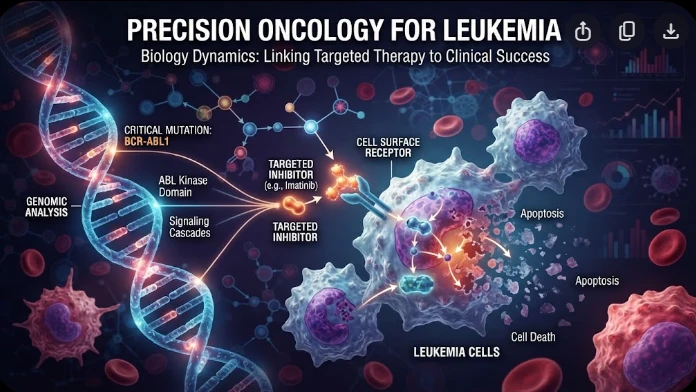
The article examines leukemia as an evolving population under targeted therapy, using chronic myeloid leukemia as the main example. BCR–ABL1 inhibition can produce deep responses, but every treatment changes the competitive environment among malignant clones. Quantitative transcript monitoring provides a continuous measure of disease burden, while deep sequencing can identify emerging resistance mechanisms before hematologic progression. A detected mutation is clinically meaningful only when its
The article examines how cardiovascular genetic risk becomes biologically active through cell-specific inflammatory signaling. Because many vascular-risk variants lie in regulatory DNA rather than coding regions, their effects may appear only in particular endothelial, macrophage, smooth-muscle, or lymphocyte states. Single-cell studies of human atherosclerotic lesions and multiomic endothelial experiments are used to illustrate this context dependence. The article also discusses IL6-related sig
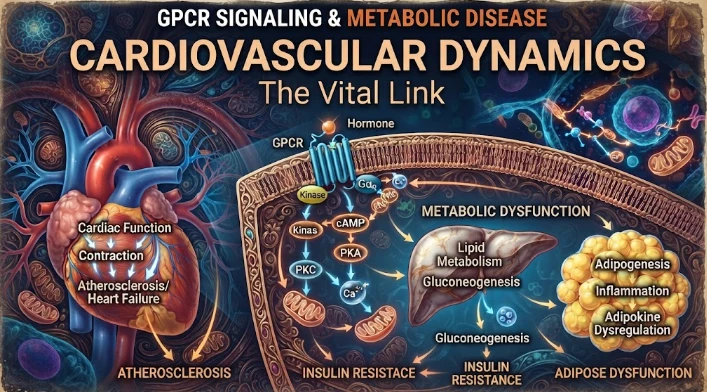
The article examines cardiovascular GPCR signaling as a dynamic response system whose abnormalities can remain hidden in resting measurements. Mechanical stretch, hormones, nutrients, sympathetic activity, and fluid balance can change the amplitude, duration, localization, and recovery of receptor signaling. Examples include mechanically activated angiotensin-receptor signaling, endosomal signaling, beta-arrestin-dependent trafficking, and biased glucagon-like peptide-one receptor responses. The