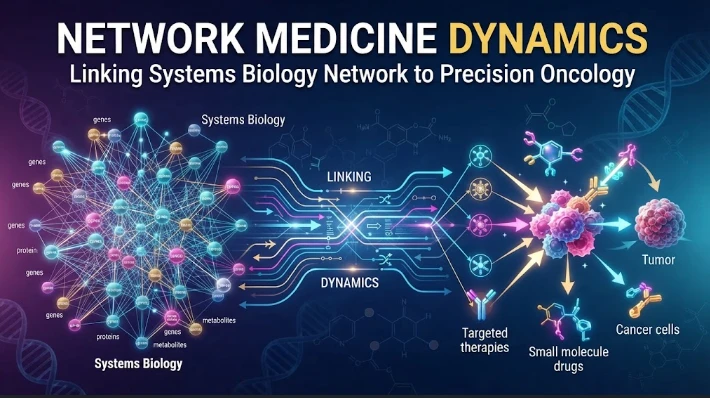
The article examines network medicine as a dynamic framework for tracking how cancer regulatory states change under therapy. Rather than treating resistance only as a new mutation, it describes treatment-driven transitions among transcriptional programs, drug-tolerant states, and stable resistant states. Gene-regulatory networks and master regulators are used to identify the proteins maintaining each state, while drug-perturbation data can nominate compounds capable of reversing those programs. Single-cell and spatial profiling reveal rare resistant populations and microenvironmental niches that bulk measurements can miss. CRISPR, organoids, xenografts, and serial biopsies provide functional and temporal validation. The article also discusses attractor-state models, adaptive treatment, network-informed combinations, and the need for locked algorithms, reproducible assays, and clinically validated thresholds. The central message is that precision oncology should continuously update treatment hypotheses as the tumor evolves, targeting the regulatory program sustaining survival at each stage rather than relying on a one-time genomic classification.
Precision oncology is often described as a match-up between a molecular change and a targeted drug. But, cancer evolution makes that a game of cat-and-mouse. Regulatory networks can be reorganized following treatment and tumor cells can shift into a different dominant mutation without actually obtaining a new mutation. Network medicine is useful because it can trace those state changes and determine which regulators are crucial as therapy alters the tumor ecosystem.
A gene regulatory network is a representation of relationships between transcriptional regulators and target genes in a given context of a cell. Patterns of network activity can be deduced not only by the abundance of regulators but also by expression patterns. This is important as this activation can occur through phosphorylation, localization, degradation, and protein interaction without increasing levels of messenger RNA. Conventional expression rankings do not necessarily show functional activity.
A cell state is specified by the combined activity of proteins called master regulators. In cancer, a small number of regulatory pathways can coordinate information from many other upstream mutations. A tumor with a few genetic defects may, therefore, end up with a same regulatory phenotype. Network medicine is looking for that intersection, making treatment hypotheses that are derived from state dependencies, not just the initial mutation list.
The dynamic part comes about in the therapeutic pressure. One signaling pathway can be suppressed by a targeted drug, altering transcription and chromatin in the remaining cells. Some cells die, some cells remain as "drug tolerant," and others proliferate by adapting to a preexisting drug resistance. These trajectories can be distinguished by a regulatory network analysis of serial samples by identifying master regulators that increase or decrease prior to the onset of disease.
At first such reprogramming is reversible. Stable genetic resistance is not the only mechanism for drug tolerant persister states. Early combination therapy may prevent the development of persisters if a network model is able to predict the regulators responsible for maintaining this state. Target selection is no longer the only factor—it's all about timing.
Master regulator landscapes in cancer support the notion that tumors exist in recurrent regulatory modules. More than one cancer type can have multiple states with varying dependencies and more than one module can create an equivalent state. These modules can be compared within patients to find convergent biology. A drug that is effective in a particular regulatory module might therefore be relevant to other regulatory modules.
Information about the drugs can link network state to therapy. A perturbing event of an expression change in the opposite direction of the tumor master regulator program can nominate a potential state reversing treatment. This approach does not require all useful drugs to bind the top regulator. A drug may be upstream or parallel to a similar regulatory program that fails the same program.
Functional validation is used to test if these predictions are true. The candidate regulators can be manipulated by CRISPR editing, disruption by targeted degradation or RNA interference, or inhibition by targeted inhibitors. When the state of the tumor collapses and viability decreases, then the prediction is given causal support. Specificity can be tested using rescue experiments. Patient derived organoids and xenografts then serve as a better real-world setting for testing the predicted combinations.
Dynamic network medicine becomes more precise when using single cell profiling. A resistant population may start as a small subset that will not show in bulk expression. Single cell transcriptomics can detect that state, and inferred regulatory activity will pinpoint that's its controlling proteins. Multiple sampling can be used to determine if the state existed prior to treatment, or if it resulted from adaptation. This difference can alter the approach to prevention.
Network state also is affected by spatial organization. Different transcriptional programs can coexist within the same tumor due to hypoxia, nutrient limitation, immune pressure, fibroblast signals and extracellular matrix. A piece of a regulatory module that is associated with resistance may not be in the whole lesion. Network activity can be linked to microenvironmental conditions in the region by multiplex imaging and spatial transcriptomics, providing insight into the dependencies established by the tumor ecology.
However, while DNA mutation is more easily measurable in regulatory state than in circulation, liquid biopsy is another potential pathway for long-term monitoring. Circulating tumor RNA, proteins or methylation patterns may serve as indirect markers, and circulating tumor DNA may offer a way to monitor the evolution of the clones. It is still vital to have tissue to confirm cellular context. There is a possibility to use a hybrid monitoring strategy (frequent circulating monitoring plus tissue monitoring).
Locked algorithms and action rules are needed for clinical implementation. Treating a network score if results are just slightly different on each sample is not warranted. Defining technical variability, biological variability and thresholds related to meaningful state transition, are necessary for prospective studies. Before network dynamics can inform decisions, calibration against outcomes and treatment response are required.
Another concept that is changing is resistance in network medicine. Resistance is not limited to a new mutation that prevents binding with the drug. This can be a system level reorganization which redefines the signaling system and stabilizes a new cell identity. This resistance can make the original target incapable of functioning, while the tumour can continue to live on a different programme. The goal of regulatory network analysis is to identify just such adaptation.
State changes can be illustrated as attractors in a regulatory landscape. One part is a stable cancer phenotype, the other is a therapy which alters the landscape and makes an alternate state easier to enter. Master regulators are used to establish the boundaries between these states. It is better to block multiple regulators simultaneously than to block one pathway that the network can circumvent.
Population context can be added to evolutionary game concepts. Nutrients, secreted factors and immune interactions between sensitive and resistant states are possible. Once competing sensitive cells are eliminated from the population by treatment, a resistant minority may dominate the population. Thus, measurements of the network in addition to population frequency can predict more than intracellular regulation. These models can inform strategies to minimize the risk of ecological release of resistant states.
These transitions need to be estimated with high temporal resolution. Only at baseline and progression will there be no clue about the intermediate path. Treatment biopsies can detect if a network is collapsing as expected early on treatment, and residual disease sampling can detect compensatory modules. This means that both regression of the tumor and the direction of the regulatory axis can be considered in judging the efficacy of a treatment, either towards durable control or towards a known resistant state.
If biomarkers are validated, adaptive designs can be used for network based trials. If a participant becomes resistant to the first agent as defined by a prespecified set of criteria, they may be treated with a second agent against the same module.If a participant becomes resistant to the first agent as defined by a prespecified set of criteria, he or she may receive a second agent against the same module. Good assay reproducibility, turnaround and safety rules are essential for such designs. It is a concept, not just an explanation of what happened in the past, but a glimpse into how network dynamics might be able to affect the timing of treatment in the future.
A regulator's timing of the perturbation can indicate whether they are starting an anti-resistance or continuing to maintain it. Blocking prior to treatment tests prevention, blocking after the resistant state tests maintenance. Various outcomes mean various clinical approaches. A prevention target could be paired from the beginning, and a maintenance target could be used for molecularly-detected escape.
This is true for treatment withdrawal as well. The state can be adaptable, not fixed, since a resistant network fails subsequently following the removal of the drugs. Rechallenge experiments can assess memory and help identify the risk of fast re-entry into the resistant program by cycling therapy.
The potential for systems biology is to use repeated molecular measurements to create a model of the changing tumor state. Precision oncology can then seek to identify which master regulators are especially prominent at baseline, which emerge during treatment, and which therapeutic action could upset the status quo. Dynamic network medicine considers cancer an adaptive system, instead of a static molecular specimen. That change opens a new avenue for treatment being targeted to the mutations the tumor possesses, and to the regulatory program that drives the survival at the time of selecting treatment.
CITE THIS ARTICLE
Tasmeem, S. (2026). Network Medicine Dynamics Linking Systems Biology Network to Precision Oncology. https://www.sadiaresearchhub.com/article/5b4b5b4b-a3c3-5da2-83ec-8408df4c4a7a
S. Tasmeem, “Network Medicine Dynamics Linking Systems Biology Network to Precision Oncology,” 2026. [Online]. Available: https://www.sadiaresearchhub.com/article/5b4b5b4b-a3c3-5da2-83ec-8408df4c4a7a
Tasmeem, S. (2026) ‘Network Medicine Dynamics Linking Systems Biology Network to Precision Oncology’. Available at: https://www.sadiaresearchhub.com/article/5b4b5b4b-a3c3-5da2-83ec-8408df4c4a7a
Tasmeem, Sadia. “Network Medicine Dynamics Linking Systems Biology Network to Precision Oncology.” 2026, https://www.sadiaresearchhub.com/article/5b4b5b4b-a3c3-5da2-83ec-8408df4c4a7a.
Sadia Tasmeem. “Network Medicine Dynamics Linking Systems Biology Network to Precision Oncology.” (2026). https://www.sadiaresearchhub.com/article/5b4b5b4b-a3c3-5da2-83ec-8408df4c4a7a.
Tasmeem S. Network Medicine Dynamics Linking Systems Biology Network to Precision Oncology. 2026. https://www.sadiaresearchhub.com/article/5b4b5b4b-a3c3-5da2-83ec-8408df4c4a7a
@misc{article_5b4b5b4ba3c35da283ec8408df4c4a7a,
  title = {Network Medicine Dynamics Linking Systems Biology Network to Precision Oncology},
  author = {Sadia Tasmeem},
  year = {2026},
  url = {https://www.sadiaresearchhub.com/article/5b4b5b4b-a3c3-5da2-83ec-8408df4c4a7a},
}
TY  - GEN
AU  - Sadia Tasmeem
TI  - Network Medicine Dynamics Linking Systems Biology Network to Precision Oncology
PY  - 2026-04-05
UR  - https://www.sadiaresearchhub.com/article/5b4b5b4b-a3c3-5da2-83ec-8408df4c4a7a
ER  -
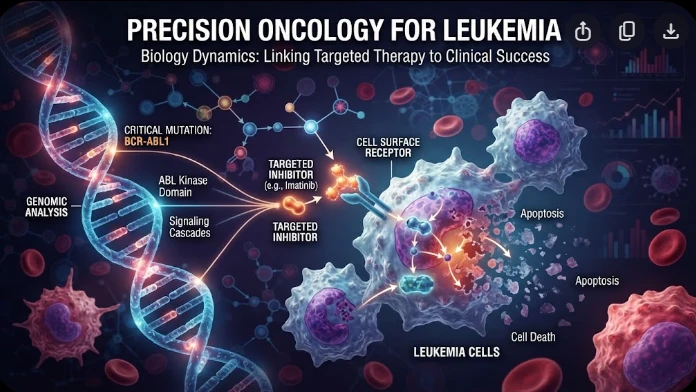
The article examines leukemia as an evolving population under targeted therapy, using chronic myeloid leukemia as the main example. BCR–ABL1 inhibition can produce deep responses, but every treatment changes the competitive environment among malignant clones. Quantitative transcript monitoring provides a continuous measure of disease burden, while deep sequencing can identify emerging resistance mechanisms before hematologic progression. A detected mutation is clinically meaningful only when its
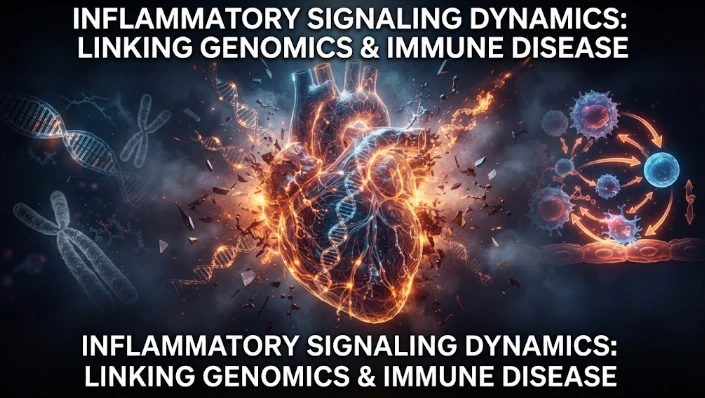
The article examines how cardiovascular genetic risk becomes biologically active through cell-specific inflammatory signaling. Because many vascular-risk variants lie in regulatory DNA rather than coding regions, their effects may appear only in particular endothelial, macrophage, smooth-muscle, or lymphocyte states. Single-cell studies of human atherosclerotic lesions and multiomic endothelial experiments are used to illustrate this context dependence. The article also discusses IL6-related sig
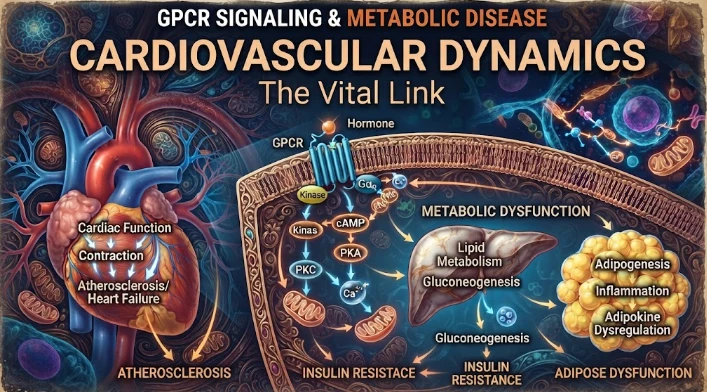
The article examines cardiovascular GPCR signaling as a dynamic response system whose abnormalities can remain hidden in resting measurements. Mechanical stretch, hormones, nutrients, sympathetic activity, and fluid balance can change the amplitude, duration, localization, and recovery of receptor signaling. Examples include mechanically activated angiotensin-receptor signaling, endosomal signaling, beta-arrestin-dependent trafficking, and biased glucagon-like peptide-one receptor responses. The