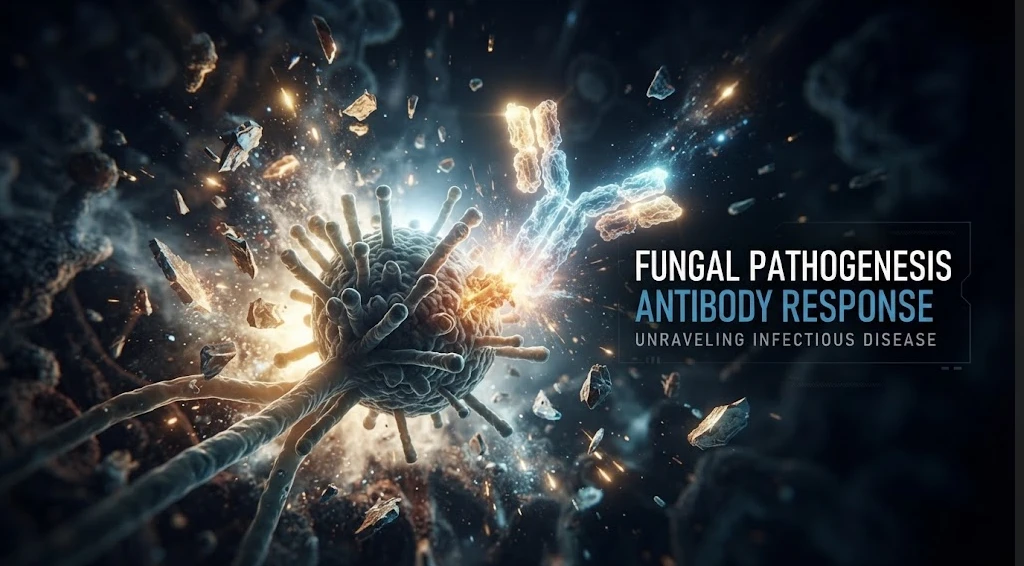
The article examines fungal pathogenesis through the functional quality of antibody responses, using Cryptococcus neoformans as the main model. It explains that antibody binding alone does not guarantee protection because isotype, epitope location, concentration, complement activity, Fc-receptor engagement, capsule architecture, and fungal phenotype all influence outcome. Experimental monoclonal-antibody studies show that some antibodies improve clearance, alter fungal physiology, inhibit biofilms, or change macrophage interactions, whereas others offer little protection. The discussion also emphasizes that antibody pressure can reshape fungal gene expression, capsule characteristics, and potential immune escape. Clinical translation is illustrated through the 18B7 monoclonal-antibody trial in cryptococcal meningitis. The article ultimately supports integrating pathogen genomics, longitudinal immune profiling, functional antibody assays, fungal morphology, treatment combinations, and standardized challenge systems to determine whether specific antibody repertoires genuinely reduce pathogen fitness and improve host outcomes.
The fungal infection raises a hard question about immunity: Just because the antibody binds, doesn't mean it's protecting. The biological effect of antibodies against the same organism can be very different in cryptococcosis depending on the antibody's specificity for the polysaccharide capsule. Some are considered to be clearance agents, some change the physiology of fungi, others appear to be of little value. The ability to respond to antibody induction is not simply indicative of infection; it is a factor in fungal pathogenesis.
Cryptococcus neoformans is a good example since its capsule is the most prominent virulence determinant and a target of antibody. The capsule prevents phagocytosis, regulates inflammatory signaling and facilitates survival in a mammalian host. Experiments using monoclonal antibodies revealed that some antibodies were protective without recognizing the antigen. The outcome can vary based on isotype specificity, epitope specificity, antibody concentration, complement binding, binding to Fc receptors, and binding site location in the capsule.
A case study was described in an early mouse study that compared two IgM monoclonal antibodies. Of the two antibodies (12A1 and 13F1), only antibody 13F1 has been found to protect animals from lethal infection; both antibodies recognize cryptococcal capsular material. That difference proved that humoral immunity is not simply a matter of numbers of antibodies. Functional quality is important because different antibodies activate immune mechanisms in different ways and can alter the way that fungal cells interact with the cell, complement and surrounding tissue.
It is not a small, inert particle that the fungal cell is. Studies using the monoclonal antibody 18B7 have shown that binding has a potential to modify the gene expression, size and capsule characteristics of cryptococcal cells. The different fungal strains showed different transcriptomic responses and time schedules. These results are part of a general picture in which host antibody pressure constitutes an environmental cue that is sensed by a pathogen, thus providing a further dimension to the evolutionary arms race between immunity and pathogenicity.
The different effects of the antibodies can be understood by the capsular architecture. Cryptococcal glucuronoxylomannan is an extracellular matrix that is complex and has varying density and organization between different strains and growth phases. Binding in the vicinity of the cell wall could result in a different mechanical and signaling environment compared to binding towards the capsule exterior. A more compressible strain may display different epitopes, alter antibody penetration and alter interaction with immune cells. Thus, the efficacy of antibodies can be influenced by the pathogen phenotype, even before the downstream immune pathway is activated.
Antibodies can also directly affect the functioning of the fungal communities. Experimental studies revealed that specific antibody against the capsule decreases the formation of Cryptococcus biofilms. Biofilms are important because the aggregated cells of fungi that are within the extracellular material have increased resistance to environmental stress and may be more difficult to treat with antimicrobial agents. Infection persistence could be affected by an antibody that changes adhesion or matrix organization but not necessarily by classic neutralization. Besides opsonization and complement activation, direct physiological effects are also worthy of consideration.
There's another level of macrophage response. The antibody bound fungi are more readily recognised by the Fc receptors, which leads to phagocytosis and affects the intracellular signalling of the phagocyte. The ingestion of cryptococcal antigen in the studies demonstrated that both Fc receptor and complement receptor pathways are able to modify cell cycle signaling in macrophages following ingestion of fungal antigen. The clinically relevant outcome will be based on what follows engulfment because under some conditions Cryptococcus can survive and replicate within a macrophage. This requires that the recognition of an antibody be coupled to productive killing instead of enhanced uptake.
This separation is particularly relevant when infection is severe, when fungal burden, site of infection, immune status, and antifungal exposure all contribute to outcome. The antibody that is effective at a certain density of the organism may have reduced efficacy at a different density. However, Fc receptor systems vary between mouse and human immunity and thus the protective isotype may exhibit different effects. This level of context dependency is why an antibody mechanism that can be a promising option needs to be layered, not just tested by binding.
A learning ground has been provided by clinical translation. In phase one research, researchers evaluated the monoclonal antibody 18B7 in people who have been treated for cryptococcal meningitis and determined that antibody based intervention could be directly studied in human fungal disease. The primary objective of the trial was primarily safety and pharmacology, and not definitive efficacy, but it was proof of practical feasibility. Most importantly, it highlighted the difference between promise and proof in the development of antifungal antibodies, a difference that remains in much antifungal antibody research.
Pathogen functional genomics associated with longitudinal host profiling would be a more robust research approach. Prior to, during and after treatment, fungal isolates can be sequenced and screened for alterations in capsule genes, stress pathways, antifungal drug resistance, and antibody binding phenotype. The matched serum might be evaluated on isotype distribution, epitope recognition, Fc dependent activity, complement recruitment and fungal growth inhibition. Experimental infection models could confirm if the observed host-pathogen interactions actually affect the survival rate, dissemination or treatment success.
This integration would also help to explain resistance. Classical mechanisms of antifungal resistance have been defined in terms of drug targets, efflux pumps, membrane composition, or genome changes. Epitope masking, cell-size changes, changes to surface organization, or changes to capsule structure might be selected for by antibody pressure, all without any of the classic hallmarks of drug resistance. Those properties may affect treatment failure in other ways, such as by altering the clearance of the immune system. Combined antifungal and antibody pressure will be able to reveal clinically relevant adaptation which current susceptibility testing will not detect.
It is a bigger lesson that antibody response to fungal disease is a dynamic response, rather than a "pass" or "fail" laboratory test. The outcome of this interaction depends on the properties of the antibodies, the state of the pathogen, the host's effector systems and the context of the treatment, and it leads to protective immunity. But the fungus can change that match, and the antibody can change the behavior of the fungus. It is important to recognize both sides as adaptive players to have more realistic diagnostic, vaccine, monoclonal antibody development and treatment failure studies.
In future studies, it is important to consider the additional variable of antibody glycosylation. There are several antibody classes that are regulated by Fc glycans, so two antibodies with the same antigen specificity may have different Fc effector functions. For fungal infections, the combination of profiling Fc structure and isotype and epitope specificity would help to explain variation not picked up by conventional titers. It would be most informative, if combined with macrophage assays and complement measures in the same participant.
Fungal morphology should also be noted when testing antibodies. Capsule size and cell size can vary in response to environmental stress and cells with larger capsules and sizes can alter phagocytic handling of Cryptococcus. These clinically relevant phenotypes may be overlooked in a functional antibody assay against the same laboratory state standard. By testing patient isolates under host-like conditions, i.e. under nutrient-limited conditions and even in the presence of antifungal drugs, one can determine whether protection can be maintained through the different morphological states that are encountered during infection.
Treatment studies require endpoints which are distinct from microbial killing and immune modulation. Different mechanisms include reduced fungal burden, slower dissemination, enhanced phagocyte killing, cytokine changes, and enhanced survival. Several outcomes can be measured and will indicate if an antibody has a direct effect on fungal physiology, an effect on opsonization, or an effect on inflammatory damage. This makes combination studies with amphotericin, azoles or newer antifungal regimens easier to interpret.
The last priority is standardization of fungal challenge assays. Measured activity can vary for capsule thickness, the growth medium, the time of antibody incubation, the type of effector cells and the availability of complement. Having shared protocols and reference strains would help to compare results from different labs, and would enable detection of any antibody activity that was still effective in spite of biological variability. Reproducibility is key to the identification of a mechanistic signal as a translational candidate.
An important goal in future work on infectious diseases is thus not just to determine if antibodies exist to a disease, but whether a particular antibody repertoire alters pathogen fitness in a manner that benefits the host. That question links molecular recognition to clinical consequence. It also thrusts experimental design into the realm of immunology, fungal genetics, biomechanics and therapy. Looking at antibody response as a part of the pathogenesis process is the most informative.
CITE THIS ARTICLE
Tasmeem, S. (2026). Fungal Pathogenesis Determinants through Antibody Response in Infectious Disease. https://www.sadiaresearchhub.com/article/66e97157-249d-5545-a78d-49e50276bfa7
S. Tasmeem, “Fungal Pathogenesis Determinants through Antibody Response in Infectious Disease,” 2026. [Online]. Available: https://www.sadiaresearchhub.com/article/66e97157-249d-5545-a78d-49e50276bfa7
Tasmeem, S. (2026) ‘Fungal Pathogenesis Determinants through Antibody Response in Infectious Disease’. Available at: https://www.sadiaresearchhub.com/article/66e97157-249d-5545-a78d-49e50276bfa7
Tasmeem, Sadia. “Fungal Pathogenesis Determinants through Antibody Response in Infectious Disease.” 2026, https://www.sadiaresearchhub.com/article/66e97157-249d-5545-a78d-49e50276bfa7.
Sadia Tasmeem. “Fungal Pathogenesis Determinants through Antibody Response in Infectious Disease.” (2026). https://www.sadiaresearchhub.com/article/66e97157-249d-5545-a78d-49e50276bfa7.
Tasmeem S. Fungal Pathogenesis Determinants through Antibody Response in Infectious Disease. 2026. https://www.sadiaresearchhub.com/article/66e97157-249d-5545-a78d-49e50276bfa7
@misc{article_66e97157249d5545a78d49e50276bfa7,
  title = {Fungal Pathogenesis Determinants through Antibody Response in Infectious Disease},
  author = {Sadia Tasmeem},
  year = {2026},
  url = {https://www.sadiaresearchhub.com/article/66e97157-249d-5545-a78d-49e50276bfa7},
}
TY  - GEN
AU  - Sadia Tasmeem
TI  - Fungal Pathogenesis Determinants through Antibody Response in Infectious Disease
PY  - 2026-08-16
UR  - https://www.sadiaresearchhub.com/article/66e97157-249d-5545-a78d-49e50276bfa7
ER  -
The article examines leukemia as an evolving population under targeted therapy, using chronic myeloid leukemia as the main example. BCR–ABL1 inhibition can produce deep responses, but every treatment changes the competitive environment among malignant clones. Quantitative transcript monitoring provides a continuous measure of disease burden, while deep sequencing can identify emerging resistance mechanisms before hematologic progression. A detected mutation is clinically meaningful only when its
The article examines how cardiovascular genetic risk becomes biologically active through cell-specific inflammatory signaling. Because many vascular-risk variants lie in regulatory DNA rather than coding regions, their effects may appear only in particular endothelial, macrophage, smooth-muscle, or lymphocyte states. Single-cell studies of human atherosclerotic lesions and multiomic endothelial experiments are used to illustrate this context dependence. The article also discusses IL6-related sig
The article examines cardiovascular GPCR signaling as a dynamic response system whose abnormalities can remain hidden in resting measurements. Mechanical stretch, hormones, nutrients, sympathetic activity, and fluid balance can change the amplitude, duration, localization, and recovery of receptor signaling. Examples include mechanically activated angiotensin-receptor signaling, endosomal signaling, beta-arrestin-dependent trafficking, and biased glucagon-like peptide-one receptor responses. The