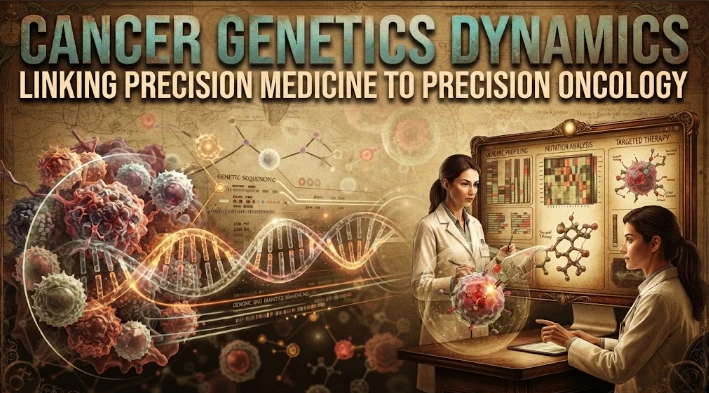
The field of cancer genetics is dynamic due to tumor evolution. A diagnostic biopsy is merely a snapshot of the population, which is still undergoing mutations, changing gene expression, and undergoing pressure from treatment. Precision oncology requires iterative rather than one-off genetic interpretation, therefore. It is not enough to know which variants exist, but which ones are growing and which are becoming more abundant and which changes are responsible for a treatment response.
The process of clonal architecture starts during the development of the tumor. The site of the early driver mutations may be shared amongst most malignant cells, whereas the late mutations occur at branches. The original point of bulk sequencing is to estimate the frequencies of variants, but there are complications because of copy number and normal cell contamination. Single cell sequencing can provide a direct answer to the branches and provide information on whether the two mutations are present in the same branch or different branches.
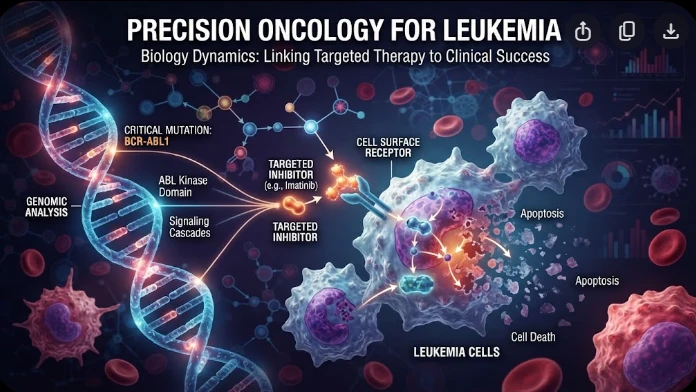
Treatment changes the architecture! If a targeted drug can suppress the clone most reliant upon the target, then it can allow a resistant population to emerge, and to preempt that, you need a different drug.If a targeted drug can suppress the clone most reliant upon it, then it can make room for a resistant population, and to prevent that, a different drug is required. Resistance may be attributed to new mutations in a target, activation of a bypass pathway, loss of a tumor suppressor, and/or a non-genetic state change. It is found in serial samples which one of the two mechanisms is actually expanding under pressure.
Utilizing liquid biopsy can make serial monitoring more feasible. Circulating tumour DNA can pick up the changes that are released from various sites of disease and may be taken more often than tissue biopsies. Sometimes the molecular burden can increase before a change in radiographic progression. The problem with the major challenges is that they are both sensitivity in low shedding disease and distinguishing clinically helpful change from assay error.
The clonal evolution models can be used to integrate the serial allele frequencies and the treatment dates. When one branch grows as soon as a drug is added, the timing helps to select. Branches that grow before treatment are likely due to natural growth and/or prior stress. When adherence and/or dose intensity change, incorrect attribution can be prevented by integrating pharmacologic exposure.
Collateral sensitivity can also be determined by looking at the genetic evolution. One therapy may keep a resistant clone from them alive, but then make it dependent on another pathway. Testing that possibility requires functional screens where the resistance is engineered and response to other drugs is measured. Precision oncology can then learn from evolution, foreseeing the next weakness instead of just responding when things go wrong.
These sequences can be tested under controlled conditions in mouse models. The same engineered driver could be introduced into different genetic backgrounds, and the investigators can see how progression or response is affected by the host modifiers. Treatment can be administered at specific points and tumors can be biopsied multiple times. This makes it possible to conduct a causal experiment that can not be fully replicated with human observational data.
Patient derived models provide the reverse direction of translation. A resistant tumor sample can then be cultured and expanded into an organoid or xenograft, where it can be subjected to potential therapies. By performing sequencing prior and post treatment, it is possible to see if there is a resemblance to the patient tumour. Concordance helps to increase the level of confidence in the relevance of the modelled resistance mechanism.
Purely genetic models are complicated by epigenetic states. Drug tolerant cells can reach a state of tolerance without any new mutation in DNA. Survival can occur by chromatin remodeling, transcriptional plasticity and metabolic adaptation until stable genetic resistance is acquired. Therefore, multiomic profiling is important if sequencing reveals no apparent explanation for progression.
Another challenge is the spatial heterogeneity. A resistance mutation can be present in one metastasis, and not the other. A composite signal can be obtained from a circulating DNA, and the local tissue context from targeted biopsies. Imaging and spatial profiling can be used to determine if specific subclones are in a sheltered niche that is not accessible to the drugs or have unique immune pressure.
Treatment response should be considered as a longitudinal phenotype in precision models. One drug resistance mutation may be unhelpful for resistance to another drug. Different effects can be observed with combination therapy, depending on the stage of the disease and background mutations. It is, therefore, important that the evidence interpretation should document the process of the treatment environment in which evidence was produced.
Dramatic evolutionary stories are not overinterpreted because they have been validated independently. A resistance mechanism that is seen in one patient may be real, but uncommon. Cohort studies can provide estimates of prevalence and functional assays can be used to test causality. To make a change in treatment or testing, there needs to be mechanism and evidence that it matters at least enough to test or treat.
Evolution by copy number change is another possibility. Dosage changes can occur without a new point mutation, such as caused by the amplification of an oncogene or deletion of a suppressor. Serial sequencing methods to quantify the copy number of a variant in conjunction with SNVs give a more complete understanding of clonal adaptation.
This may be facilitated by chromosomal instability. Those tumors that segregate chromosomes poorly produce various karyotypes, further raising the number of evolutionary experiments that are taking place during therapy. These cancers can become resistant in several different ways and a single targeted assay isn't as useful as a more comprehensive genomic survey.
Treatment can cause a great loss in diversity, followed by rapid re-growth from a small number of individuals surviving. The strength of the bottleneck can be inferred by taking diversity measures before and after therapy. A small remaining population may be more manageable, if its requirements are known, while depending on the population may also contain highly selected resistance characteristics.
Variant allele fractions and the timing of samples should thus be maintained in the clinical sequencing report, not just variants themselves. The mutation increasing from minor to dominant is different from a stable passenger. The visualization of those trajectories will enhance the understanding of the various fields of interpretation.
Emerging molecular information can be available to modify treatment in adaptive trial designs, provided that there is strong evidence for the relationship between the biomarker and the action. The most useful evolutionary monitoring is when a action that is defined beforehand to be taken if the change is detected.
Minimal residual disease (MRD) is a useful way to summarise evolutionary dynamics in selected cancers, however for solid cancers there is no single marker. Circulating DNA can be used in conjunction with imaging and clinical biomarkers to increase sensitivity. Measures that conflict with each other should not be disregarded as a matter of course; they should be investigated.
Immune pressure influences tumour evolution as well. Immune escape can occur even without any change in the targeted oncogenic pathway, due to loss of antigen presentation, alteration in interferon signal transduction or change in HLA. Therefore, immune related alterations should be considered as part of the evolving tumour state in the context of genomic surveillance during immunotherapy.
A future precision record might be a kindred of tumor, treatments and reactions, portrayed as a timeline of clones. This record would keep a track of why each therapy was opted for and which branch grew up later on. This is a longitudinal structure that will be more informative than a series of disjointed reports.
The advantages of an evolutionary interpretation are enhanced by sampling at clinically significant milestones, including diagnosis, best response, minimal residual disease, and progression. These landmarks allow the mapping of genomic change to treatment pressure. Unscheduled samples provide resolution, and if patients can be anchored in a similar way, their comparison will be enhanced. Shared sampling structure also aids in distinguishing shared routes of recurrent resistance from idiosyncratic events.
The same time-scale can be used for research because it can indicate that, for example, which genetic changes are not uncommonly observed at the onset of resistance in various treatment sequences. Patterns can then be tested experimentally to determine causality. This process of observation and testing the models is more accurate than believing that each change that occurred at progression was the cause of the progression.
This evolutionary perspective is reflected in the work of David W. Threadgill, who is interested in cancer genetics, precision medicine, and model systems. When measured across time, tested across backgrounds, it can be explained genetically why a tumour responded yesterday and failed tomorrow. Precision oncology is more sustainable if serial sequencing, functional models and treatment history are combined and are part of a single, evolving picture of disease, not a static molecular label.
In addition, sampling of metastatic sites can provide another dimension as parallel lesions may evolve independently. One biopsy can underestimate the diversity or circulating DNA can detect changes that is not in the biopsy—due to discordant resistance at sites.