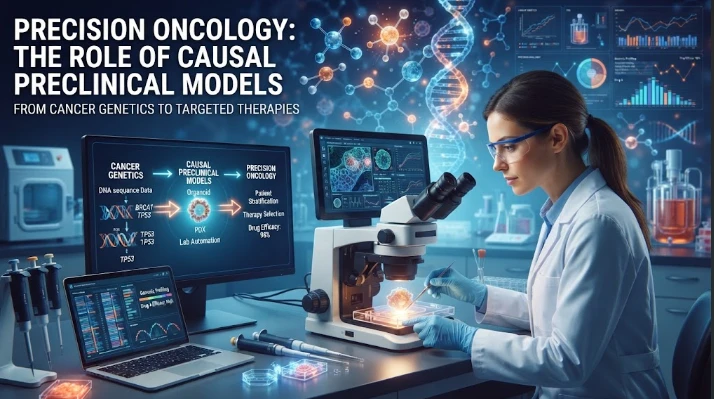
The article argues that preclinical models in precision oncology should demonstrate causality rather than simply resemble human tumors. Genetically engineered mouse models, organoids, xenografts, and related systems can introduce a defined cancer alteration and test whether that change affects initiation, maintenance, resistance, or therapeutic response. Temporal control is particularly useful because the same gene can have different roles at different stages. The article emphasizes isogenic comparison, functional rescue, pharmacologic perturbation, and patient-genotype matching as stronger evidence than histological similarity alone. Spatial profiling can test whether resistant clones occupy comparable stromal, hypoxic, or immune-excluded niches in models and patients. Experimental randomization, blinding, pharmacokinetic realism, and independent replication are treated as essential for causal confidence. The model should also reproduce clinically relevant pathway behavior and treatment response. Ultimately, preclinical systems are most valuable when a defined genetic mechanism predicts an intervention and the intervention changes the expected biological outcome across independent contexts.
The resemblance is a key criterion used to evaluate preclinical cancer models: a mouse tumour resembles the human disease; an organoid has the same mutations; or a xenograft reacts to the same drug. A more stringent requirement for causal precision. A model should show that there is a measurable biological effect due to a defined genetic modification and that changing the relevant pathway results in a different biological effect. A change from resemblance to causality is key to the applications of preclinical models in precision oncology.
One way is through the use of genetically engineered mouse models. Mutations can be induced in a chosen tissue in a normal organism; the mutants grow into tumors within the living host. The model can account for interactions that are not known to occur in simple transplantations, since the immune system and stroma grow along with the cancer. A mutation may be necessary for initiation, maintenance or resistance and this can be determined by temporal control.
CRISPR and base editing increase the scope of being tested the changes. While most variation in cancer can be explained by point mutations, no traditional knockout models have been able to mimic the unique properties of these mutations. In vivo base editing can generate desired single nucleotide variants and mixtures, thereby establishing tumors with specific alleles. This type of configuration can be used to determine if a human variant affects the course of disease or drug response, but without having to replace the whole gene.
Variance among genetic background should be intentional. Targeted cancer prevention studies have revealed that apparent drug efficacy can be altered by studies of model, sex, background strain and diet. Host modifiers affect the signaling or toxicity and can cause a therapy to work for one inbred strain and not for another. Having several backgrounds tested can help determine if a proposed dependency is strong or context specific.
Functional genomics screen can nominate causal genes at scale. By perturbing multiple candidate genes in the tissue, in vivo CRISPR screens have pinpointed cancer drivers and drug vulnerabilities. Hits are particularly useful when they relate recurrent mutations in the human to measurable changes in tumour behaviour. Then, individual validation ensures that there is no statistical artefact in the pooled screen.
Organoids allow for quick mechanistic testing. Editing of patient or mouse tumour cells – adding or correcting a mutation – and exposing cells to candidate drugs can be done in three dimensional culture. Isogenic comparison is used to identify effect of a single change. When the introduction of the mutation leads to resistance and the correction back to sensitivity, the causal chain is strengthened considerably.
While xenografts provide pharmacokinetics and systemic physiology, in cases where immunodeficient hosts are needed, immune interpretation might be constrained. Some questions can be answered using humanized models and syngeneic, but each of these has its drawbacks. The selection of the model should be determined by the mechanism being tested, not by the assumption that one model is better overall.
The use of a clonal approach can show that there is heterogeneity within a single model. The growth rates or interactions with the immune system can vary between clones of genetically defined tumors. Lineage tracking done by barcode may reveal that therapy slows down all the clones or that some clones are killed and others are selected. That's important if a bulk tumour measure indicates only partial response.
Spatial profiling can be used to determine the interaction of genotype and niche. A resistant clone may localize in the vicinity of fibroblasts, hypoxic areas or immune excluded areas. If the mechanism of the disease is suggested to occur in patients across a tissue, and the prototype of the disease is a preclinical model, then a mapping of the mutations with the cell states and tissue architecture can determine if the spatial mechanism is seen in the preclinical model. This validation adds to the level of confidence added to the translation beyond the similarity in histology.
It is important to have external replication. If there is a genetic dependence in one model, it should be assessed in a different model, patient derived system, or independent cohort. Rather, discordance should be explored. A context limited effect is clinically useful when the context that is relevant to a specific effect can be identified in advance.
Clinically realistic treatment is needed with preclinical models as well. Wherever possible, exposures achieved by drug dose and schedule should be similar to those achieved by human therapy. A weak target may appear strong with over-dosing; while toxicity may occur that is independent of the clinical dose. Concentrations of drug and tumor response can be measured to enhance interpretation.
Endpoints should be the same as the clinical claim. But a decrease in short term tumor volume does not justify a different interpretation than a prevention or a survival extension. Molecular response can inform of target engagement, but prolonged monitoring is needed for durable control. The design of the model should start with the decision the experiment is meant to provide answers to.
Genetic engineering quality is another crucial factor for preclinical reproducibility. Animals with multiple unwanted alleles in their tumors can be produced using mosaic editing. Deep sequencing of engineered locus and of off-target assessment help to confirm the intended change is the phenotype. When subtle effects are anticipated it may be easier to interpret results with stable lines or clonally derived organoids.
The effects of ageing and comorbidities are important. Experimental animals tend to be young, healthy animals with no underlying metabolic or cardiovascular disease, whereas many human cancers occur in older patients with metabolic or cardiovascular disease. Immunity, metabolism of drugs, and tissue repair may be affected by aging. The use of older or comorbid models for selected questions can help identify therapeutic limits early.
Pharmacodynamic biomarkers can be used to verify drug action and modulation of the desired pathway. If the biological hypothesis is not met, it is not a failure when there is no target engagement. In contrast, high engagement of the target without control of the tumor indicates pathway redundancy, or adaptation.
Negative Preclinical results should be retained. When a genetically plausible target fails in various models, this information can be used to avoid further clinical development. The publication bias of successful interventions reduces the predictive power across all the model ecosystem.
Model comparison must be clearly stated. The genetically engineered model can be useful for initiation biology, the organoid for controlled perturbation, and the patient derived xenograft to assess drug response. It is better to triangulate across complementary strengths than to raise one platform as a standard.
Intra-study randomization enhances causal confidence within preclinical studies. Tumor burden at baseline should be systematically the same in animals/ organoids to be used for treatment and when possible, outcome measures should be blinded. These fundamental design principles are valid for more advanced genomic models as well.
Sample size should be proportional to biological variability particularly in a diversity of genetic backgrounds. A study with one inbred strain can be underpowered if there is high genotype-specific variance in response. Hierarchical models can estimate the average treatment effect and the deviations between the average effect and the treatment effect at the genotype level.
The advantage of clinical translation is also a set of predetermined stopping rules. When a model exhibits high toxicity or no target engagement, additional efficacy interpretation is misleading. Prior agreed decision criteria limit emphasis on positive end points during experiments.
The use of causal preclinical modeling is thus as much about experimental discipline as technology. Resolution comes with genome editing, single cell analysis, and organoids, but randomization, replication, and transparent negative results are needed to ensure that a mechanistic claim can be trusted.
The process of selecting a model can be programmed. A quick organoid screen can pick a dependency, a genetically engineered mouse can capture context, and a patient derived model can further assess heterogeneity. Moving forward only those findings that pass through each stage limits the number of weak hypotheses churned up to costly clinical development. The sequence must be flexible, since not all mechanisms are represented on all platforms.
This staged evidence can uncover solid relationships, yet it can additionally uncover context limits prior to a clinical trial.
This causal approach is well supported by the work of David W. Threadgill, an investigator with a focus on precision medicine, cancer genetics and mouse models. The best preclinical systems reveal the interactions between genetic background, defined mutations and treatment context. Precision oncology requires models that are "fail fast" and fail for the appropriate reasons, are able to identify modifiers of response, and are reproducible across platforms. A model is not valuable if it resembles a patient tumor, but if it can predict what should happen if a certain biological mechanism is altered.
That discipline makes the prediction of preclinical causality more predictive.
The external replication should continue to be required.
CITE THIS ARTICLE
Tasneem, S. (2025). Causal Preclinical Model Roles in Precision Oncology through Precision Medicine and Cancer Genetics. https://www.sadiaresearchhub.com/article/739d908a-fe1b-516e-bff0-df9fc1806ea9
S. Tasneem, “Causal Preclinical Model Roles in Precision Oncology through Precision Medicine and Cancer Genetics,” 2025. [Online]. Available: https://www.sadiaresearchhub.com/article/739d908a-fe1b-516e-bff0-df9fc1806ea9
Tasneem, S. (2025) ‘Causal Preclinical Model Roles in Precision Oncology through Precision Medicine and Cancer Genetics’. Available at: https://www.sadiaresearchhub.com/article/739d908a-fe1b-516e-bff0-df9fc1806ea9
Tasneem, Sadia. “Causal Preclinical Model Roles in Precision Oncology through Precision Medicine and Cancer Genetics.” 2025, https://www.sadiaresearchhub.com/article/739d908a-fe1b-516e-bff0-df9fc1806ea9.
Sadia Tasneem. “Causal Preclinical Model Roles in Precision Oncology through Precision Medicine and Cancer Genetics.” (2025). https://www.sadiaresearchhub.com/article/739d908a-fe1b-516e-bff0-df9fc1806ea9.
Tasneem S. Causal Preclinical Model Roles in Precision Oncology through Precision Medicine and Cancer Genetics. 2025. https://www.sadiaresearchhub.com/article/739d908a-fe1b-516e-bff0-df9fc1806ea9
@misc{article_739d908afe1b516ebff0df9fc1806ea9,
  title = {Causal Preclinical Model Roles in Precision Oncology through Precision Medicine and Cancer Genetics},
  author = {Sadia Tasneem},
  year = {2025},
  url = {https://www.sadiaresearchhub.com/article/739d908a-fe1b-516e-bff0-df9fc1806ea9},
}
TY  - GEN
AU  - Sadia Tasneem
TI  - Causal Preclinical Model Roles in Precision Oncology through Precision Medicine and Cancer Genetics
PY  - 2025-04-06
UR  - https://www.sadiaresearchhub.com/article/739d908a-fe1b-516e-bff0-df9fc1806ea9
ER  -
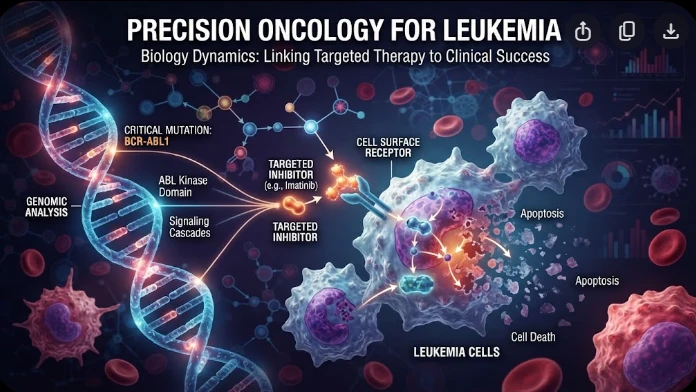
The article examines leukemia as an evolving population under targeted therapy, using chronic myeloid leukemia as the main example. BCR–ABL1 inhibition can produce deep responses, but every treatment changes the competitive environment among malignant clones. Quantitative transcript monitoring provides a continuous measure of disease burden, while deep sequencing can identify emerging resistance mechanisms before hematologic progression. A detected mutation is clinically meaningful only when its
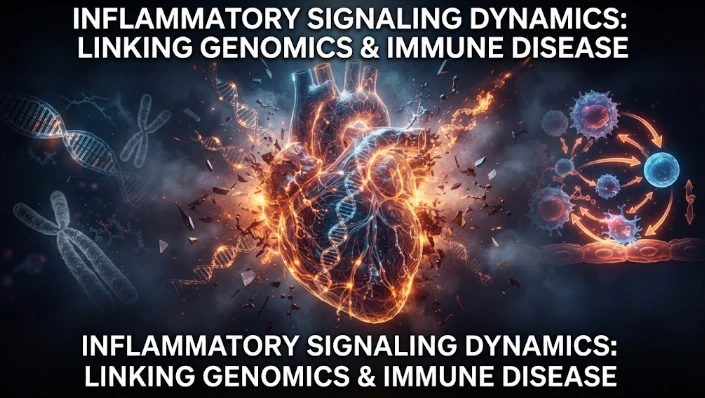
The article examines how cardiovascular genetic risk becomes biologically active through cell-specific inflammatory signaling. Because many vascular-risk variants lie in regulatory DNA rather than coding regions, their effects may appear only in particular endothelial, macrophage, smooth-muscle, or lymphocyte states. Single-cell studies of human atherosclerotic lesions and multiomic endothelial experiments are used to illustrate this context dependence. The article also discusses IL6-related sig
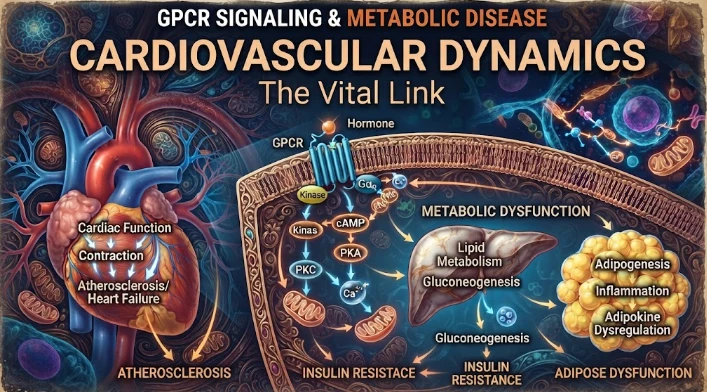
The article examines cardiovascular GPCR signaling as a dynamic response system whose abnormalities can remain hidden in resting measurements. Mechanical stretch, hormones, nutrients, sympathetic activity, and fluid balance can change the amplitude, duration, localization, and recovery of receptor signaling. Examples include mechanically activated angiotensin-receptor signaling, endosomal signaling, beta-arrestin-dependent trafficking, and biased glucagon-like peptide-one receptor responses. The