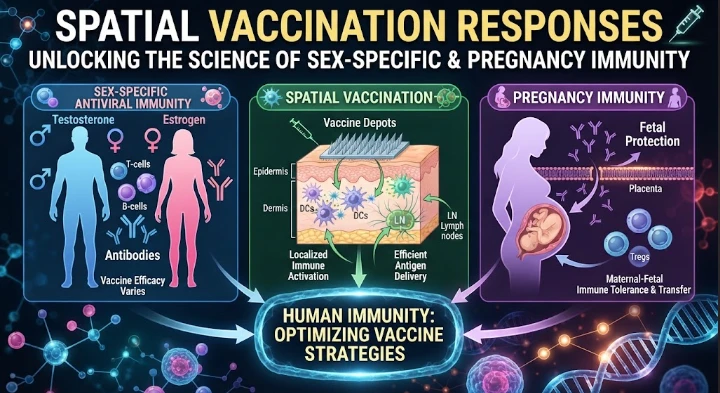
The article uses a spatial framework to explain vaccination during pregnancy across maternal blood, placenta, fetal circulation, and postpartum milk. Each compartment follows different transport rules and immune functions, so maternal antibody concentration alone cannot define neonatal protection. Vaccination timing affects affinity maturation and the duration available for placental transfer, while platform, prior infection, fetal sex, and placental health can further alter antibody quality and movement. Paired maternal–cord studies illustrate efficient transfer but also show that transferred antibodies can differ in subclass, Fc properties, and effector function because the placenta acts as a selective immune interface. Spatial transcriptomics and imaging are proposed to map placental transport and antiviral pathways. Longitudinal infant and milk sampling can assess decay and continuing mucosal exposure. The article concludes that vaccination research should connect timing, compartment, antibody function, placental biology, and clinical protection rather than relying on a single maternal or cord-blood titer.
If a woman gets vaccinated during her pregnancy, she will become immune in multiple interconnected compartments. Antigen is transported to mother, antibodies and immune memory occur in maternal tissues, placenta filters and selects for transfer of immunoglobulin, cord blood is passively acquired and breast milk can provide continued maternal immunity. This isn't any vaccine response, it's important biology. A spatial framework is a view in which maternal blood, placenta, fetal circulation, and postpartum milk are all different immune environments that are connected but not equal, with different transport rules and time scales.
That spatial distribution is influenced by the timing. Vaccination early in pregnancy gives more time for affinity maturation and placental transfer to take place, and vaccination nearer to delivery can allow for rapid increase in maternal titers, but reduce the placental transfer time. Studies have demonstrated different antibody profiles in the mother and neonate depending on the gestational timing and vaccine types/platforms. The optimum time is dependent on the desired outcome, e.g. protection of mother during pregnancy or antibody levels at birth.
Platform effects can be a function of the platform. Research into various mRNA and other COVID-19 vaccine platforms during pregnancy revealed variations in antibody magnitude and Fc properties. This variation alone is not directly reflected in an easy ranking, as variant in circulation and prior infection are also important, as is the dose schedule. A functional analysis of antibody properties should be performed in both maternal (and cord) compartment, not just maternal.
Efficiently transferring antibodies from maternal to cord blood has been shown in paired maternal and cord blood studies with SARS-CoV-2 vaccine. The findings of the research that included women who were infected, vaccinated, or both indicated that vaccination might be the best way to maximize passive transfer even if a woman's prior infection history differed. The transfer ratio, however, is not synonymous with neonatal protection. The duration of a meaningful passive immunity depends on the function of the antibody, decay of antibodies after birth, and exposure to the pathogen.
There is dissension between maternal and fetal antibodies at the functional level. Passively-transferred antibodies to vaccines can exhibit unique Fc characteristics and effector functions indicative of selection at the placenta, and not the mere diffusion of maternal antibody into the fetal circulation. The efficiency of the cross of antibodies is influenced by glycosylation and binding to Fc receptors. The placenta thus serves as an immune filter and forms a neonatal antibody repertoire that is different from, but similar to, maternal serum.
The placenta has a spatial structure. A regulated barrier between the trophoblast layers, fetal capillaries, stromal cells and resident immune cells. The Fc receptors are found in these compartments, with inflammation affecting expression or tissue integrity. The spatial transcriptomics and multiplex imaging can reveal the location of changes in transport machinery and antiviral signaling following vaccination or infection. Such studies can link transport mechanisms at the molecular level to the observed blood results in the cord.
Maternal cellular immunity predominates on the maternal side of that barrier, and can affect antibody quality. CD4 T cell help works together with B cells to induce their maturation, and memory B cells govern subsequent recall. Combined examination of T cell and B cell states with antibody transfer can reveal whether the decrease in cord antibody levels is indicative of poor maternal priming or inefficient transfer to the fetus. Different solutions are needed for those mechanisms.
A postpartum milk compartment is also present, containing yet another set of antibodies. Secretory immunoglobulin A is dominant at mucosal surfaces and immunoglobulin G may be seen following vaccination. Milk antibody can't replace placental transfer as it is different in terms of route of exposure and function. Post-delivery longitudinal sampling can capture persistence and effects of maternal timing of boosters on neonatal mucosal exposure.
Placental immunity also can be influenced by the fetal sex. Recently, infection experiments have reported sex-dependent interferon responses and antibody transfer patterns at the maternal fetal interface. Sample size should be adequate for fetal sex analysis when including it in the vaccination studies. A spatial vaccine model must consider the context, placental transport, and maternal response, and not assume that all variability is due to maternal physiology.
Each layer has population heterogeneity. Immune measurements can be affected by age, obesity, previous infection, parity, placental disease, gestational diabetes, vaccine type and time since dose. The multicohort analysis can be used to determine if spatial patterns can be replicated across settings. Harmonized assays are crucial since there may be variations in transfer ratios and functional antibody measurements across different assay platforms.
The pathway may be organized by causal mediation. Vaccination can impact on the maternal antibody characteristics, thereby impacting on the placental transfer, which can impact on the cord blood function. The intermediate step may be altered by placental inflammation or gestational age. These relationships can be quantified using mediation models, but mechanistic tissue studies are required to verify the proposed transport pathway is biologically active.
Functional endpoints should be included in external validation. For any transfer signature that has high cord antibody concentration as a prediction, it should be tested in addition with neutralization, Fc effector activity, antibody persistence or infant infection, if sufficiently powered data exist. The relevance of the clinical situation can be exaggerated if the sole focus is concentration. The desired marker should be one that provides protection in the compartment where protection is required.
Longitudinal design can be used to show decay and recall. The antibodies transferred to the fetus via the placenta disappear after vaccination, placentally acquired infant antibodies disappear after birth, and maternal memory can react to boosters or infection. When done repeatedly, the levels of immunity in the mother, cord, infant and milk can be used to show immunity movement over time. That trajectory can detect the presence of protection gaps, and determine if these gaps are filled at the right time.
Strong evidence is needed for clinical recommendations, but not for descriptive spatial differences. If the risk of maternal disease is higher during delay, a biological finding justifies not delaying vaccination. When designing decision models, the competing goals of maternal protection, transfer of antibodies to the newborn, transmission risk of pathogens in the bloodstream, and real-world vaccine access matter. The best schedule is a clinical outcome question, not just a laboratory titer question.
Cord blood will give a snapshot at birth, while infant follow up will tell you the length of transferred immunity. The decay of antibody levels may differ depending on the starting antibody, subclass and antigen. Repeated infant samples can provide an estimation of half life and a correlation between passive immunity and risk of infection in the early months. Since it is a longitudinal step, a high transfer ratio at delivery should not be taken as a sign of long-term protection.
Antibody specificities can also compete with each other for placental transfer. The efficiency of transport depends on the Fc receptor binding and glycosylation, which means that antibodies induced by infection and vaccine may have different transport efficiency. In the systems serology, the measurement of the three parameters of subclass, Fc receptor engagement, neutralization, and effector function can all be done in one measurement. This difference in antibody profile may indicate selective enrichment in cord blood of antibody features, instead of just a proportional transfer of antibody from maternal serum.
Spatial measurements must go hand in hand with timing of exposure. Placental receptor expression changes over gestation and antibodies produced following vaccination take weeks to mature. Both maternal antibody age and placental developmental stage can thus be incorporated into a mechanistic model. The same cord titers may have different functional profiles when they are acquired by different combinations of such factors.
Implementation research can assess efficacy of complex immune findings for improved care. A simplified maternal and cord assay may be used as a predictor of the ability of an infant to function with their own antibody in situations where complete system serology is not feasible. These translations need to have strong thresholds and be cost-effective. The most useful spatial biology is when it defines a smaller measurable feature that will still provide predictive power in a variety of clinical situations.
Protection of the infant also relies on the context of the exposure. The infection risk can be influenced by the presence of local pathogens, maternal infection after delivery, breastfeeding, and household transmission. It is important to note that the infant studies that have been done should document those differences and not assume they are only related to transfer biology. Exposing to careful exposure measurement, separation of immune protection and unequal opportunity for infection.
Sabra L. Klein's research interests in maternal vaccination involve a study of sex differences, pregnancy, and vaccines and vaccines in infants. Spatial analysis elucidates the differences between compartments of the maternal blood, placenta, cord blood and milk, and the regulation of their connection. Multicohort longitudinal studies can assess the impact of order of vaccination, fetal sex, prior infection and gestational timing on each compartment and allow for a more accurate depiction of protection than any single antibody measurement.
CITE THIS ARTICLE
Tasmeem, S. (2025). Spatial Vaccination Responses through Sex Specific Antiviral Immunity and Pregnancy Immunity in Human Immunity. https://www.sadiaresearchhub.com/article/9f536975-7aae-5069-b3f2-a4a2b918ac2b
S. Tasmeem, “Spatial Vaccination Responses through Sex Specific Antiviral Immunity and Pregnancy Immunity in Human Immunity,” 2025. [Online]. Available: https://www.sadiaresearchhub.com/article/9f536975-7aae-5069-b3f2-a4a2b918ac2b
Tasmeem, S. (2025) ‘Spatial Vaccination Responses through Sex Specific Antiviral Immunity and Pregnancy Immunity in Human Immunity’. Available at: https://www.sadiaresearchhub.com/article/9f536975-7aae-5069-b3f2-a4a2b918ac2b
Tasmeem, Sadia. “Spatial Vaccination Responses through Sex Specific Antiviral Immunity and Pregnancy Immunity in Human Immunity.” 2025, https://www.sadiaresearchhub.com/article/9f536975-7aae-5069-b3f2-a4a2b918ac2b.
Sadia Tasmeem. “Spatial Vaccination Responses through Sex Specific Antiviral Immunity and Pregnancy Immunity in Human Immunity.” (2025). https://www.sadiaresearchhub.com/article/9f536975-7aae-5069-b3f2-a4a2b918ac2b.
Tasmeem S. Spatial Vaccination Responses through Sex Specific Antiviral Immunity and Pregnancy Immunity in Human Immunity. 2025. https://www.sadiaresearchhub.com/article/9f536975-7aae-5069-b3f2-a4a2b918ac2b
@misc{article_9f5369757aae5069b3f2a4a2b918ac2b,
  title = {Spatial Vaccination Responses through Sex Specific Antiviral Immunity and Pregnancy Immunity in Human Immunity},
  author = {Sadia Tasmeem},
  year = {2025},
  url = {https://www.sadiaresearchhub.com/article/9f536975-7aae-5069-b3f2-a4a2b918ac2b},
}
TY  - GEN
AU  - Sadia Tasmeem
TI  - Spatial Vaccination Responses through Sex Specific Antiviral Immunity and Pregnancy Immunity in Human Immunity
PY  - 2025-09-21
UR  - https://www.sadiaresearchhub.com/article/9f536975-7aae-5069-b3f2-a4a2b918ac2b
ER  -
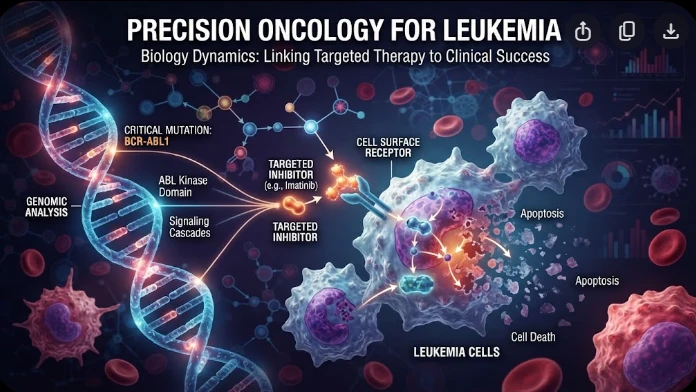
The article examines leukemia as an evolving population under targeted therapy, using chronic myeloid leukemia as the main example. BCR–ABL1 inhibition can produce deep responses, but every treatment changes the competitive environment among malignant clones. Quantitative transcript monitoring provides a continuous measure of disease burden, while deep sequencing can identify emerging resistance mechanisms before hematologic progression. A detected mutation is clinically meaningful only when its
The article examines how cardiovascular genetic risk becomes biologically active through cell-specific inflammatory signaling. Because many vascular-risk variants lie in regulatory DNA rather than coding regions, their effects may appear only in particular endothelial, macrophage, smooth-muscle, or lymphocyte states. Single-cell studies of human atherosclerotic lesions and multiomic endothelial experiments are used to illustrate this context dependence. The article also discusses IL6-related sig
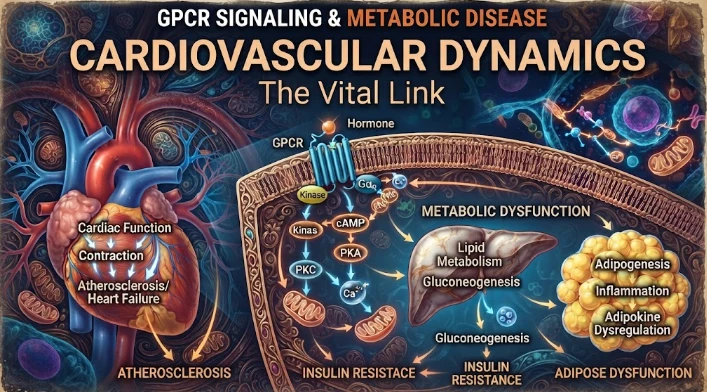
The article examines cardiovascular GPCR signaling as a dynamic response system whose abnormalities can remain hidden in resting measurements. Mechanical stretch, hormones, nutrients, sympathetic activity, and fluid balance can change the amplitude, duration, localization, and recovery of receptor signaling. Examples include mechanically activated angiotensin-receptor signaling, endosomal signaling, beta-arrestin-dependent trafficking, and biased glucagon-like peptide-one receptor responses. The