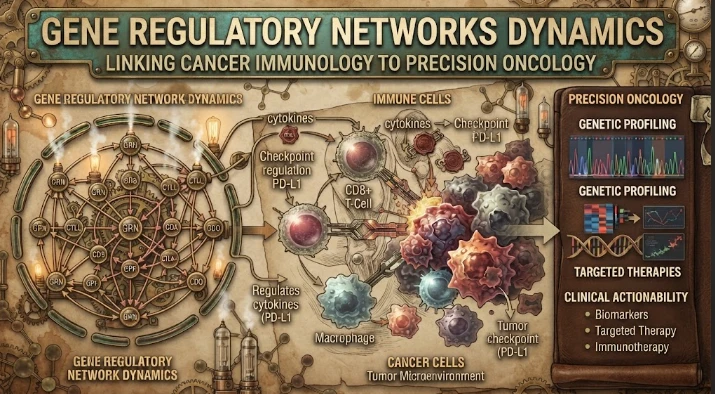
The article focuses on how gene-regulatory networks change during cancer immunotherapy and how those transitions can reveal mechanisms of immune escape. Tumor cells can alter antigen presentation, interferon responses, chemokine production, checkpoint ligands, lineage programs, and metabolism without necessarily acquiring a new dominant mutation. Single-cell and chromatin profiling can identify rare regulatory states and determine whether therapy selects pre-existing resistant populations or induces new adaptive states. The article emphasizes the time-dependent role of interferon signaling, epigenetic stabilization, lineage plasticity, T-cell dysfunction, and myeloid feedback loops. CRISPR perturbation and preclinical models are recommended for testing whether candidate regulators are causal. Spatial profiling can identify resistant cellular neighborhoods, while locked network models and independent cohorts are needed for clinical validation. The central aim is to move from retrospective descriptions of resistance to early detection of regulatory transitions that can guide rational sequencing or combination therapy before resistant disease becomes dominant.
Much of the change in cancer cells is driven by immune pressure, which involves changes in gene regulation. The tumor may not replace its entire genome, but it can alter antigen presentation, interferon signaling, chemokine production, stress pathways and checkpoint ligand expression. Changes over time can be followed in gene regulatory networks. Immunology becomes a valuable addition to precision oncology when thinking of it as a dynamic cell state instead of a static cell property.
The relationships between transcription factors and target genes are organized into patterns that form regulatory networks. Cancer immunology relevant modules can regulate antigen processing, cytokine signaling, cell death, metabolic adaptation or lineage identity. It is possible to deduce the activity of a transcription factor from the program that it regulates even if there is not much change in the messenger RNA level of the factor itself. This can help localize functional regulation by phosphorylation.
Prior to therapy a tumor may harbor multiple immune states. Cancer cells can either have high antigen presentation machinery or low interferon response or high expression of inhibitory ligands. T cells may be activated effectors or dysfunctional or exhausted cells. Myeloid cells can exist between an inflammatory and suppressive program. Bulk sequencing combines these states and may mask the minority population that is most likely to be the source of resistance.
Single cell sequencing techniques address some of those issues, by defining cell-specific regulatory programs. The network inference can detect the transcription factors related to immune sensitive and immune resistant cancer states. Then with repeated sampling it is determined whether therapy eliminates one state and increases another. Such dynamics can differentiate the selection of a pre-established resistant population from transcriptional adaptation once treatment starts.
A good example would be interferon response, as it can vary over time. Acute signaling can enhance antigen presentation and immune cell recruitment. Chronic signaling can lead to inhibitory feedback, stress adaptation, and resistant phenotypes. A static interferon signature does not provide any information on which phase is dominating. Longitudinal network analysis can distinguish between early activation and long-term compensation regulation.
Transitions can be stabilized by epigenetic mechanisms. Chromatin remodeling may either block the presentation of antigens, or activate enhancers for a resistant lineage program. Removal of the original signal may not cause a reverse chromatin state and therefore may not reverse the previous phenotype. Combining chromatin accessibility and transcriptomics can reveal when a temporary regulatory response transitions to a more permanent state.
This should be taken into consideration when creating therapeutic combinations. Treatment with a checkpoint inhibitor could create a stronger immune pressure and a second treatment might block the regulatory program that appears in the remaining cells. The best partner is determined by the network that is active following treatment, not prior to it. The rational design of such sequences can, thus, be directed by serial molecular profiling.
CRISPR perturbation can be used to determine whether a predicted network controller is causal. Tumor cells can be disrupted in any number of ways prior to immune challenge, including disruption of candidate genes for transcription factors, disruption of candidate genes for chromatin regulators, disruption of candidate genes for signaling proteins, or disruption of candidate genes for antigen processing genes. Functionally, changes in T cell killing or tumor growth are evaluated. Focused experiments can dissect the mechanism, pooled screens can identify unexpected regulators.
The choice of a preclinical model greatly affects interpretation. The advantages of transplantable tumors are the speed and immune compatibility; genetically engineered models, more natural tumor development; and human-specific testing with organoid immune cocultures. These are single cells from the tumor immune system. A regulatory mechanism that is tested through multiple different models, not just one experimental setting is more convincing.
There is another dimension in spatial biology. Immune resistant states may be grouped in close proximity to hypoxic areas, fibrotic stromata or suppressive myeloid cells. Thus, a transcriptional programme linked to resistance may be intrinsic to the cancer and be influenced by the microenvironment. Spatial transcriptomics and multiplex imaging can determine which signals are associated with the state, and identify if complementary immune-cell failure is occurring in nearby cells.
Clinical samples should be correlated with a specific time of treatment. Biopsy samples obtained weeks post-therapy may be from a different regulatory phase than one obtained at progression. Sampling program should include early response, residual disease, and resistant growth. If that timing is not observed, then changes in a network may be mistakenly thought to cause changes when they are actually an effect of change.
The art of prediction can only be done through locked analysis. To avoid overfitting, outcome tests should be kept apart from the construction of a network and the choice of a regulator. Independent cohorts can test if the same resistant state is associated with the same outcome of failure from institution to institution. When scores from a network are translated into response probabilities, calibration is of concern. Precision oncology requires reproducible thresholds, not retrospective pattern recognition.
The general message is that immunity resistance can be a process. As immune pressure shifts from one state to another, so do cancer cells; immune cells shift from one activation state to another and from one memory state to another or between other states of dysfunction. Both sides of the adaptation can be described in a language of the gene regulatory networks. The appropriate target can thus be altered throughout therapy.
Lineage plasticity can also result in network dynamics. A cancer cell which switches to a new differentiation state may alter its antigen expression and cytokine production simultaneously. Transitions can also result in immune escape, even if the antigen presentation genes are not directly suppressed. Longitudinal analysis should thus be performed in conjunction with immune regulatory modules, as well as lineage markers.
Regulatory networks of T cells are altered in parallel. MSL1 and other epigenetic programs are associated with antigen persistence and can lead to progressive dysfunction via distinct transcription factors. Some features are reversible upon checkpoint blockade, others are deeply fixed. If a tumor and T cell trajectory analysis can be performed, it can be used to determine if failure is due to cancer cell escape, immune cell dysfunction, or a combination of both.
There is additional complexity in the case of myeloid dynamics. Monocytes and macrophages have the capacity to invade tumors and to switch function to either inhibit T cells or promote tumor angiogenesis or tissue repair. The transcription of these cells can be reprogrammed by cytokines generated by the tumor cells, and the production of cytokines by the myeloid cells can be incorporated into tumor transcription. These feedback loops can be modeled in terms of networks of multiple cells, and points of intervention can be discovered that are not within the cancer cell itself.
The observed transition can then be used for therapy sequencing. A myeloid suppressive program may occur prior to T cell failure in that case, an early myeloid directed intervention may maintain the checkpoint sensitivity. When antigen presentation fails, the logical next step is targeting intrinsic to the tumor. Dynamic network measurements establish this temporal ordering, turning intricate immune data into an actionable series of defence actions.
A useful computational model will also be able to estimate uncertainty around each of the inferred transitions. Single cell datasets include sampling noise, dropout and changing composition of the cells. Independent specimens can be used for bootstrap inference and replication to determine if a resistant regulator is always detected. If a change is sustained, then the clinical actions should be based on this, rather than one loud ranking.
Temporal hypotheses can be directly tested through the use of combination trials where samples of tissue are taken at baseline, early treatment, and residual disease. If the predicted escape network is present before progression and suppressed by the combination, the trial has more than just a response rate mechanism of action. Some tumors may shrink temporarily but if the network is not suppressed, it will redirect development.
This is to avoid the descriptive nature of resistance biology, which is retrospective.
To further determine if a network transition is tumor type-specific or if it is a general immune escape mechanism, it can be repeated across other tumor types. Shared regulators can be wide therapeutic targets, and lineage limited regulators can aid to narrow down to a biomarker approach. In both, they are helpful because the important thing when it comes to precision is to know where it works and where it doesn't work.
That dynamic information can be used by precision oncology to go beyond the baseline immune biomarkers. It is best to ask which regulatory state is developing, what keeps it regulated and can it be channeled elsewhere before resistant disease takes over. The integration of serial single cell profiling, chromatin analysis, spatial mapping and functional perturbation can help to turn gene regulatory networks from maps into predictive and counteracting tools for immune escape.
CITE THIS ARTICLE
Tasmeem, S. (2026). Gene Regulatory Networks Dynamics Linking Cancer Immunology to Precision Oncology. https://www.sadiaresearchhub.com/article/a8d26d7a-d442-5c70-bfe9-2a3d51918e5a
S. Tasmeem, “Gene Regulatory Networks Dynamics Linking Cancer Immunology to Precision Oncology,” 2026. [Online]. Available: https://www.sadiaresearchhub.com/article/a8d26d7a-d442-5c70-bfe9-2a3d51918e5a
Tasmeem, S. (2026) ‘Gene Regulatory Networks Dynamics Linking Cancer Immunology to Precision Oncology’. Available at: https://www.sadiaresearchhub.com/article/a8d26d7a-d442-5c70-bfe9-2a3d51918e5a
Tasmeem, Sadia. “Gene Regulatory Networks Dynamics Linking Cancer Immunology to Precision Oncology.” 2026, https://www.sadiaresearchhub.com/article/a8d26d7a-d442-5c70-bfe9-2a3d51918e5a.
Sadia Tasmeem. “Gene Regulatory Networks Dynamics Linking Cancer Immunology to Precision Oncology.” (2026). https://www.sadiaresearchhub.com/article/a8d26d7a-d442-5c70-bfe9-2a3d51918e5a.
Tasmeem S. Gene Regulatory Networks Dynamics Linking Cancer Immunology to Precision Oncology. 2026. https://www.sadiaresearchhub.com/article/a8d26d7a-d442-5c70-bfe9-2a3d51918e5a
@misc{article_a8d26d7ad4425c70bfe92a3d51918e5a,
  title = {Gene Regulatory Networks Dynamics Linking Cancer Immunology to Precision Oncology},
  author = {Sadia Tasmeem},
  year = {2026},
  url = {https://www.sadiaresearchhub.com/article/a8d26d7a-d442-5c70-bfe9-2a3d51918e5a},
}
TY  - GEN
AU  - Sadia Tasmeem
TI  - Gene Regulatory Networks Dynamics Linking Cancer Immunology to Precision Oncology
PY  - 2026-03-15
UR  - https://www.sadiaresearchhub.com/article/a8d26d7a-d442-5c70-bfe9-2a3d51918e5a
ER  -
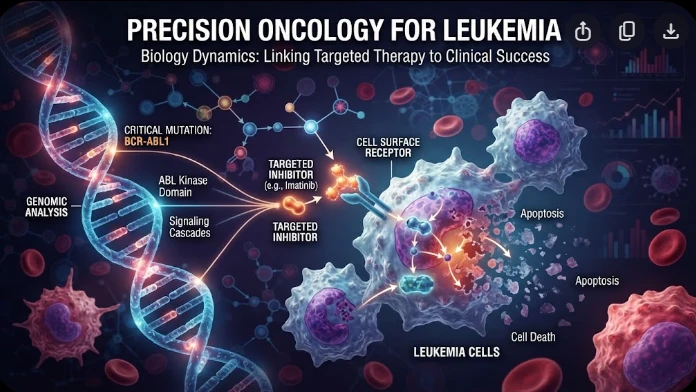
The article examines leukemia as an evolving population under targeted therapy, using chronic myeloid leukemia as the main example. BCR–ABL1 inhibition can produce deep responses, but every treatment changes the competitive environment among malignant clones. Quantitative transcript monitoring provides a continuous measure of disease burden, while deep sequencing can identify emerging resistance mechanisms before hematologic progression. A detected mutation is clinically meaningful only when its
The article examines how cardiovascular genetic risk becomes biologically active through cell-specific inflammatory signaling. Because many vascular-risk variants lie in regulatory DNA rather than coding regions, their effects may appear only in particular endothelial, macrophage, smooth-muscle, or lymphocyte states. Single-cell studies of human atherosclerotic lesions and multiomic endothelial experiments are used to illustrate this context dependence. The article also discusses IL6-related sig
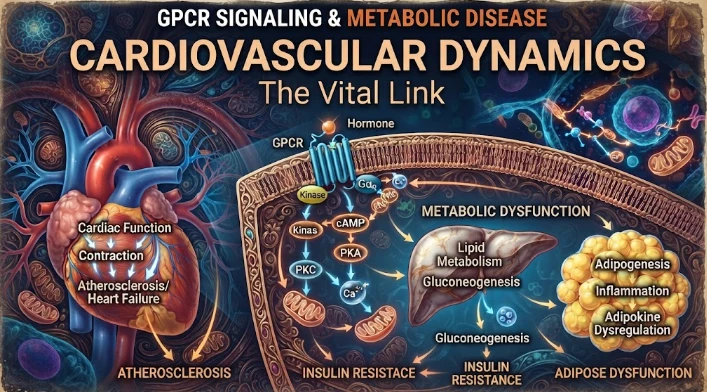
The article examines cardiovascular GPCR signaling as a dynamic response system whose abnormalities can remain hidden in resting measurements. Mechanical stretch, hormones, nutrients, sympathetic activity, and fluid balance can change the amplitude, duration, localization, and recovery of receptor signaling. Examples include mechanically activated angiotensin-receptor signaling, endosomal signaling, beta-arrestin-dependent trafficking, and biased glucagon-like peptide-one receptor responses. The