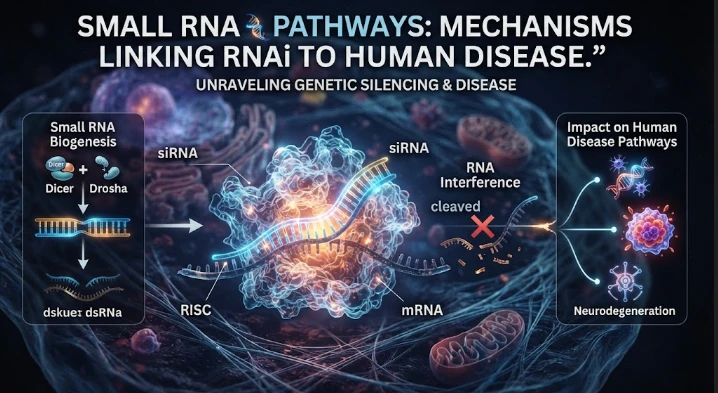
The article explains the molecular steps that make small-RNA pathways relevant to human disease and RNA-interference therapy. MicroRNAs and small interfering RNAs require correct precursor processing, Argonaute loading, target accessibility, and cell-specific delivery. Argonaute 2 can directly cleave highly complementary RNA, while other Argonaute complexes often repress translation or promote RNA decay. Alternative splicing and RNA structure can create or remove target sites, making long-read sequencing valuable for identifying the disease-relevant transcript isoform. Proteomics is needed because transcript knockdown and protein decline can occur on different timescales. The article also discusses genome defense, allele-selective silencing, immune sensing, delivery barriers, off-target effects, pharmacogenomic variation, protein turnover, and potential resistance through mutation or isoform change. Therapeutic success therefore depends on integrating sequence design, formulation, biodistribution, pharmacodynamics, and long-term monitoring. Small-RNA mechanisms become clinically actionable only when the entire path from guide production to durable functional change is quantified.
Small RNA pathways are a way to communicate short nucleotide sequences to select gene expression. The central logic is elegant, but there are many steps that need to be undertaken correctly for the disease to be relevant: The precursor must be processed properly, the guide must be able to enter the right Argonaute complex, the target must be accessible, and it must be repressed in the right cell type. Any failure can affect development, metabolism, immunity or genome stability. Therapeutic design is the same requirements, but in reverse. The generation of miRNAs starts with longer transcripts that get processed into short regulatory RNAs. These guides enter Argonaute complexes and typically bind targets by partial complementarity, particularly in a seed region.
The role of just one microRNA can affect multiple messenger RNAs, so a change in a single microRNA can alter an entire gene network, not just one protein. In general, siRNAs are more complementary in action. The target RNA can be directly cleaved when an appropriate guide is loaded into Argonaute 2. Experimental studies showed that the slicing activity of RNA interference is associated with human Argonaute 2. This catalytic step will give a clear mechanism for therapeutic anti-gene knockdown. It is identity of Argonaute what makes the difference. All human Argonaute proteins are capable of binding small RNAs, but they have distinct enzymatic activities. Noncleaving Argonautes can inhibit translation or facilitate RNA degradation via interactions with other factors.
A small RNA can thus exhibit different behaviors in different complexes and in different locations. Target access is modified by RNA structure. It may be challenging for the silencing complex to access a complementary site inside of a stable structure or bound by an RNA binding protein. Target sites can be deleted or added by alternative splicing. The advantage of the long read sequencing of RNA is that it can help to separate multiple transcript isoforms that can be combined by short reads, which will enhance the ability to predict which transcript(s) relevant to the disease are really targetable. Proteomics offers the second measure. The decrease in messenger RNA does not necessarily correspond to a corresponding decrease in protein because the half lives of proteins are different.
It is possible that a therapeutic small interfering RNA will be able to cause rapid transcript knockdown while the protein encoded will last for days. The real pharmacodynamic timeline is obtained by measuring both the layers. In addition, small RNA pathways are also linked to genome stability. piRNA systems are involved in germ cells to suppress mobile elements and protect the genome from the presence of mobile elements. Repetitive elements and heterochromatin can also be regulated by other RNA silencing pathways. If genome defense is compromised, transposon activity may lead to DNA damage, insertional mutations, or to abnormal pattern recognition receptor signaling. Mechanisms of disease can be gain or loss of silencing.
A loss of a tumor suppressive microRNA could release a target oncogene, and an increase in the expression of another microRNA could inhibit a component of the differentiation or apoptosis pathway. Changes in small RNA profiles and RNA processing may also play a role in neurological disease, however, causal links must be established through direct functional testing and not by correlation of expression levels. Long read sequencing can be used to detect disease specific isoforms that alter small RNA regulation. An alternative three prime untranslated region may be able to remove a microRNA binding site and become un-repressed. Isoform switching is a feature of rapidly growing cells and cancer. The relationship between isoform structure and the binding of Argonaute and production of protein can help to uncover a mechanism that is not detected by gene-level expression analysis.
The best test is functional perturbation. Changes in predicted miRNA sites that do not alter the protein coding sequence can determine whether repression is dependent on the predicted miRNA site. Small RNA locus deletion tests guide side of interaction. The restoration of the guide or target site can serve as a rescue, making a direct causal chain from sequence to regulation to phenotype. This mechanism has been translated to the clinic with the use of therapeutic small interfering RNA. Chemically stabilized guides can be targeted to the liver with lipid nanoparticles or with ligand based delivery, providing long-term silencing of disease related genes. Optimized delivery, chemistry and target are essential to ensure the intracellular silencing machinery can be recruited safely in the liver, as illustrated by success in hepatic targets.
Extrahepatic delivery continues to be a major hurdle. Effective concentration in the cytoplasm may be restricted as a result of endosomal escape, tissue specificity, exposure to nucleases, and activation of the immune system. If the guide is not delivered to the target cell, it can't do its job and cannot guide the RNA polymerase. The delivery technology is hence not just a formulation detail, but actually part of the mechanism. Dose and duration should be related to protein turnover. A long-lived protein will need to have its RNA suppressed for some time before it has a functional response and a short-lived protein will respond rapidly. Messenger RNA and protein half life should be incorporated into pharmacodynamic models for more rational dosing intervals than relying on measuring transcripts alone.
Another opportunity is allele selective silencing. In some cases, a pathogenic variant can be distinguished from the normal allele by a difference in the sequence at a critical recognition position that a guide can recognize. It is a good strategy for dominant genetic diseases but has to be carefully tested for mismatch tolerance as incomplete selectivity may lead to the suppression of the healthy copy. The measurement of immune sensing has to be done in real time. Chemistry of RNA can be recognised by endosomal and cytosolic receptors which can induce interferon or inflammatory response. Although this risk can be minimized with chemical modification, sequence and formulation also play a key role.
In addition to preclinical efficacy testing, cytokine assays and innate immune transcriptional profiles should be performed. Deliveries vehicles can have an impact on what cells actually get delivered. Efficient delivery to the liver has been achieved by ligating hepatic receptors and nanoparticles can be distributed by their size, charge and protein adsorption. Whole organ knockdown should not be assumed to be equivalent to tissue biodistribution or to be cell specific uptake. Resistance is possible even for RNA based therapies. There are several ways a target sequence might be modified: mutations, alternative splicing (removing the guide site), and compensatory pathways (recouping the function). These escape routes can be found using a longitudinal sequence throughout treatment.
Combination guides focused on conserved regions can increase the barrier in the event of a biologically plausible resistance risk. RNAi response may vary in response to pharmacogenomic variation. Variations in the uptake receptors, endosomal trafficking, nuclease activity, or target sequence may alter the exposure between individuals. Common variants should be investigated during clinical development for their ability to provide reduced knockdown or greater toxicity. The selection of biomarkers should be based on the mechanism. Target messenger RNA is a pharmacodynamic marker and downstream protein and physiological measures demonstrate functional consequence. All three can be measured to help determine if a therapy is failing when the clinical response is incomplete. Combination RNAi can target two genes or two regions of the same gene, but the total load of RNA and pathway saturation must be taken into account.
When two guides are being used, the dose optimisation should be used to determine whether the first guide's efficiency is compromised by the second guide. The consistency of manufacturing is important because of the effect of chemical modification patterns and particle properties on stability and delivery. Biological reproducibility is thus part of analytical quality control, particularly in therapies that depend on the exact sequence and formulation. Target selection is programmable and small RNA mechanisms continue to be quite attractive. They can only be fully realized when processing, delivery, Argonaute loading, off target activity, and protein turnover are all integrated as one connected pharmacologic system, instead of being isolated technical issues.
The clinical monitoring should also check the durability following repeated doses. Later cycles can vary due to accumulation of formulation, adaptive immune responses and changes in target expression. If serial pharmacokinetic and pharmacodynamic measurements are carried out, it can help determine if each dose induces the desired knockdown. For chronic diseases that require long-term RNA interference therapy, repeated response is required. Phillip D. Zamore has been studying RNA interference and small RNA pathways that is consistent with this mechanism-based definition of human disease. The impact of one small RNA depends on sequence, Argonaute identity, transcript isoform, protein turnover and cellular delivery. Combining long read sequencing with transcriptomics and proteomics can identify the actual location(s) of a predicted silencing interaction.
When the full process of guide production to long-term protein modification is quantified, not just by sequence alone, small RNA biology enters the realm of clinical action.
CITE THIS ARTICLE
Tasneem, S. (2025). Small RNA Pathways Mechanisms Linking RNA Interference to Human Disease. https://www.sadiaresearchhub.com/article/156d0e8c-39a0-5459-878b-af192fe9f313
S. Tasneem, “Small RNA Pathways Mechanisms Linking RNA Interference to Human Disease,” 2025. [Online]. Available: https://www.sadiaresearchhub.com/article/156d0e8c-39a0-5459-878b-af192fe9f313
Tasneem, S. (2025) ‘Small RNA Pathways Mechanisms Linking RNA Interference to Human Disease’. Available at: https://www.sadiaresearchhub.com/article/156d0e8c-39a0-5459-878b-af192fe9f313
Tasneem, Sadia. “Small RNA Pathways Mechanisms Linking RNA Interference to Human Disease.” 2025, https://www.sadiaresearchhub.com/article/156d0e8c-39a0-5459-878b-af192fe9f313.
Sadia Tasneem. “Small RNA Pathways Mechanisms Linking RNA Interference to Human Disease.” (2025). https://www.sadiaresearchhub.com/article/156d0e8c-39a0-5459-878b-af192fe9f313.
Tasneem S. Small RNA Pathways Mechanisms Linking RNA Interference to Human Disease. 2025. https://www.sadiaresearchhub.com/article/156d0e8c-39a0-5459-878b-af192fe9f313
@misc{article_156d0e8c39a05459878baf192fe9f313,
  title = {Small RNA Pathways Mechanisms Linking RNA Interference to Human Disease},
  author = {Sadia Tasneem},
  year = {2025},
  url = {https://www.sadiaresearchhub.com/article/156d0e8c-39a0-5459-878b-af192fe9f313},
}
TY  - GEN
AU  - Sadia Tasneem
TI  - Small RNA Pathways Mechanisms Linking RNA Interference to Human Disease
PY  - 2025-02-09
UR  - https://www.sadiaresearchhub.com/article/156d0e8c-39a0-5459-878b-af192fe9f313
ER  -
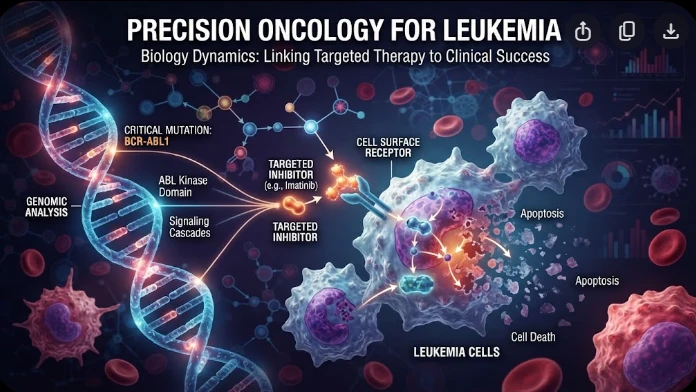
The article examines leukemia as an evolving population under targeted therapy, using chronic myeloid leukemia as the main example. BCR–ABL1 inhibition can produce deep responses, but every treatment changes the competitive environment among malignant clones. Quantitative transcript monitoring provides a continuous measure of disease burden, while deep sequencing can identify emerging resistance mechanisms before hematologic progression. A detected mutation is clinically meaningful only when its
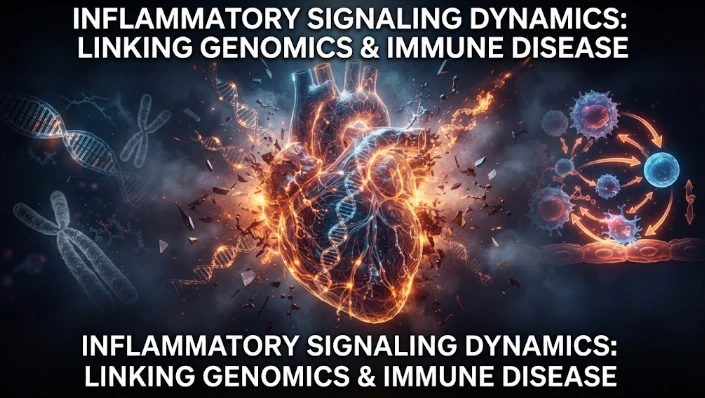
The article examines how cardiovascular genetic risk becomes biologically active through cell-specific inflammatory signaling. Because many vascular-risk variants lie in regulatory DNA rather than coding regions, their effects may appear only in particular endothelial, macrophage, smooth-muscle, or lymphocyte states. Single-cell studies of human atherosclerotic lesions and multiomic endothelial experiments are used to illustrate this context dependence. The article also discusses IL6-related sig
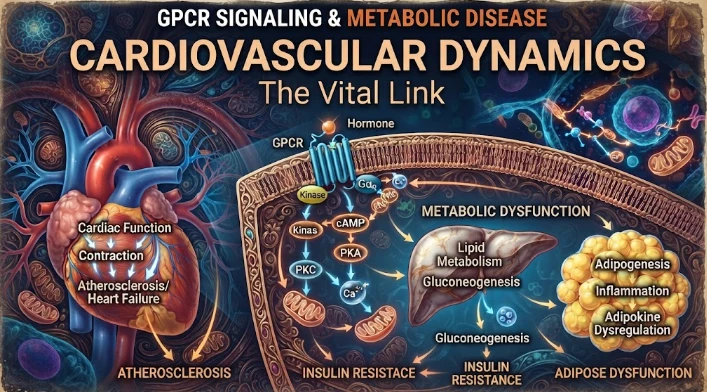
The article examines cardiovascular GPCR signaling as a dynamic response system whose abnormalities can remain hidden in resting measurements. Mechanical stretch, hormones, nutrients, sympathetic activity, and fluid balance can change the amplitude, duration, localization, and recovery of receptor signaling. Examples include mechanically activated angiotensin-receptor signaling, endosomal signaling, beta-arrestin-dependent trafficking, and biased glucagon-like peptide-one receptor responses. The